Twisting Light in a Nanocrystal express
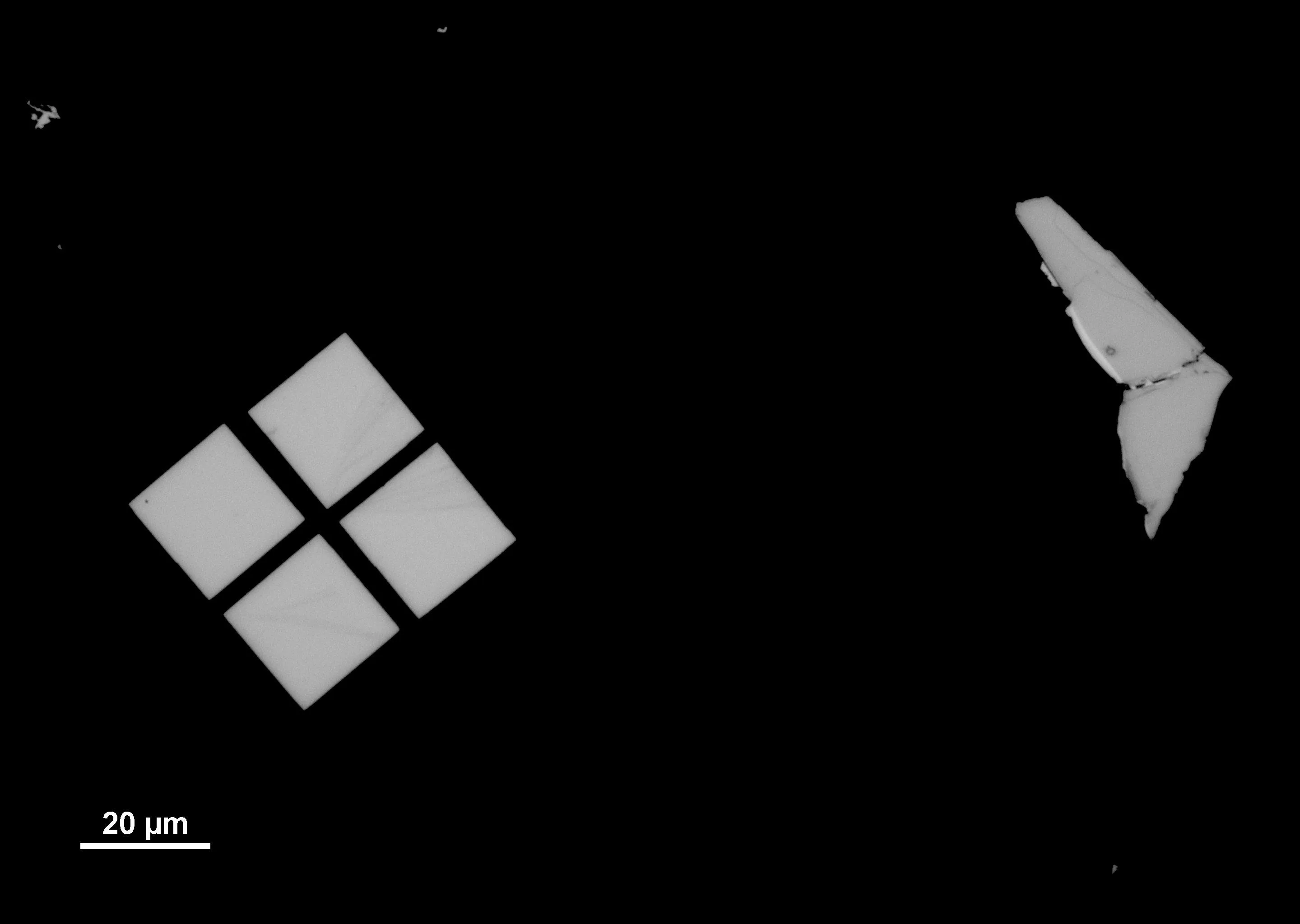
A light beam usually travels in a straight line, but you can make it spin around its axis, like water swirling into a vortex as it drains. This 'twisted' light carries more information and is needed for ultra-fast communication and quantum computing. The problem was that creating such beams used to require large lenses, mirrors, and precise alignment — a whole optical table.
Now, a team of researchers has done it on a crystal just 46 nanometers thick — less than one-hundredth the thickness of a human hair. The crystal is made of layers of molybdenum disulfide (a material similar to graphite in pencils) stacked in a special way. When an infrared laser beam hits it, the crystal emits light at twice the frequency, like a musician playing a note an octave higher. And this new light is already twisted.
The switching happens incredibly fast — faster than one oscillation of the light wave. This opens the way to tiny devices that control light on a chip, without bulky optics. In the future, such crystals could become the basis for compact quantum computers and secure communication channels, where information is encoded precisely in the twist of light.
Original abstract
as written by the authors arXiv:2608.13548v1
The orbital angular momentum (OAM) of light is a discrete, unbounded degree of freedom that underpins mode-multiplexed communications and high-dimensional quantum photonics. Yet, dynamic OAM control remains dependent on bulky free-space optics or cascaded architectures that separate switching from wavefront shaping, hindering nanoscale integration. Here, we engineer artificial van der Waals crystals from rhombohedrally stacked (3R) MoS$$_2$$, in which spatial control of the local crystal orientation imprints a nonlinear geometric phase onto the second-harmonic (SH) field, enabling background-free generation of SH vortex beams in an ultrathin (46 nm) van der Waals platform. Leveraging the C$$_{3v}$$ symmetry of 3R-MoS$$_2$$, we demonstrate monolithic, all-optical switching with sub-optical-cycle precision between Hermite-Gauss-like and Laguerre-Gaussian vortex SH beams with opposite topological charges ($$l=\pm1$$). Our results establish artificial 3R-MoS$$_2$$ crystals as a monolithic platform for the generation and all-optical reconfiguration of nonlinear structured light at the nanoscale, advancing active nanophotonic sources for integrated classical and quantum photonic technologies.
The crystal is 46 nanometers thick — if you scaled it up to the size of a football field, a human hair would be as tall as a ten-story building.
In 'Star Trek,' subspace is used for communication over vast distances, but twisted light beams are a real way to pack more data into the same beam.