An Invisible Stone in the Stellar Pond ✛
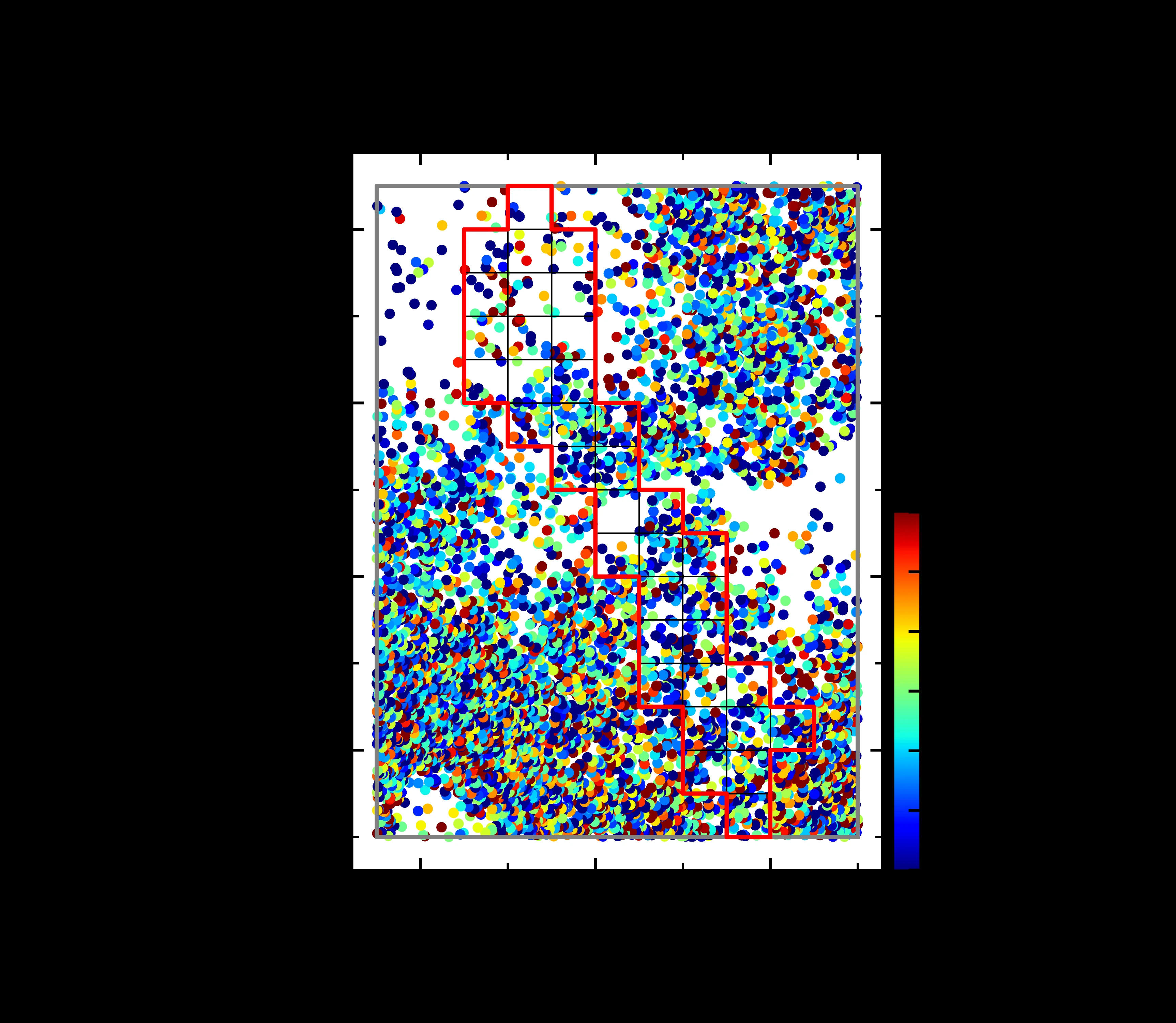
Someone has thrown an invisible stone into the stellar pond of the Milky Way. The ripples spread not through water but through the motion of stars: in a region 200 by 50 parsecs across, their average vertical velocity is 7 km/s lower than that of their neighbors. The deviation is statistically significant at the 6σ level, so chance cannot explain it.
The anomaly lies about 3.9–4.0 kiloparsecs away, in the direction of the constellation Serpens. It is elongated along the galactic plane and coincides with a void in atomic hydrogen (a region devoid of neutral hydrogen clouds), a molecular shell CO 16.134–0.553, and a gas filament. These structures had already been interpreted as the aftermath of a dark subhalo impact, a compact clump of dark matter within the halo. Now the impact is visible in the stars as well.
Before this work, the evidence was indirect: gas structures could be explained by other processes. Now, the motions of more than a million stars from Gaia data have been measured, and a clear dip in vertical velocities is found in a small volume. Horizontal velocities are unchanged, meaning the stars are moving predominantly downward, as if they were pushed.
The method opens a new observational channel for finding low-mass subhalos that are otherwise invisible. One can systematically survey the disk, look for similar anomalies, and test the predictions of the ΛCDM model about 'missing satellites.' If many such 'stones' are found in the pond, the picture of dark matter on small scales will become clearer.
The mass estimate of the impactor from the Hoyle-Lyttleton radius gives about 50 million solar masses, comparable to the mass of a globular cluster, yet the object is invisible in radio, infrared, and X-ray bands.