A Sling for a Particle: How Delay Helps It Escape the Pit ✛
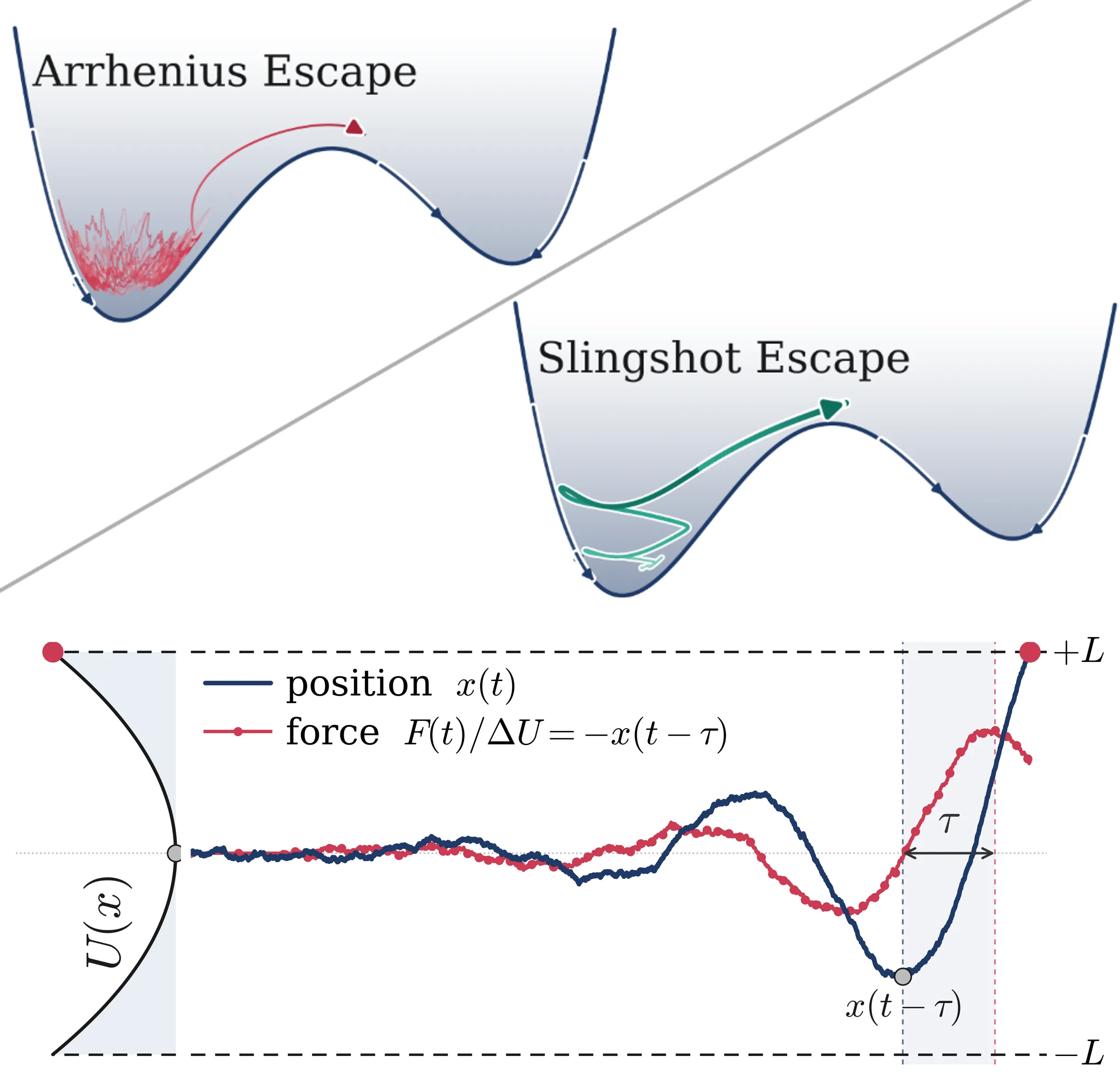
A pea sits in a hollow. To roll out, it needs a strong kick, and such kicks are rare, especially if the hollow is deep. But if you shake the hollow in a special way, with a delay, so that the force responds to the pea's position not immediately but a moment later, the pea starts to swing more and more strongly and eventually flies out. This is like a sling: the hand whirls the stone, building up energy, and then lets go.
At first, the particle sits at the bottom of the pit, and thermal noise nudges it slightly. If the delay is small, the pit dampens these nudges, and the particle stays put. But when the delay exceeds a threshold, the pit becomes unstable. Now even a tiny random fluctuation grows on its own, like a snowball rolling downhill. The particle swings more and more, and after some time it is thrown over the barrier.
The key finding is that the escape time now depends on the barrier height not exponentially but logarithmically, meaning it grows very slowly. You can tune the delay so that the particle escapes faster than if there were no pit at all. This could help speed up chemical reactions or measure trap properties.
The optimal delay allows the particle to leave the well faster than if the well were absent altogether: free diffusion to the boundary takes longer. This resembles a "slingshot" effect: the delayed force rocks the particle and flings it out, using the energy of the trap itself.