How Delay Turns an Escape from a Pit into a Slingshot ✛
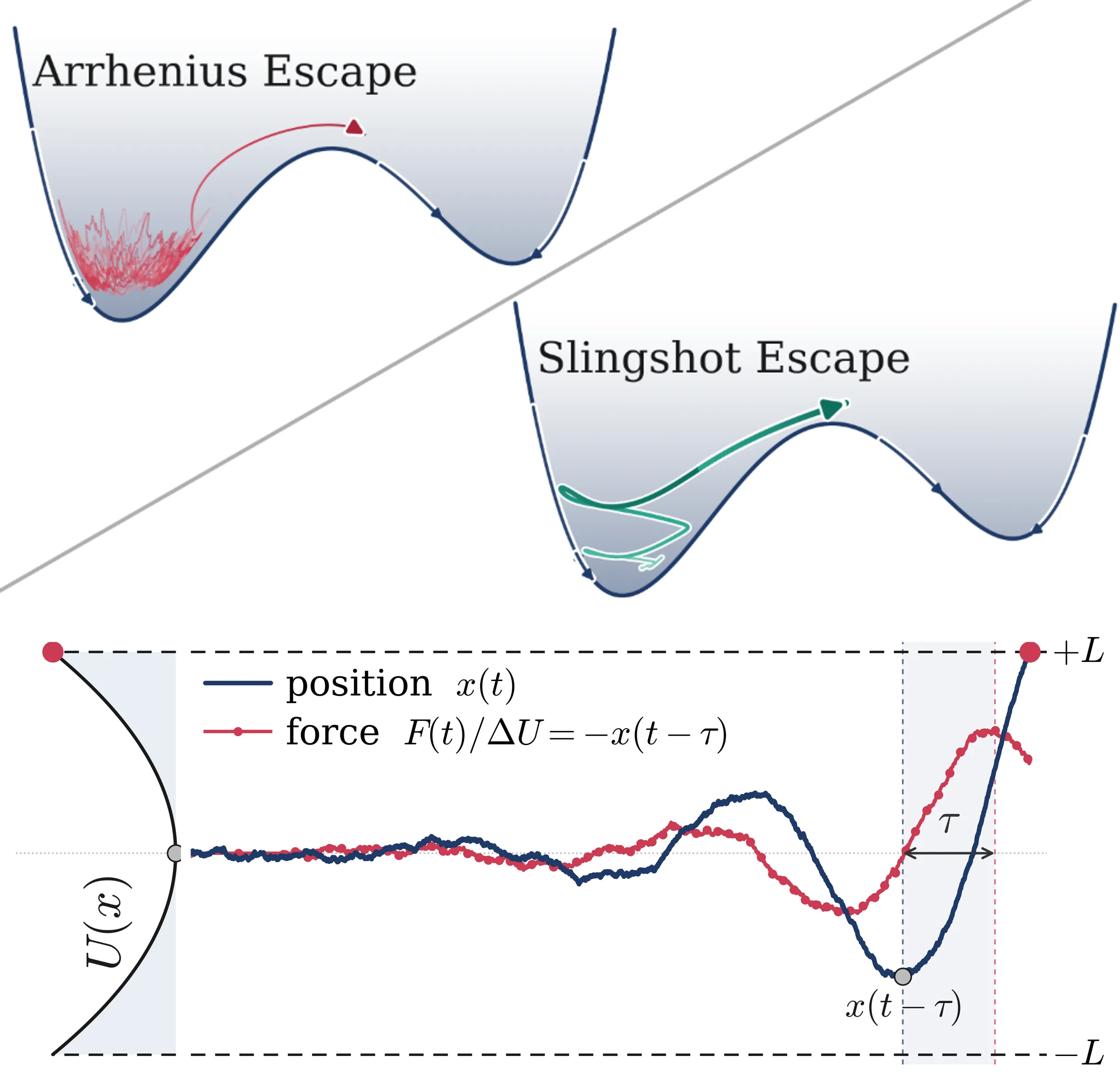
A particle sits in an energy pit like a pea in a dimple. To get out, it needs to go over the barrier, and usually this is rare: the higher the barrier, the longer the wait. The Arrhenius law says the waiting time grows exponentially, meaning doubling the barrier height increases the time by hundreds of times. But what if you shake the pit not randomly but smartly, with a delay, as if the force responds to the pea's position not instantly but a moment later? It turns out that then escape stops being a rare event and becomes a regular ejection.
When the delay is small, the pit remains stable: the particle oscillates near the bottom and only occasionally escapes. But once the delay exceeds a threshold determined by the pit's curvature, the minimum loses stability. Now any random deviation, even tiny, starts growing on its own, like a snowball. The particle swings more and more, and after a while it is thrown over the barrier. This is like a slingshot: the delayed force acts like a hand that spins the stone, accumulating energy, and then releases it.
The main result of the work is a formula for the mean escape time. Instead of an exponential of the barrier height, a logarithm appears: the time grows slowly, like the logarithm of the ratio of barrier to noise. The slope of this logarithmic dependence depends only on the delay, not on the pit's shape. This means you can tune the delay so that the particle leaves the pit faster than if there were no pit at all, that is, faster than free diffusion.
The authors split the escape into two stages. First, thermal noise creates a tiny seed: a random displacement of the particle from the bottom. Then the instability amplifies this seed deterministically, like an audio amplifier. The seed amplitude has a Gaussian distribution, which allows averaging the first-passage condition and obtaining a closed-form formula. Numerical simulations confirm the analytical predictions for different pit shapes.
A slingshot in action: the delayed force swings the particle and throws it out, using the energy of the trap itself. This mechanism could help speed up chemical reactions or measure the curvature of the energy landscape in optical traps. And if it once seemed that a high barrier was a death sentence, now we see how delay turns waiting into a controlled launch.
The optimal delay allows the particle to leave the well faster than if the well were absent altogether: free diffusion to the boundary takes longer. This resembles a "slingshot" effect: the delayed force rocks the particle and flings it out, using the energy of the trap itself.