The arrow of time is the concept that time has a one-way direction, flowing from the past to the future, unlike the symmetric laws of physics that work equally well forward and backward. The most widely accepted explanation ties this asymmetry to the second law of thermodynamics: entropy, a measure of disorder, tends to increase in an isolated system. This statistical tendency creates a clear distinction between past (lower entropy) and future (higher entropy), giving time its perceived direction.
History
The concept was popularized by Arthur Eddington in 1927, who coined the term 'arrow of time' and linked it to entropy increase, building on Ludwig Boltzmann's earlier statistical mechanics work.
How it works
At the microscopic level, the fundamental equations of physics are time-reversible — a movie of two particles colliding looks equally plausible played backward. However, when you have a system with many particles, the number of possible disorderedstates vastly outnumbers ordered ones. So, if you start in a low-entropy state, the natural evolution is toward higher entropy, simply because that's overwhelmingly more probable. This probabilistic drift from order to disorder is what we perceive as the forward flow of time.
In practice
The arrow of time is fundamental in cosmology and astrophysics, helping explain the evolution of the universe from the Big Bang to its eventual heat death, and it underpins our understanding of irreversible processes in thermodynamics.
Fun fact
The arrow of time is not absolute: in certain quantum experiments, researchers have observed temporary reversals of entropy increase on very small scales, though the overall macroscopic direction remains forward.
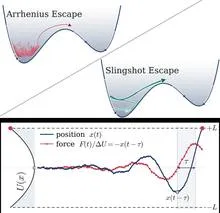
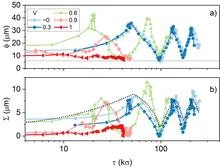
A particle sits in an energy pit like a pea in a dimple. To get out, it needs to go over the barrier, and usually this is rare: the higher the barrier, the longer the wait. The Arrhenius law says the waiting time grows exponentially, meaning doubling the barrier height increases the time by hundreds of times.
A mail carrier delivers letters along one-way streets. As long as he only drives forward, the route is simple and predictable. But if U-turns are suddenly allowed, he'll start doubling back, crossing his own tracks, and the delivery pattern gets tangled. That's roughly how an infection behaves when people can get sick more than once.
In the grand orchestra of the universe, every instrument has its own rhythm. Electrons in an atom make quantum leaps in femtoseconds, neurons in the brain exchange signals in milliseconds, and a human needs tenths of a second to become aware of the 'now.' Physicists have long sought the conductor…
Two passengers step into an empty car on a ring subway line and take their seats. After one full loop, they are surprised to find themselves in each other’s seats — even though nobody moved. That’s pretty much how monodromy plays out in vineyards — families of persistence diagrams, a method rooted in the work of Henri Poincaré.
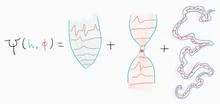
Spacetime isn't a flat sheet, but a crumpled fabric: stars and planets leave creases on it. Information is written into every crease, and to erase it, heat would have to be released — that's how Landauer's principle works. Thus, the 'crumpledness' of space can be measured through entropy — the universal measure of disorder.
The shape of a riverbed precisely follows the equation describing the growth of a universe with negative curvature. In the lab, water flowing over sand spontaneously carves a cross-section that matches the solution for the Anti-de Sitter model.
A river tends toward a shape that maximizes bottom friction.
At the heart of an active galaxy, where interstellar gas spirals into a dazzling accretion disk around a supermassive black hole, a boundary is born through which even sound cannot break. This acoustic horizon was long considered frozen ripples on water.
A doctor holds a stack of test results taken at different times. Each sheet on its own is just a snapshot of a single day, but what you want is a whole movie of how the disease unfolded. A neural network called Tempo learns to glue these scattered frames into a smooth reel.
A typical recipe explains how to cook a dish: step by step, from the initial ingredients to the finished result. The new approach flips the logic: imagine that the future pie itself dictates how much flour to add now. In the quantum world, researchers suggest, a particle receives signals from the future measurement outcome.
Normally, current flows equally well in both directions if there's no magnet. A magnetic field or magnetic material breaks that symmetry: electrons start to prefer one direction. But in a new study, physicists found a way to do without magnets.
In a crystal, atoms may not sit perfectly ordered but with some disorder.
A film of a shattered cup played backward looks absurd: shards don't spontaneously reassemble. This intuitive sense of irreversibility is tied to the increase of entropy — a measure of disorder in a system. The second law of thermodynamics states that the entropy of an isolated system never decreases, setting time's direction from past to future.
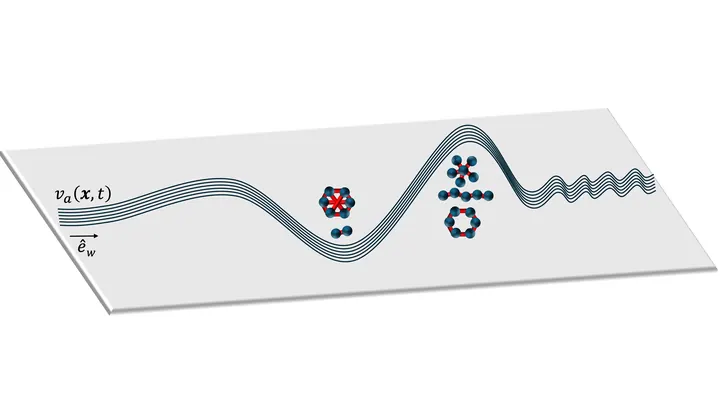
Polymers are long threads of carbon and hydrogen atoms. In living cells, they encounter streams of chemical signals that pulse like the surf. Long chains and closed rings behave like skilled surfers: they catch the wave and glide with it. Short fragments and tight coils, counterintuitively, move strictly against it.
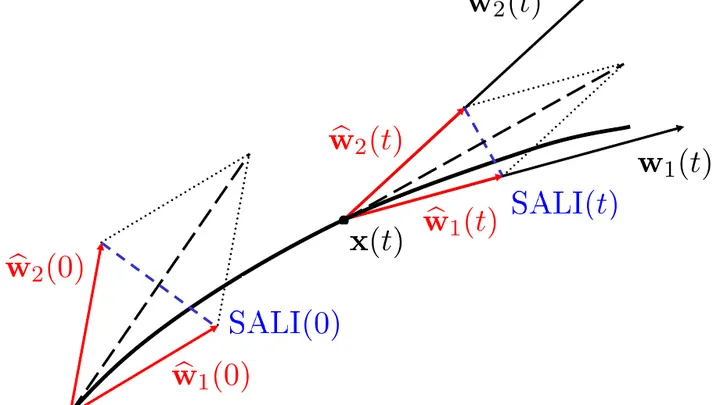
Drop a stone into a calm pond — the ripples spread evenly. Drop it into a churning stream — the water swirls unpredictably. Scientists have long wrestled with a similar question: how can you tell from a single particle's path whether its motion is chaotic? Previously, this meant comparing the particle's path with neighboring ones, which is complicated and time-consuming.
Time is a one-way road: events race forward with no U-turn allowed. The arrow of direction is governed by entropy — a measure of disorder, which only grows in the Universe, like a traffic jam at rush hour. You can clear one intersection, but the overall congestion only gets worse.
Water always flows downhill, and heat from hot to cold. That's what энтропия dictates. But the quantum world finds loopholes.
Physicists made light particles interact with hot and cold environments in an uncertain sequence — like a flipped coin that hasn't landed yet.
In the lab, time usually ticks on the wall: hands, digits, a frequency standard. But for the Universe, there are no external clocks. The Wheeler–DeWitt equation, the main law of quantum gravity, contains no time at all, and all fundamental theories lack an inbuilt arrow of time.
When entropy reaches its maximum, the play is over. The curtain falls, the actors leave, the scenery freezes. But the stage remains. So it is with time: the heat death of the universe erases the direction 'past—future', but not time itself.
The clock on the kitchen wall ticks, and each tick relentlessly carries us from breakfast to lunch. This is so familiar that it seems like a law of nature, but physics says otherwise. In Einstein's equations, time is reversible: you can rewind the film, and no frame will give the trick away.
Two translators listen to the same symphony. One hears only the fundamental tone: a clean, predictable melody. The other catches the overtones that color every note.