In the mid-19th century, several scientists independently concluded that heat is not a mysterious fluid but a form of particle motion. Julius Mayer, observing the color of sailors' blood, noticed a connection between the body's work and heat. James Joule, through precise experiments, measured how much heat mechanical work produces. Hermann von Helmholtz formalized it into a coherent theory. The law of conservation of energy states: in an isolated system, total energy — the sum of kinetic, potential, thermal, and other forms — is constant. It's like a family budget: income and expenses can change form, but the total amount in the account is preserved if no external source intervenes.
History
The idea of the indestructibility of 'vis viva' (mv²) goes back to Leibniz in the 17th century. However, until the mid-19th century, heat was considered a special substance — caloric. Physician Julius Mayer in 1842 was the first to formulate the mechanical equivalent of heat, observing people in the tropics. James Joule in 1843–1847 experimentally proved the conversion of mechanical work into heat. Hermann von Helmholtz in 1847 gave a mathematical formulation for all types of energy. Emmy Noether in 1918 revealed the deep connection between symmetries and conservation laws. Albert Einstein extended the law to the relativistic domain, including mass-energy equivalence (E=mc²).
How it works
The law is applied in all branches of physics and engineering: from calculating planetary trajectories to designing heat engines and nuclear reactors. Its boundaries are indicated by general relativity, where gravitational field energy is non-local, and quantum mechanics, where energy fluctuations are possible on short intervals (uncertainty principle). However, in the macroscopic world and in closed systems it is absolute.
In practice
Without this law, power plants would not work: the chemical energy of coal turns into heat, then into electricity. In every battery and solar panel, its action is present.
Fun fact
Thanks to this law, we know exactly: the flap of a butterfly's wing does not disappear without a trace, but dissipates in the chaos of thermal motion of air.
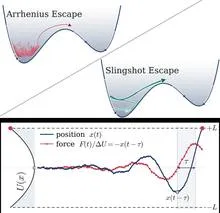
A particle sits in an energy pit like a pea in a dimple. To get out, it needs to go over the barrier, and usually this is rare: the higher the barrier, the longer the wait. The Arrhenius law says the waiting time grows exponentially, meaning doubling the barrier height increases the time by hundreds of times.
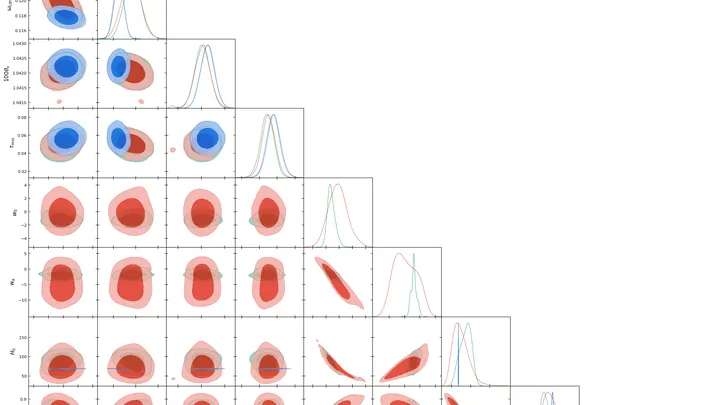
The cosmological standard model is like a recipe for a cake where everything is strictly measured: dark matter is like flour without a single lump (zero pressure), and dark energy is like the perfect leavening agent (equation of state exactly minus one). But what if the flour is a bit damp and the leavening agent has lost its oomph?
A speed of 7,5 kilometers per second is the threshold beyond which a cosmic collision turns dust grains into a chemical reactor. In the interstellar medium drift tiny cosmic dust grains — the legacy of dying stars.
1799 kilometers per second — that's the speed at which star S5-HVS1 is permanently leaving the galaxy. 4.8 million years ago, it was ejected from the center of the Milky Way during a close encounter with the supermassive black hole Sgr A*.
Usually, a black hole is described as a frozen frame: there's mass, there's charge, and it's all static. But real objects live in time. They radiate, lose energy, and change.
Water boils at one hundred degrees — everyone knows that. But why exactly one hundred? Why not smoothly, but abruptly: a second ago it was liquid, and suddenly — bubbles, steam, bubbling. Such sharp changes are called phase transitions, and they have a rigorous mathematical foundation.
Imagine a green beam that, passing through an ingenious optical setup, twists into a three-dimensional funnel of light — an optical vortex. At its heart, like in the eye of a hurricane, the intensity drops to zero. It is there that photons disappear.
Imagine water as a ballroom, where each molecule is a dancer, constantly forming fleeting partnerships. These hydrogen bonds give rise to local patterns: some resemble a stiff waltz — an ordered network with cavities (low-density structure), others a wild jitterbug, where partners crowd into chaotic dense clusters.
Inside planets and stars, in rotating oceans of plasma, turbulent flows, Coriolis forces, and magnetic tension collide. The central question is how the energy of this chaos crystallizes into a stable magnetic framework that can last billions of years.
The universe is a grand orchestra, with dark energy conducting the expansion. Ten billion years ago, the conductor changed its gesture: the negative pressure that had been holding back galaxy assembly gave way to accelerating expansion — the very phenomenon discovered by [scientist:Saul…
The Universe is an orchestra playing the symphony of the Big Bang. For a long time, the conductor was thought to be dark energy — an unwavering metronome setting the pace of expansion.
A billiard ball strikes another, and the sum of their velocities before and after the collision obeys strict rules. The same happens in the microscopic world: energy, momentum, and charge cannot simply vanish.
Active galactic nuclei (AGN) are the universe’s powerhouses: their X-ray coronae blaze millions of times hotter than stellar atmospheres. But what strikes the spark? A ten-day X-ray campaign by the XRISM and XMM-Newton satellites, aimed at NGC 3783, provided the answer: it’s actual thunderstorms.
The universe is expanding at an accelerating rate, like dough that keeps rising faster even though the yeast ran out long ago. For twenty years, astronomers have been searching for the cause and call it dark energy. But what it is remains a mystery.
New work proposes an unexpected source: the vacuum inside the atomic nucleus.
A drop of water on a table lives a double life. Inside, molecules are surrounded by neighbors on all sides, but at the surface they have neighbors only below and to the sides — above is air. This difference creates the tension that holds the drop in shape.
Tea in a cup cools quietly on the table. But if you zoom past at near-light speed, the thermometer will read higher — even though no one heated the tea. Calculations confirm: the needle will creep up.
A century ago, physicists split into three camps.
Billions of tiny motors hum inside every living creature. Cells ceaselessly pump substances, burn sugar, and build new proteins, and all this invisible motion warms us from within. To maintain order, life must dissipate heat into the environment, like a stove that never goes out.
The power of this internal heating is almost independent of size.
In 1867, James Clerk Maxwell proposed an image that still stirs physicists today. Two compartments of gas are separated by a door. Molecules dart about chaotically: fast and slow. A tiny gatekeeper opens the door only for fast ones, letting them through to one side, and slow ones to the other. The hot compartment gets hotter, the cold one colder.
A pot of soup forgotten on the stove cools to room temperature. It seems everything has come to rest. But if you look inside with a quantum magnifying glass, you'll find that water molecules haven't frozen: they continue their dance. It's just that now the dance is steady, not turbulent like when boiling.
A pot of water on the stove eventually settles down: the temperature evens out, the liquid stops boiling. Physicists call this thermal equilibrium — a state where energy is distributed in the most probable way.
A hot spoon in a cup of tea — heat runs along the metal from the hot end to the cold one. Textbooks describe this process as atoms jiggling and passing on their jolts to each other. But atoms don't just jiggle: they also spin, like tiny tops. Until now, physicists had no common language to describe both motions at once.
The authors of the work built such a language.
If you pour sand into a glass, it settles in a flat layer. But instead of sand, take the tiniest particles of gas: in a gravitational field they don't just fall: each particle races along its own trajectory, collides with neighbors, and all this commotion creates pressure.
Inside a piece of metal, electrons don't sit still: they move like water in a river. But you can't see this motion directly; it's too fast and too small. Scientists devised a workaround: they take 'frozen snapshots' of the electron liquid at different temperatures, then reconstruct how the electrons moved from those snapshots.
An ordinary heat engine is like a mill between the hot and cold banks of a river: the greater the drop, the stronger the current. Here, the drop is tiny, just one or two degrees, but water can still turn the wheel. The secret is that water is made to boil not by heating but by a sudden drop in pressure, so steam bursts out even from barely warm liquid.
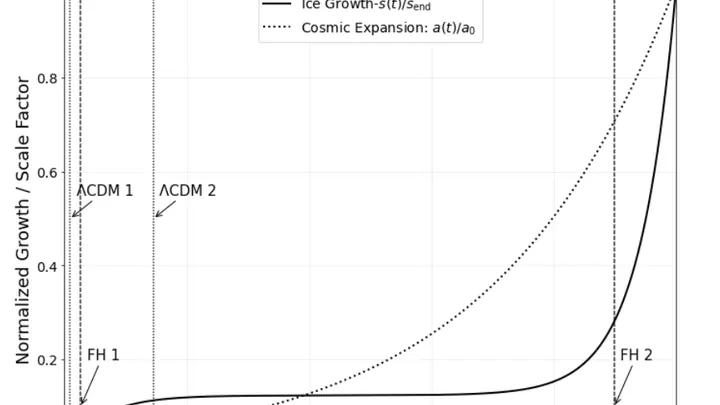
In winter, a lake freezes over, and this simple process turns out to be a living model of an expanding universe. Ice thickness grows according to the same mathematical law as the distances between distant galaxies.
The secret lies in the movement of water beneath the ice crust.
A hot coffee cools by radiating invisible light. To maintain temperature, it must receive exactly as much light back. This silent trade of photons is what we feel as steady warmth.
Water in a glass settles down once you stop stirring it. Oil in an engine dampens vibrations. It seems viscosity is always about damping. But in some flows, it's the opposite: add friction, and waves start to grow as if from nowhere.
Physicists have found a simple explanation.
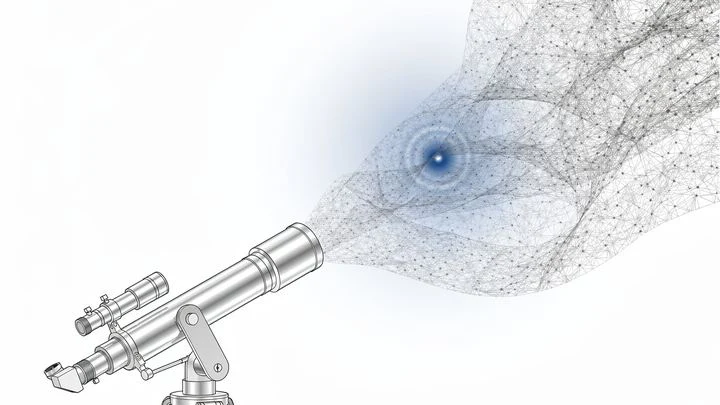
The Universe is expanding, and it's doing so faster and faster. This acceleration is driven by mysterious dark energy. For a long time, it was thought to be as constant as a textbook constant. But new data from DESI, an instrument that captures spectra of millions of galaxies, hint that dark energy may have been stronger or weaker in different epochs.
A translator gets distracted by every rustle in the hall, and a one-hour meeting stretches into two. Single molecules squeezed between two metal contacts behave much the same way: they constantly change their shape and seating, and this affects how current and heat pass through them.
Water in a glass cools, ice melts, and a kettle heats the stove: that's how the world works: heat always flows from hot to cold. This is the second law of thermodynamics, a law that has never been broken.
Water always flows downhill, and heat from hot to cold. That's what энтропия dictates. But the quantum world finds loopholes.
Physicists made light particles interact with hot and cold environments in an uncertain sequence — like a flipped coin that hasn't landed yet.