Delay Turns Arrhenius Escape into Logarithmic ✛
Context
This work stands apart: there is almost nothing nearby. The closest neighbors in the archive deal with quantum memory, noise-induced order, and ultra-reliable networks. All of them touch on controlling stochastic systems, but none consider delay as a tool to change the escape mechanism itself. Classical activation theory, from Arrhenius to modern generalizations for non-Markovian and active media, preserved the exponential dependence of escape time on barrier height. Delay in the conservative force, rather than in friction, opens a different path: destabilization of the minimum and deterministic amplification of noise.
Methods
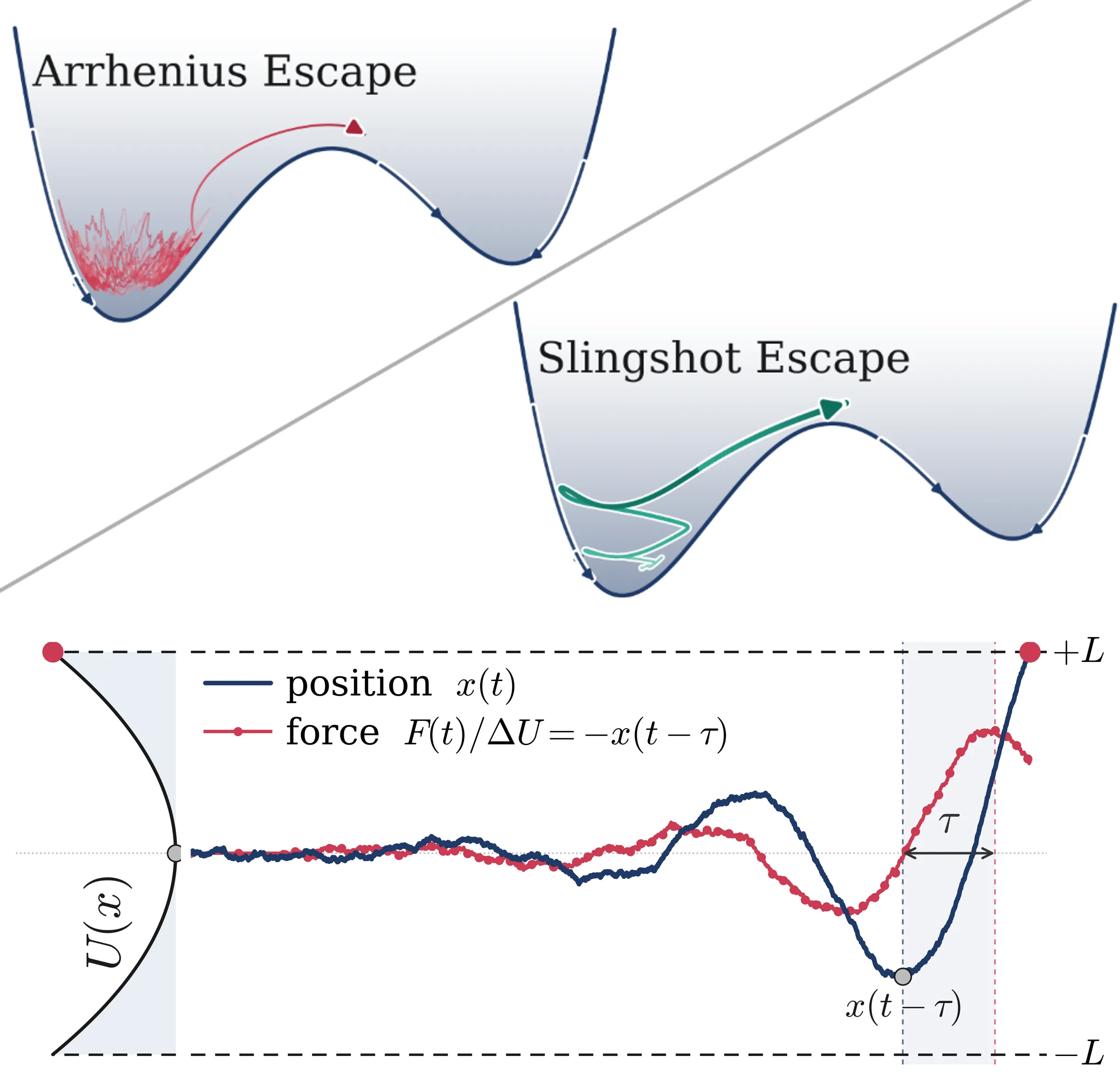
The authors considered an overdamped particle in a potential where the force is computed from the particle's position at a time τ earlier. The dynamics are described by a stochastic delay differential equation. First, the noiseless system is analyzed: the characteristic equation is solved via the Lambert W-function, yielding the stability threshold $s_c$ = π/2 (in dimensionless units s = τ/$τ_{rela}$x). Beyond the threshold, the minimum becomes an unstable focus with exponential growth of amplitude. Escape is divided into two stages: an initial free diffusive displacement (the seed) and subsequent deterministic amplification to the boundary. The seed amplitude has a Gaussian distribution, allowing one to average the first-passage condition and obtain a closed-form formula for the mean escape time. Numerical Langevin simulations confirm the analytical predictions for various potentials.
Results
The main result: the mean escape time ⟨T⟩/$τ_{rela}$x = A(s) ln(ΔU/D) + B(s), where A(s) = 1/(2 Re z) is the slope depending only on the delay, and B(s) is a constant reflecting the potential shape. The slope is universal for all "stiffening" potentials (harmonic, x²+x⁴, x²+x⁶, cosh x−1): it is determined by the curvature of the minimum, not the barrier shape. The delay dependence is nonmonotonic: the escape time drops sharply after the threshold, reaches a minimum near s≈3, where it becomes smaller than the free diffusion time, and then saturates. The distribution of escape times converges to the Gumbel distribution with characteristic positive skewness. Numerical simulations confirm the collapse of histograms onto the Gumbel curve already at ΔU/D=50.
Implications
This work differs from its neighbors by treating delay not as a stabilizing factor but as a mechanism for regime change: instead of rare thermal fluctuations, escape is triggered by a typical fluctuation amplified deterministically. This is the first demonstration of a logarithmic escape law in a broad class of potentials with delayed force. The result connects delay-induced instability with known logarithmic laws for the decay of unstable states and transition path times, but here the growth rate is tuned by a single parameter: the delay.
Future development
A natural extension is to study soft potentials, where the growing oscillation saturates into a limit cycle, and escape requires an additional thermal fluctuation over a residual barrier. Also interesting is the multidimensional case: the instability arises along the stiffest direction of the Hessian, which may allow selection of escape channels by curvature rather than barrier height. The underdamped regime and interacting systems with delay are insufficiently studied.
Impact
The results can be used to accelerate activation processes in colloidal systems with optical tweezers, where the delay is set programmatically. They also offer a new way to measure the curvature of the free-energy minimum without crossing the barrier.
Next steps
Test the predictions in experiments with optical traps, where the delay is precisely controlled. Investigate soft potentials and multidimensional landscapes to understand the selection of escape paths.
Key open problems
This work is directly related to the problem of accelerating rare events in statistical physics: how to bypass the exponential Arrhenius slowdown in complex landscapes. The proposed delay mechanism complements existing methods of tilting and resetting, attacking the problem by destabilizing the minimum rather than reweighting.
The knowledge machine's view
This section is addressed to the author of the paper and their colleagues. Neighbouring works were found by meaning-based search across our archive, not by word overlap. We do not review: we show the field around the work.
What the work does
The authors examine an overdamped particle in a potential with a time-delayed force and show that beyond the stability threshold set by the curvature of the minimum, thermal noise triggers an instability that grows deterministically. As a result, the mean escape time becomes logarithmic in the barrier height, and the distribution of escape times converges to the Gumbel law. The analytical predictions are confirmed by numerical simulations for several potentials.
Where its strength is
This work demonstrates a new escape mechanism in which delay turns the exponential dependence of escape time on the barrier into a logarithmic one, and provides a universal formula for the slope that depends only on the delay. This opens the possibility of controlling escape time with a single parameter, which could be useful in stochastic systems with feedback.
Where it could go next
- It might be interesting to compare the obtained logarithmic escape time with the behavior of systems where the rate of a process bypasses the limits imposed by standard thermal laws: our archive contains a review of work on how speed can exceed the predictions of ordinary thermodynamics.based on: Motion as Fuel: A Quantum Engine Beats Carnot arXiv:2508.11554
- Nearby lies a study on how a single feature (a hole) drastically changes the dynamics of a system; perhaps an analogy with a point change in a parameter could help extend the analysis to potentials with local defects or non-smooth barriers.based on: One Hole Changes Everything arXiv:2607.16965
- The archive also includes work on how an obstacle that usually slows a process can, under certain conditions, disappear and cease to matter; this resonates with the idea that delay can remove a barrier and may suggest how to look for similar transitions in other systems with delay.based on: When the Obstacle Vanishes arXiv:2604.27489
Worth trying
- Test whether the logarithmic law persists for state-dependent delay or multiple delay timescales.
- Apply the method to systems with non-Gaussian noise to see how universal the Gumbel distribution is.
- Consider potentials with multiple minima and investigate how delay affects the choice of escape path and competition between channels.
Why this may matter
If the logarithmic escape law holds under more general conditions, it could offer a simple way to control transition times in stochastic systems, for example in biophysical processes or in artificial devices with feedback.
Nearby works in our archive
- Why neural networks forget old knowledge when learning new thingssimilarity 0.48
- The Horizon Breathes: How Black Hole Walls Movesimilarity 0.47
- When being together is a choicesimilarity 0.47
- Motion as Fuel: A Quantum Engine Beats Carnotsimilarity 0.47
- One Hole Changes Everythingsimilarity 0.46
- Why Quantum Resources Melt at the Horizonsimilarity 0.46
- When the Obstacle Vanishessimilarity 0.46
The archive is sparse around this work: the closest review is only 0.48, against a usual 0.64. It looks like few have drilled nearby.
The optimal delay allows the particle to leave the well faster than if the well were absent altogether: free diffusion to the boundary takes longer. This resembles a "slingshot" effect: the delayed force rocks the particle and flings it out, using the energy of the trap itself.
Key numbers
- stability threshold: s_c = π/2 ≈ 1.57
- optimal delay: s ≈ 3
- barrier in simulations: ΔU/D = 50
- slope at s=2: A(s) = 5.79