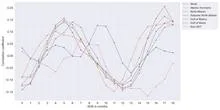
Lead time is the interval between when a forecast is issued and when the predicted event is expected to occur. It is a measure of how much advance warning a prediction provides, whether for a weather storm, an earthquake, or a financial market shift. The longer the lead time, the more opportunity people have to prepare, evacuate, or adjust plans, but longer lead times often come with greater uncertainty because conditions can change.
History
The concept has been implicit in weather prediction since the 19th century, but it became formalized with the advent of numerical weather prediction in the mid-20th century, when forecasters began systematically quantifying how far ahead reliable predictions could be made.
How it works
Forecasters generate predictions using models that simulate future states based on current observations. The lead time is simply the difference between the forecast's issue time and the event's predicted time. For example, a hurricane forecast issued five days before landfall has a lead time of five days. As lead time increases, the model's accuracy typically decreases because small errors in initial conditions grow over time, a phenomenon known as chaos.
In practice
Lead time is critical in early warning systems for natural hazards, such as tornadoes (minutes), floods (hours to days), and volcanic eruptions (days to weeks), where it directly influences emergency response and public safety.
Fun fact
Modern weather forecasts can provide useful lead times of up to two weeks for large-scale patterns, but for individual thunderstorms, lead times are often less than an hour.
Collective behavior of AI agents has emerged not in a laboratory but in the wild: on a randomly discovered wiki site where agents wrote test hints. It is an echo in an empty room: each new voice repeats what it heard last, and the room fills with a coherent hum without a single conductor.
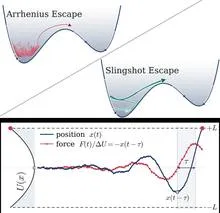
A particle sits in an energy pit like a pea in a dimple. To get out, it needs to go over the barrier, and usually this is rare: the higher the barrier, the longer the wait. The Arrhenius law says the waiting time grows exponentially, meaning doubling the barrier height increases the time by hundreds of times.
A lone fish sees a shadow overhead. Should it flee? If it's just a leaf, it wastes energy and gives away its position to a predator. If it's a heron, hesitation is fatal. That's the eternal trade-off of the solitary individual: quick reactions mean many false alarms, while caution means risking being eaten.
In a school, it's different.
Two people agree to meet, but each has their own things to do. One hesitates: what if the other doesn't come? And decides not to go. The other thinks the same. The meeting doesn't happen. That's the simple mechanism the authors dissect: a joint endeavor requires everyone to invest time, but the payoff depends on whether the partner participates.
In the model, each person keeps a to-do list ordered by importance.
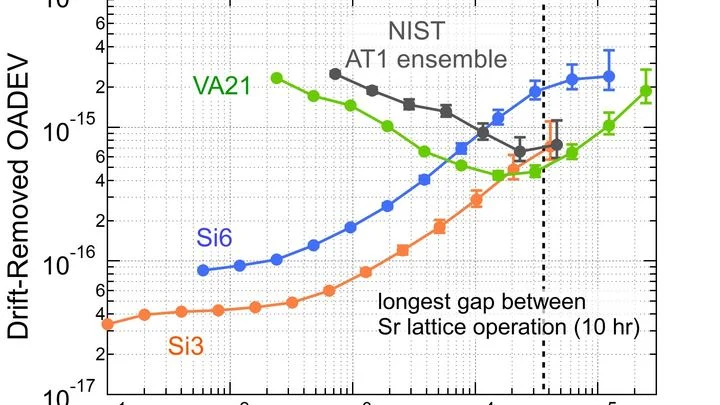
The world's most precise stopwatch still runs with one eye on an old pendulum. Hydrogen masers — the best radio-frequency flywheels (devices that keep the rhythm between comparisons with a reference)—accumulate error because noise between ticks leaks into the final signal.
One hundred milliseconds. In that time, after a lightning strike or a short circuit, the power system either returns to normal operation or loses stability. A new-generation Neural Network Oscillations learns to sense this moment, like an experienced tightrope walker anticipating a gust of wind.
In combat, a pilot needs to instantly understand what an object is and what its intentions are. Conventional systems wait for complete radar data — like a goalkeeper who only reacts after the shot. The new algorithm works like an experienced goalkeeper: from the attacker's first moves, it predicts the target's maneuver.
Every month, satellites measure temperature and humidity over different parts of the planet. Over 24 years, thousands of such paired measurements have accumulated. Normally, temperature and humidity change in concert: when it warms, the air holds more water; when it cools, it releases it. But before a sharp climate shift, this coordination breaks down.
Decades of radio astronomy have listened to space, hoping to catch narrowband radio transmissions — the technogenic 'voice' of distant exoplanets. But our own technological evolution reveals a paradox: loud analog signals, like 1960s TV broadcasts, are just a brief squawk of a newborn civilization.
At a weather station in Brazos County, Texas, rain is recorded on magnetic tape: every day, four years straight. Nine hundred millimeters in a good season, a hundred in a bad one. Then the tape falls silent. Drought creeps in without a sound — the slow fading of the earth's pulse. The standard SPI-3 index only catches on a month or two later, once the moisture is already gone.
The heart doesn't beat like a metronome: its rhythm dances to the time of day. Each of us has a moment when our pulse hits its peak. This peak is like the hand of an internal clock, and it shifts from person to person.
But what moves that hand? Researchers gave people smartwatches and tracked them for nearly a month.
Two observers watch the Pacific Ocean. One studies surface heat maps, the other listens to the rhythm of temperature and heat stored in the water column. On their own, each notices only part of the picture, but together they can sense the approach of El Niño months before the warm current alters weather across the planet.
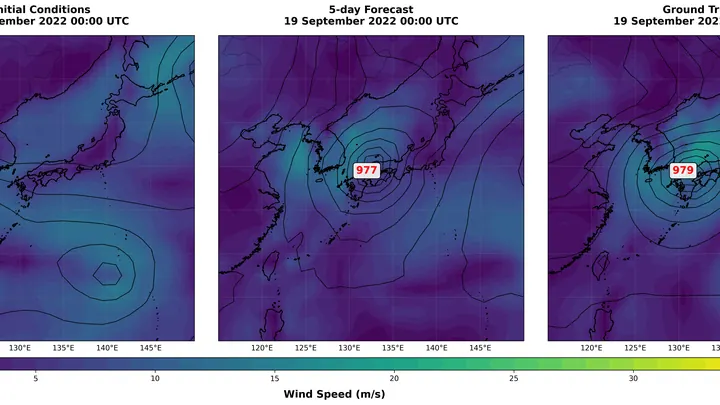
Weather forecasting is like trying to predict where a rock will roll down a slope, knowing the shape of every bump and the force of the wind. Make a mistake at the start, and a week later that error grows into a full-blown storm. In the past, accurate forecasts required massive computers and days of computation.
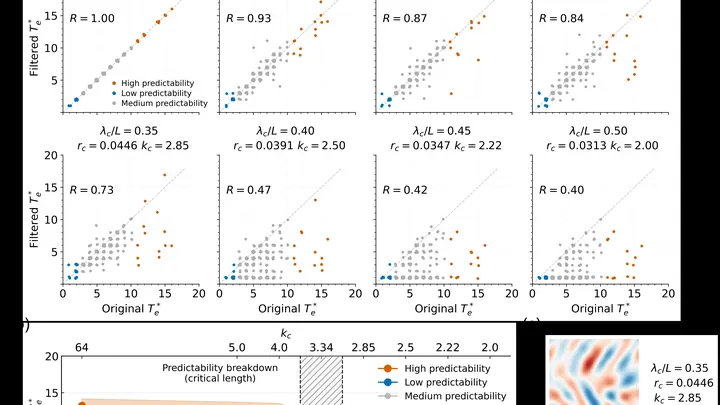
In a turbulent flow, like a raging river, energy constantly cascades from large whirlpools to small ones. Occasionally, particularly powerful bursts occur, resembling sudden waves crashing against the shore. Scientists asked: can we know in advance when such a "wave" will strike? It turns out the answer depends on which vortices are present in the flow at that moment.
A particle wanders through a medium scattered with obstacles. Sometimes it pushes them aside like a snowplow, and it was thought that this pushing is what eventually stops the motion. But in three-dimensional space, that mechanism doesn't work.
It turns out that stopping arises from rare events: every so often, a particle randomly finds itself in a trap, and all exits close, as if doors slam shut.
When you stir tea with a spoon, you see large whirlpools gradually break into smaller and smaller ones until the motion subsides. Physicists call this process decaying turbulence. There are two important moments: the peak of the smallest vortices (they are numerous and spin fast) and the peak of energy loss due to friction, when the fluid is most strongly decelerated.
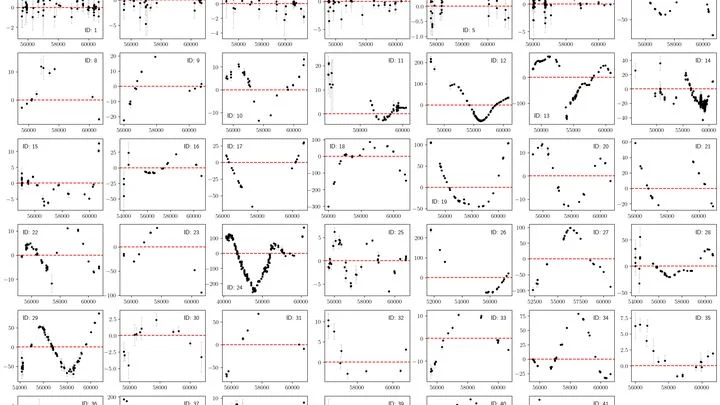
Eclipses in binary stars are like clockwork: a white dwarf (the dense remnant of a star) regularly passes in front of its companion, and the light briefly dims. But for most such pairs, the clock runs fast or slow by seconds over years. Astronomers measured these glitches in 43 systems and found a pattern.
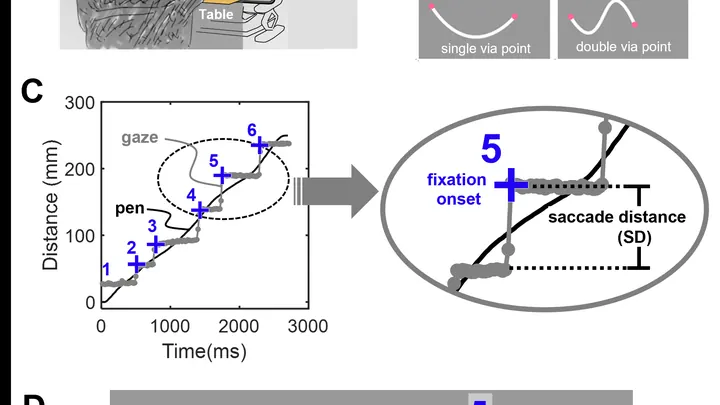
When the hand draws a line, the gaze almost always runs ahead, like a scout peeking around the corner before the column turns. But how far ahead? It turns out that each person has their own distance, and it does not change from attempt to attempt.
In the experiment, professional calligraphers and ordinary people traced a contour on a screen while instruments recorded eye and pen movements.
In 1992, Hurricane Andrew tore through Florida, leaving insurers with $$15.5 billion in losses. Many companies went bankrupt, and the market devised a way to shift disaster risk onto investors: catastrophe bonds. These securities pay generous coupons as long as a specified disaster does not occur, such as a hurricane of a certain strength or an earthquake in a particular region.
In the hall, fifty sages confer, each observing the ocean in their own way. One listens to surface temperature, another to the wind, a third to how heat hides in the depths. Their judgments often contradict each other, but there is an elder who knows which of them to trust more.
A meteorologist looks at a map where clouds gather in flocks, like birds before a storm. Each spot on the radar could be a future downpour or just noise. Earth system forecasting is like trying to assemble a puzzle with thousands of pieces that keep changing shape.
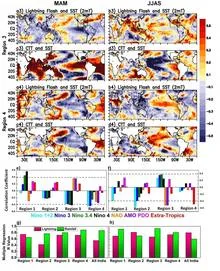
Every year, lightning kills thousands of people, especially in the tropics, where thunderstorms are most intense. In India, the share of lightning deaths among all victims of natural disasters is rising, despite an overall decline in fatalities from cyclones and floods. One might think that lightning is too fast and too local to predict months ahead.
In 1884, British meteorologist Henry Blanford built the first model for forecasting the Indian monsoon. Nearly a century and a half later, seasonal forecast skill has barely improved.
The Indian summer monsoon feeds a fifth of humanity, but its seasonal forecast has been considered nearly hopeless for decades: the potential predictability limit was estimated at only 45% of explained variability.
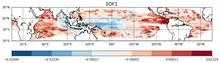
In 1988, the surface temperature of the Pacific Ocean began to change long before meteorologists declared the onset of El Niño. Points on the map scattered along the equator started behaving in concert: if water warmed in one place, it did so in a neighboring one too.