Why Light Flows Around an Obstacle Without Friction ✛
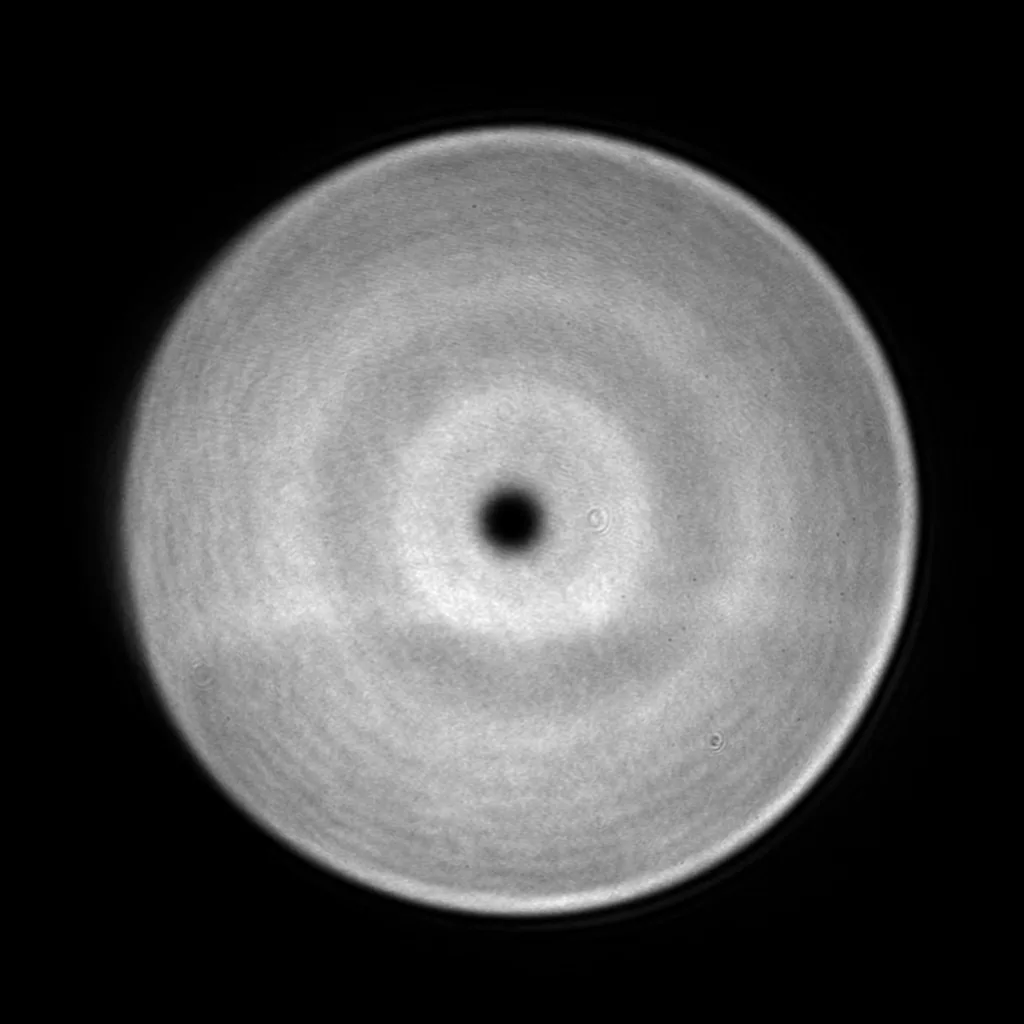
When ordinary water flows around a stone, it slows down: some energy goes into friction and eddies. But a superfluid liquid, such as liquid helium at temperatures below two degrees above absolute zero, flows with no friction whatsoever. In a Paris laboratory, the same behavior was seen in light: a laser beam was sent through a hot gas, and it flowed around an obstacle without losing energy.
The light was made to flow through a narrow channel: one laser beam created the fluid itself, and a second, narrower beam served as a movable obstacle. As long as the flow speed was low, the light bent around the obstacle smoothly. But when the speed exceeded a certain threshold, vortices began to appear behind the obstacle: small swirls, like eddies behind a rock in a fast stream.
That threshold is the critical speed of superfluidity. Previously it was measured using a single signature, and the results disagreed slightly. Now the scientists tracked three things at once: how many vortices were born, how strongly the flow pushed on the obstacle, and how much the obstacle itself shifted. All three methods gave the same answer: the critical speed turned out to be lower than the old calculation predicted, and it decreased when the obstacle was made larger. This means that light can serve as a convenient model for studying superfluidity, and the triple-check method will be useful in experiments with other quantum fluids.
Superfluid light in this experiment flows at a speed of only about 0.0056 radians, which corresponds to a beam tilt angle of roughly a third of a degree. Yet the critical velocity is reached already at a tilt of a tenth of a degree.
The idea of light behaving as a frictionless liquid echoes the concept of 'liquid light' from science fiction, for example in Greg Egan's novel 'Schild's Ladder', where the vacuum has nontrivial optical properties.