Light Flows Without Friction: Three Ways to Measure the Limit ✛
Context
Superfluidity, that is, frictionless flow, was first seen in liquid helium, then in ultracold gases and exciton-polariton condensates. Paraxial superfluid liquids of light are two-dimensional optical analogs where the propagation of a laser beam in a nonlinear medium obeys the same equation as the dynamics of a Bose condensate. Nearby in the archive are works on quantum friction, superfluidity with angles, vortices in liquid light, superconductors, and quantum heat counters. All of them touch on dissipation and threshold phenomena in quantum liquids, but this work stands out because it is the first to cross three independent observables for the same system.
Methods
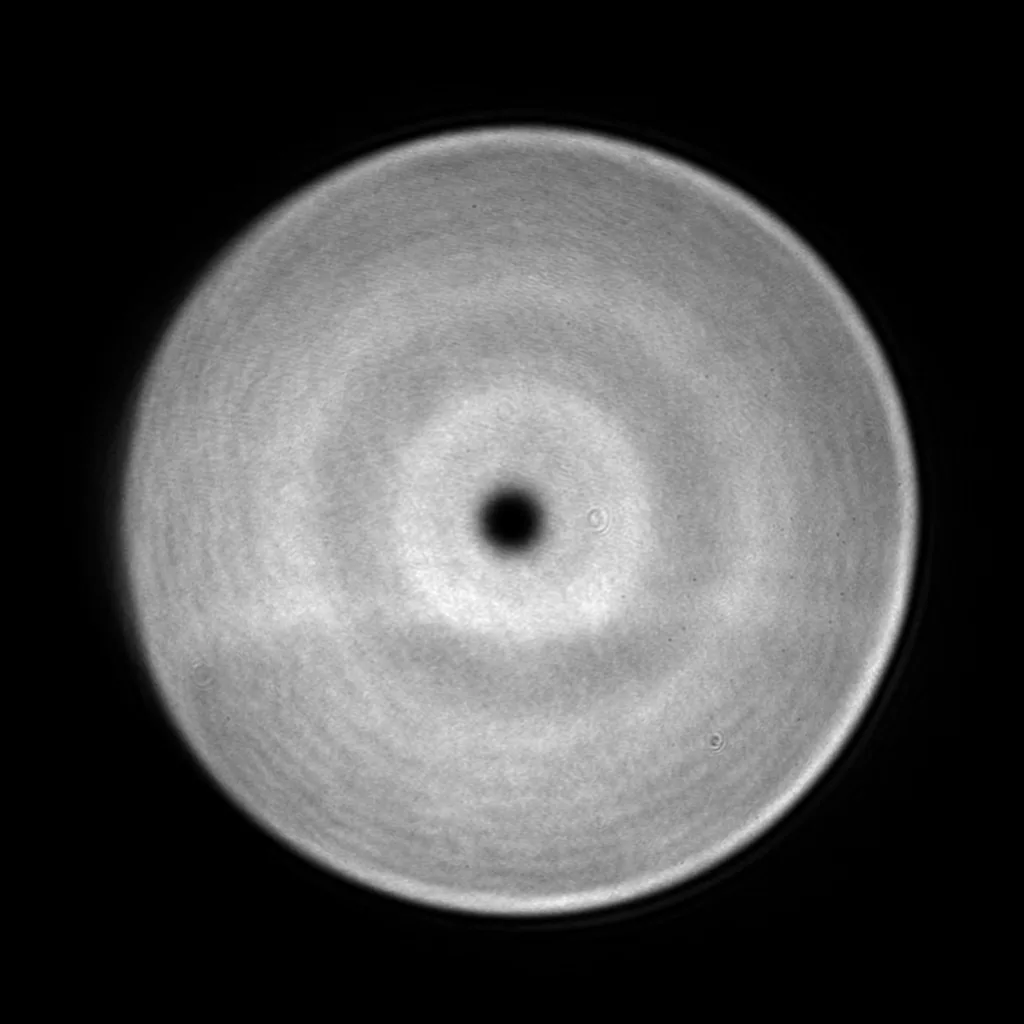
The experiment is built on a two-color optical scheme in warm rubidium-87 vapor. A broad Gaussian beam at 780 nm creates a two-dimensional superfluid liquid of light as it travels through a 20-centimeter cell heated to 150 degrees Celsius. A second, narrower beam at 795 nm forms a repulsive potential, a moving impurity. The tilt angle of the main beam sets the flow velocity, while the power of the impurity beam controls the obstacle radius. The full amplitude and phase map of the light field is recovered interferometrically at the cell exit, giving the density and velocity distribution of the superfluid.
Results
For each flow velocity, three quantities were measured simultaneously: the number of quantized vortices in the wake behind the impurity, the hydrodynamic force acting on it, and the drift velocity of the impurity relative to the flow. All three methods gave close values of the critical Mach number, which systematically lie below unity, that is, below the Landau speed of sound. As the impurity radius increased from 4.3 to 6.4 coherence lengths, the critical velocity monotonically dropped from about 0.52 to 0.18 times the speed of sound. The average over all measurements was 0.35, which matches the theoretical limit for an impermeable disk of large diameter.
Implications
The work shows that paraxial superfluid liquids of light are not just a pretty analogy but a full-fledged experimental platform for quantum hydrodynamics. Unlike neighboring works, where the critical velocity was estimated from a single signature, here three independent observables mutually confirm each other and reduce systematic errors. This is the first time that topological, force, and kinematic manifestations of the transition from superfluid to dissipative flow have been tracked simultaneously for the same system.
Future development
The topic could develop toward a more accurate theoretical description of soft Gaussian obstacles, taking into account cross-phase modulation and optical losses. It may also be possible to study the dynamics of an impurity with finite mass, where self-propulsion effects reminiscent of active particles have already been noticed. Extending the range of radii and velocities would allow testing predictions for various obstacle geometries.
Impact
The triple-diagnosis method will be useful in experiments with polariton condensates and ultracold atomic gases, where reliably determining the superfluidity threshold is also important. The optical platform could become a convenient tool for testing theoretical models of quantum hydrodynamics.
Next steps
The next step will be to build a theoretical model that accounts for the Gaussian shape of the impurity, cross-phase modulation, and absorption, in order to achieve quantitative agreement with the experiment. Regimes with larger impurity radii and higher flow velocities are also planned.
Key open problems
For quantum hydrodynamics, the exact form of the critical velocity dependence on the obstacle shape and size in the nonlinear regime remains an open question. This work shows that existing analytical models for hard disks give only qualitative agreement, and accounting for the soft profile and two-component coupling requires new approaches.
The knowledge machine's view
This section is addressed to the author of the paper and their colleagues. Neighbouring works were found by meaning-based search across our archive, not by word overlap. We do not review: we show the field around the work.
What the work does
The paper experimentally investigates the transition from superfluid to dissipative flow in a paraxial fluid of light moving past a repulsive obstacle. The number of nucleated vortices, the hydrodynamic force on the obstacle, and its displacement were measured simultaneously, yielding consistent values of the critical velocity that lie below the Landau prediction and decrease with increasing obstacle size.
Where its strength is
A strong point is the simultaneous use of three independent observables (topological, force-based, and kinematic) to determine the critical velocity in the same system, which provides cross-checks and reduces systematic errors.
Where it could go next
- It might be interesting to see how the critical velocity in this system is affected by the shape and profile of the obstacle potential, not just its size. Nearby on the archive there is a paper on how corners and geometry of obstacles break superfluidity; perhaps similar effects can be reproduced in a fluid of light.based on: Sharp Corners Break Superfluidity arXiv:2602.18876
- Since the experiment already reconstructs the full amplitude and phase map, one could attempt to directly measure vortex correlations and dynamics, for instance their pair creation or interaction. The archive contains an analysis of vortices in liquid light that discusses such topological excitations.based on: Quantum Leapfrog: How Vortices Play in Liquid Light arXiv:2512.07935
- It would be interesting to probe the system's behavior as it approaches a quantum quench or under strong nonlinearity. A neighboring paper on superconductors at a quantum quench might suggest which regimes to explore in a fluid of light.based on: Superconductors at the Quantum Brink arXiv:2604.10621
Worth trying
- Test the critical velocity measurement for obstacles with anisotropic or angular shapes, comparing with predictions for superfluidity with corners.
- Use interferometric data to track individual vortex trajectories and their correlations, thereby testing models of vortex dynamics.
- Explore the behavior of the critical velocity near a phase transition or when varying nonlinearity parameters, drawing on analogies with quantum phase transitions in superconductors.
Why this may matter
Such an extension could turn paraxial fluids of light into a versatile testbed for quantum hydrodynamics theories, including effects of obstacle geometry and strong correlations that are difficult to probe in other superfluid systems.
Nearby works in our archive
- The Superconductor That Refuses to Die Quicklysimilarity 0.57
- Whirlwinds in a Cloud of Atomssimilarity 0.55
- Quantum Particle Defies Friction: Frictionless Motion in a One-Dimensional Systemsimilarity 0.54
- Light Vortices Stir Up Turbulencesimilarity 0.53
- Compression Improves Superconductorssimilarity 0.53
- Superconductors at the Quantum Brinksimilarity 0.53
- Sharp Corners Break Superfluiditysimilarity 0.53
- Quantum Leapfrog: How Vortices Play in Liquid Lightsimilarity 0.53
The archive is sparse around this work: the closest review is only 0.57, against a usual 0.64. It looks like few have drilled nearby.
Superfluid light in this experiment flows at a speed of only about 0.0056 radians, which corresponds to a beam tilt angle of roughly a third of a degree. Yet the critical velocity is reached already at a tilt of a tenth of a degree.
The idea of light behaving as a frictionless liquid echoes the concept of 'liquid light' from science fiction, for example in Greg Egan's novel 'Schild's Ladder', where the vacuum has nontrivial optical properties.
Key numbers
- average critical Mach number: 0.35
- impurity radius range: 4.3–6.4 coherence lengths
- speed of sound: 5.6×10⁻³ rad
- coherence length: 50 μm
- rubidium vapor temperature: 150 °C