Light Flows Without Friction: Three Ways to Measure the Limit ✛
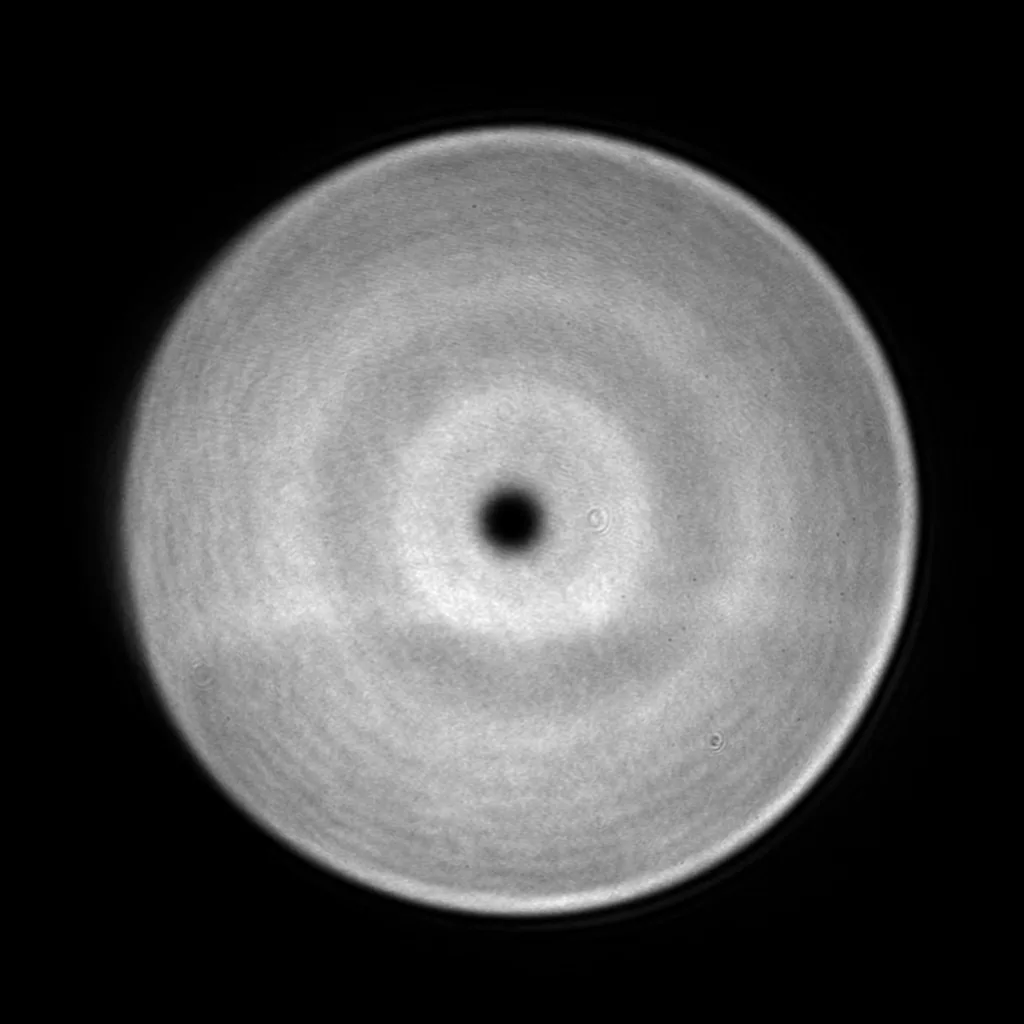
In a Paris laboratory, light was made to flow around an obstacle the way water flows around a rock in a stream. But this water is special: it feels no friction. Such a state is called superfluidity, and until now it had been observed in liquid helium and ultracold gases, and now in a laser beam traveling through rubidium vapor heated to 150 degrees.
The physicists built a narrow channel for light: a broad laser beam at 780 nanometers creates a two-dimensional fluid, while a second, narrower beam at 795 nanometers acts as a movable obstacle. Tilting the main beam sets the flow speed, and the power of the second beam sets the obstacle size. As long as the speed is low, the light flows smoothly around the obstacle without losses. But once the critical threshold is exceeded, vortices begin to form behind the obstacle: tiny swirls, each carrying an integer number of phase windings.
To catch this threshold, the researchers tracked three things at once: how many vortices appeared in the wake, how strongly the flow pushed on the obstacle, and how much the obstacle itself shifted relative to the flow. Previously, the critical speed of superfluid light was measured by a single signature, and different methods gave slightly different thresholds. Now three independent observables in a single experiment gave consistent values.
The critical speed turned out to be noticeably lower than Landau's prediction and decreased with increasing obstacle size: from 0.52 times the speed of sound at a radius of 4.3 coherence lengths down to 0.18 at a radius of 6.4. The coherence length is the minimum scale over which the fluid density recovers after a perturbation, about 50 micrometers in this experiment. The average value of 0.35 matched the theoretical limit for an impermeable disk of large diameter.
Now superfluid light can serve as a testbed for quantum hydrodynamics. The triple-diagnostic method will be carried over to experiments with polariton condensates and cold atoms, where the superfluidity threshold also needs reliable determination. Light flowing around a rock without a single splash turned out to be more convenient than helium: it is easier to set in motion, easier to measure, and easier to understand.
Superfluid light in this experiment flows at a speed of only about 0.0056 radians, which corresponds to a beam tilt angle of roughly a third of a degree. Yet the critical velocity is reached already at a tilt of a tenth of a degree.
The idea of light behaving as a frictionless liquid echoes the concept of 'liquid light' from science fiction, for example in Greg Egan's novel 'Schild's Ladder', where the vacuum has nontrivial optical properties.