Light is a true sprinter of the Universe, always running at the same speed. No matter whether you are chasing a flashlight beam or rushing towards it, its speed will remain unchanged for you — about 300,000 km/s. This is unlike the everyday world: if you walk on a moving escalator, your speed adds to the speed of the steps. With light, this trick doesn't work! It is this strange property that leads to time dilation and length contraction in relativity.
History
The first indications of the constancy of the speed of light came from Maxwell's equations (1861), from which c = 1/√(μ₀ε₀) was calculated. Attempts to detect the ether wind through the Michelson–Morley experiment (1887) yielded a null result. Hendrik Lorentz and Henri Poincaré developed the preparatory mathematical apparatus, but it was Albert Einstein in 1905 who elevated the constancy of c to a fundamental postulate, discarding the ether and building the theory of relativity.
How it works
The principle underlies all modern high-energy physics and astrophysics. It is necessary for the correct operation of particle accelerators, satellite navigation systems, and understanding the evolution of the Universe. Limits of applicability: special relativity does not account for gravity, so in strong fields (near black holes or at extreme densities) general relativity is required, where the speed of light is locally constant, but its global behavior is more complex.
Fun fact
Imagine a light bulb turning on in the center of a carriage flying at near-light speed. A passenger inside will see the light reach the front and back walls simultaneously. For an observer on the station, the light will first catch up with the back wall, which is moving towards it, and only then the front wall. To both, it will seem that the light traveled at the same speed! It's just that time flows differently in different frames — such wonders.
Water in a tank spins at nearly four revolutions per second, and, as if by magic, a column the size of a dinner table emerges. The vortex lives for dozens of rotations, even though everything around it churns and trembles. Where does such stability come from?
The secret is that the vortex is not isolated.
In a Paris laboratory, light was made to flow around an obstacle the way water flows around a rock in a stream. But this water is special: it feels no friction.
A thrown stone arcs through the air, but a planet around the Sun follows a closed curve. Why an ellipse, and not a circle or a spiral? Kepler's first law provides the answer, but its usual proof requires heavy computation. This work offers a shorter path — through a single simple ratio of velocities.
In a glass of murky liquid where starch is settling, the eye sees only a gray haze. Particles inside are moving, but what exactly is happening remains a mystery. Conventional optical instruments cannot penetrate such a suspension: light scatters already in the top layer.
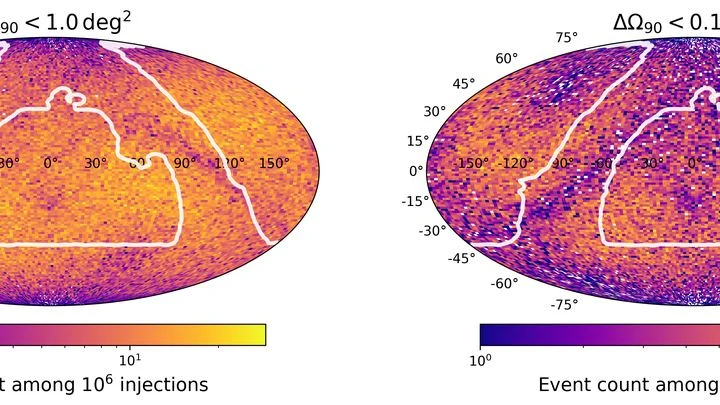
A proton or an atomic nucleus slams into Earth's atmosphere at tremendous speed, and a cascade of billions of particles is born. This extensive air shower races toward the surface, while sensitive telescopes catch its faint glow. From the shape of the glow, physicists determine how deep the shower penetrated the atmosphere and what it was made of.
Predicted by Albert Einstein, gravitational waves are like beacons in the dark ocean of space. They flare up when black holes collide, sending ripples through the fabric of the Universe.
Neutron stars are the last clumps of visible matter before collapsing into a black hole. In their interiors, matter is squeezed to trillion-fold densities. Here, nuclear forces and gravity weave into an exotic substance inaccessible to any earthly particle accelerator.
In 2021, the LHAASO observatory registered gamma quanta with energies above a petaelectronvolt from sources like the Crab Nebula — a supernova remnant with a pulsating neutron star at its heart.
In the ordinary world without dark energy, the mass of any object is always positive. That seems obvious: positive mass attracts, creating gravity. But the real universe has dark energy — a mysterious force making the cosmos expand faster and faster.
A runner on the middle of a track suddenly switches to a walk — not speeding up or slowing down, but maintaining a constant pace. Something similar may have happened to the universe itself shortly after the Big Bang.
The explosion of a distant supernova told us something hard to believe: the universe is expanding faster and faster. The engine of this acceleration is dark energy — nearly 70% of everything that exists.
Neutron stars are the final chord in the evolution of massive suns. Born in the cataclysm of a supernova, they pack a mass comparable to the Sun's into a sphere the size of an earthly metropolis.
Light or sound can be confined in a tiny region of a crystal, like a pearl in a shell. Usually, two methods are used. The first is like a heavy ball in a pit: a particle with large mass simply cannot roll out. The second is a perfect cage of mirrors, where waves cancel each other everywhere except in the trap itself.
At the heart of a warp drive lies Einstein's idea that massive bodies curve spacetime — the very stage on which all cosmic events unfold. Picture a bubble of such curved spacetime. Inside it, the ship floats without any G-forces, like a passenger in an airplane cabin who doesn't feel the headwind.
In 1963, Maarten Schmidt unraveled the nature of quasars — distant active nuclei outshining entire galaxies. Since then, we've learned that at their hearts lurk supermassive black holes, converting infalling matter into blinding light.
An ordinary diode in electronics works like a one-way street: current flows in only one direction. In superconductors, where electricity flows without resistance, such behavior has long been elusive — current is usually symmetric.
The authors of the new work found a way to create a perfect superconducting diode using light.
A ball on a slope with two pits usually rolls into the nearest one and comes to rest. But if the slope is slightly deformed and 'remembers' recent nudges, the ball can hang around halfway for a long time — in a narrow spot it doesn't want to leave. That's exactly the trick physicists played with light.
When two dead stars collide in a distant galaxy, two messengers bring us the news: a shiver in space, a gravitational wave, and a flash of light. Both messengers race toward us across the entire Universe, but their paths can differ slightly. Light sometimes gets delayed by cosmic dust, while gravitational waves pass through everything almost without noticing obstacles.
The speed of light in a vacuum is physics' metronome: it sets the rhythm for all processes. If it falters, the familiar harmony collapses. Neutrinos, ubiquitous but almost intangible particles from space, can check if this rhythm ever stumbles under extreme conditions.
A drop of ink falls into a glass of water, and ripples spread out from it. Water seems simple, but if you look inside, each molecule isn't just moving forward: it's also spinning like a tiny top. Physicists call this intrinsic rotation spin. Usually, it goes unnoticed: in calm water, the tops spin every which way, and their rotation doesn't affect the fluid's overall motion.
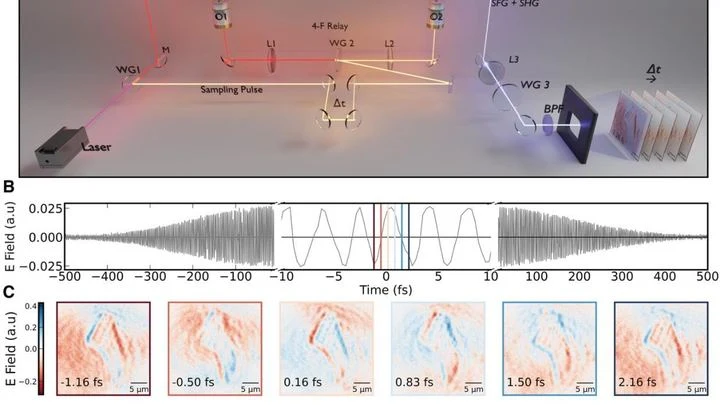
Light is not just a beam but a wave with an electric field that changes at a speed unimaginable to ordinary clocks. Until now, this field could only be measured at a single point, like taking temperature with a single thermometer. Now researchers have created a method that shows the entire field at once, like a thermal imager showing a heat map.
A handful of sand on a vibrating table is like a crowd on a dance floor that still holds the rhythm of the old song for a second after the DJ has switched to a new one. Scientists made a thin layer of grains bounce on a vertically shaking platform and abruptly changed the shaking intensity.
The diffusion equation, a mathematical tool describing how particles spread out in space, has long painted a paradoxical picture: a disturbance, like ripples on Water, instantly engulfs the entire universe. This challenged the theory of relativity, which holds that nothing can move faster than light.
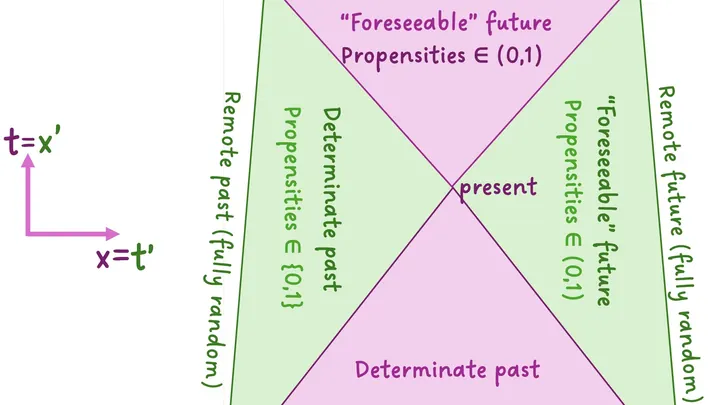
According to the laws of physics, nothing can outrun light, otherwise for some observers the effect would occur before the cause. Artur Ekert and Andrzej Dragan showed that this situation creates an uncertainty resembling quantum indeterminacy.
All bodies in vacuum fall with the same acceleration: this principle, formulated by Einstein in general relativity, underpins our understanding of gravity. Yet so far it has been experimentally confirmed only for particles of ordinary matter.
In October 2022, the LHAASO observatory measured the spectrum (energy distribution) of gamma-ray burst GRB 221009A — the brightest on record. Its light traveled for two billion years and was so intense that it disturbed the upper layers of Earth's atmosphere.
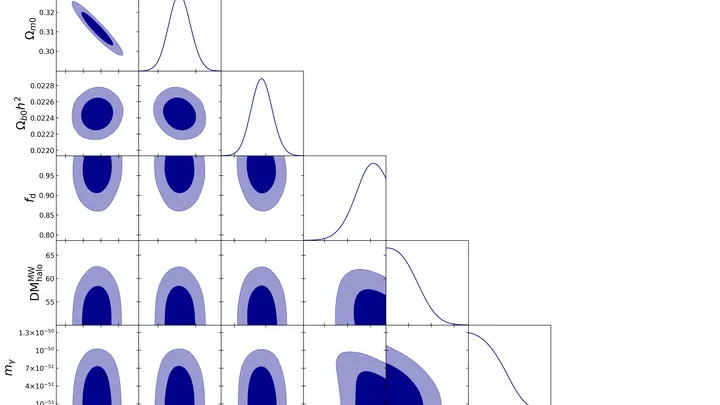
Fast radio bursts are brilliant cosmic flashes that, like a starting signal, set off a race of radio waves across the universe. Astronomers used them as a natural laboratory to test whether the photon, the quantum of light and the carrier particle of the electromagnetic interaction, has mass.