Optics That Fix Themselves ✛
Context
Modern quantum computers based on neutral atoms control hundreds and thousands of qubits with laser beams that pass through dozens of mirrors and lenses. Any element can shift imperceptibly due to vibrations or temperature changes, and then the whole system stops working. Manually aligning such optics is like looking for a needle in a haystack: you have to check each screw one by one, and an error in one place ruins everything else. Classical alignment algorithms often get stuck in local minima or take too much time. This work stands apart: there are related studies on automating optics with machine learning, but most of them either limit themselves to a small number of adjustments or fail to provide a quick recovery from a fully misaligned state.
Methods
The authors built an experimental setup with a high-finesse optical cavity (finesse about 20000) and five degrees of freedom: tilts of two mirrors and the position of a focusing lens. A laser beam with a power of 150 microwatts was sent into the cavity, and a camera captured the transmitted light pattern. These images were then fed into a ResNet-18 neural network, trained to predict the adjustments needed to return the cavity to its optimal state. For training, they collected 5000 image-adjustment pairs, randomly misaligning the system. After that, they applied partial least squares (PLS) to identify the main directions in the adjustment space that most strongly affect mode purity.
Results
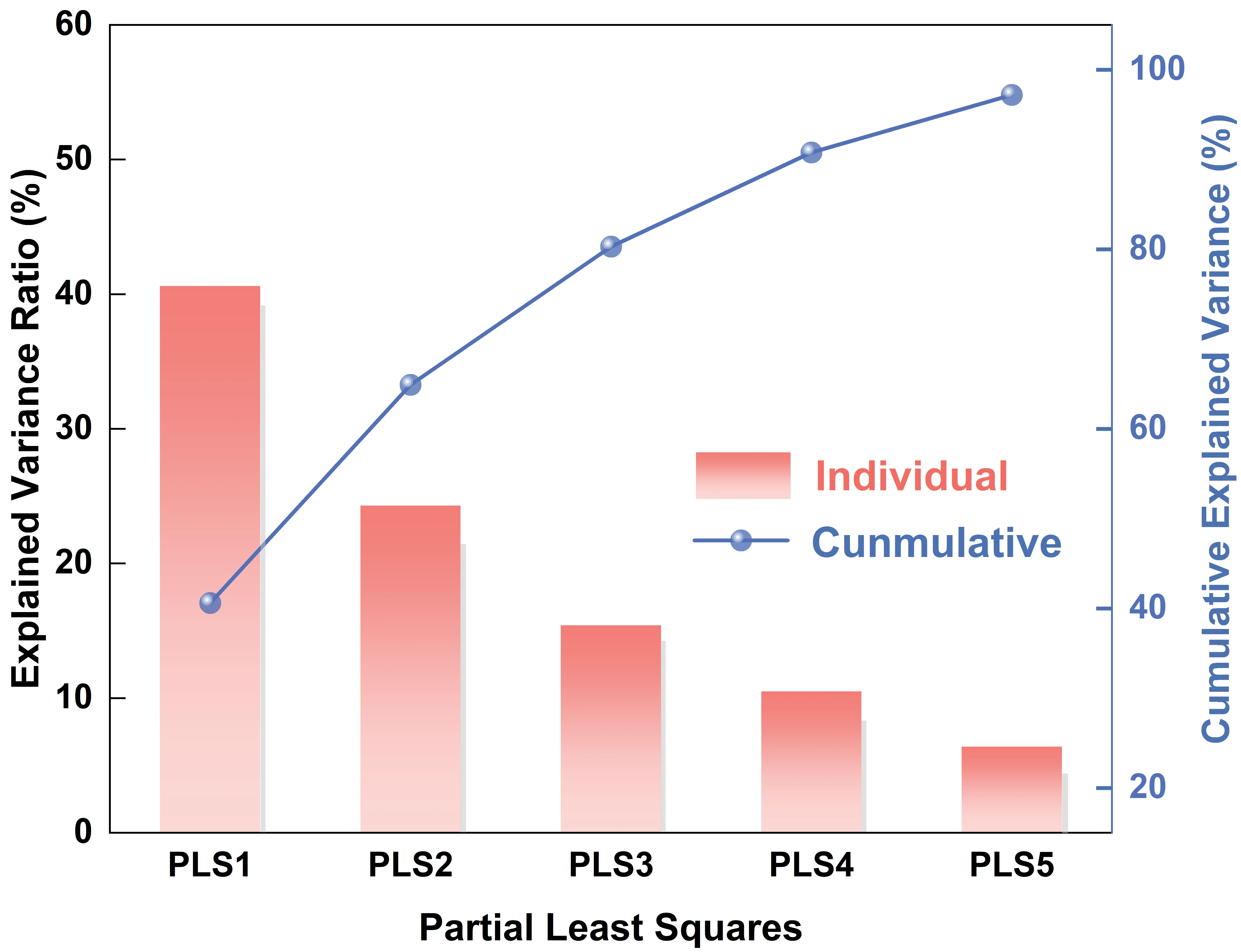
The neural network learned to output a vector of five corrections in a single pass, taking the system from a fully misaligned state to a working one. On average, a cold start required 2.25 iterations, with the fundamental mode purity rising above 60%. Then a local linear scan along the axes was performed, and within 45 seconds the purity reached 90%. Out of 40 random starts, the system never got stuck. PLS analysis showed that the five degrees of freedom actually reduce to three principal components explaining 80.3% of the variance. The most important direction (PLS1) is loaded with the angles of the second mirror and the lens position, while the secondary direction (PLS2) involves the lens position and the angles of the first mirror. This means the adjustments are not independent and must be turned in a coordinated way.
Implications
This work differs from its neighbors in that it is the first to combine deep learning with an analysis of hidden correlations among adjustments for a fast recovery from a fully misaligned state. Other approaches either use slow iterative algorithms or train only on small deviations. Here, the neural network acts as a global navigator, while PLS provides a sensitivity map that guides local fine-tuning. This turns optical alignment from blind trial and error into targeted intervention.
Future development
Scaling to hundreds of degrees of freedom looks feasible: the authors showed that the amount of training data grows roughly linearly with the number of adjustments, not exponentially as with grid-based methods. For 9 degrees of freedom, about 9000 samples were needed, and the error remained below 0.1. This paves the way for automatic alignment of large arrays of optical tweezers for thousands of atomic qubits. In the long run, such systems could be embedded in fully autonomous laboratories, where an agent based on a large language model plans measurements and calls diagnostic tools itself.
Impact
The method will be useful in quantum computing with neutral atoms, in gravitational-wave detectors, and in any setup with complex free-space optics that requires constant alignment.
Next steps
Test the approach on a real array of atomic traps with dozens of mirrors. Integrate the system with a laboratory equipment control protocol for autonomous operation without human intervention.
Key open problems
For quantum optics, a key unsolved problem is maintaining the stability of hundreds of laser beams over long periods. This work directly addresses part of that problem by offering a fast and reliable way to automate alignment. The next challenge is adapting to slow drifts that are not captured by a static model.
The knowledge machine's view
This section is addressed to the author of the paper and their colleagues. Neighbouring works were found by meaning-based search across our archive, not by word overlap. We do not review: we show the field around the work.
What the work does
The paper describes an automatic alignment system for an optical cavity using a ResNet-18 neural network and partial least squares (PLS) analysis. From an image of transmitted light, the neural network predicts corrections for five adjustments, achieving cold start in 2.25 iterations, while PLS identifies three principal components that explain 80.3% of the variance. A local linear scan brings the mode purity to 90% in 45 seconds.
Where its strength is
The strong point is the combination of deep learning for global navigation with analysis of hidden couplings between adjustments (PLS), which enables rapid recovery from a fully misaligned state and targeted local refinement.
Where it could go next
- It might be interesting to see how the approach of training on random misalignments can be adapted to systems with a larger number of degrees of freedom, for example, in multi-element optical schemes for quantum processors. A related work on space-based alignment of entangled photons also requires precise tuning of optics under challenging conditions.based on: Space-Age Alignment for Entangled Photons arXiv:2601.16968
- Perhaps it is worth considering transferring the method to other types of cavities or laser systems where fast mode stabilization is important. The archive has an analysis of a tiny mirrorless laser, where control of the mode composition could benefit from similar machine learning.based on: A Tiny Laser with No Mirrors arXiv:2607.06556
- It would be interesting to test how PLS sensitivity analysis combines with compressed sensing methods to reduce the number of measurements. The archive contains a paper on how a shadow instead of a full portrait allows information to be recovered, which could be useful for speeding up diagnostics.based on: A Shadow Instead of a Full Portrait arXiv:2602.14694
Worth trying
- Test training the neural network on synthetic data generated by a physical model of the cavity to reduce the number of real misalignments.
- Check whether PLS components can be used as features for a simplified neural network or a classical controller.
- Assess the transferability of the trained model to slightly different cavities (different finesse, geometry) using domain adaptation.
Why this may matter
Automating optical alignment is critical for scaling neutral-atom quantum processors, where the number of optical elements grows and manual tuning becomes unrealistic. Fast cold start and an understanding of hidden couplings between adjustments can reduce downtime and improve the reliability of quantum computers.
Nearby works in our archive
- Space-Age Alignment for Entangled Photonssimilarity 0.58
- A Tiny Laser with No Mirrorssimilarity 0.58
- How a Laser and Mirrors Squeeze Timesimilarity 0.56
- A microscope hunts for single photonssimilarity 0.56
- A Shadow Instead of a Full Portraitsimilarity 0.55
- Dancing Atoms Under Optical Tweezerssimilarity 0.54
The archive is sparse around this work: the closest review is only 0.58, against a usual 0.64. It looks like few have drilled nearby.
The optical cavity here acts like a very sensitive nose: a tiny mirror tilt changes the light pattern more than the eye can notice. And the neural network learns to 'sniff out' that tilt from a single snapshot.
Key numbers
- degrees of freedom: 5 (main configuration)
- mode purity after cold start: >60% in 2.25 iterations
- mode purity after local scan: >90% in 45 seconds
- variance explained by three PLS components: 80.3%
- neural network prediction error: 0.07 (normalized MAE)