A Tiny Laser with No Mirrors express
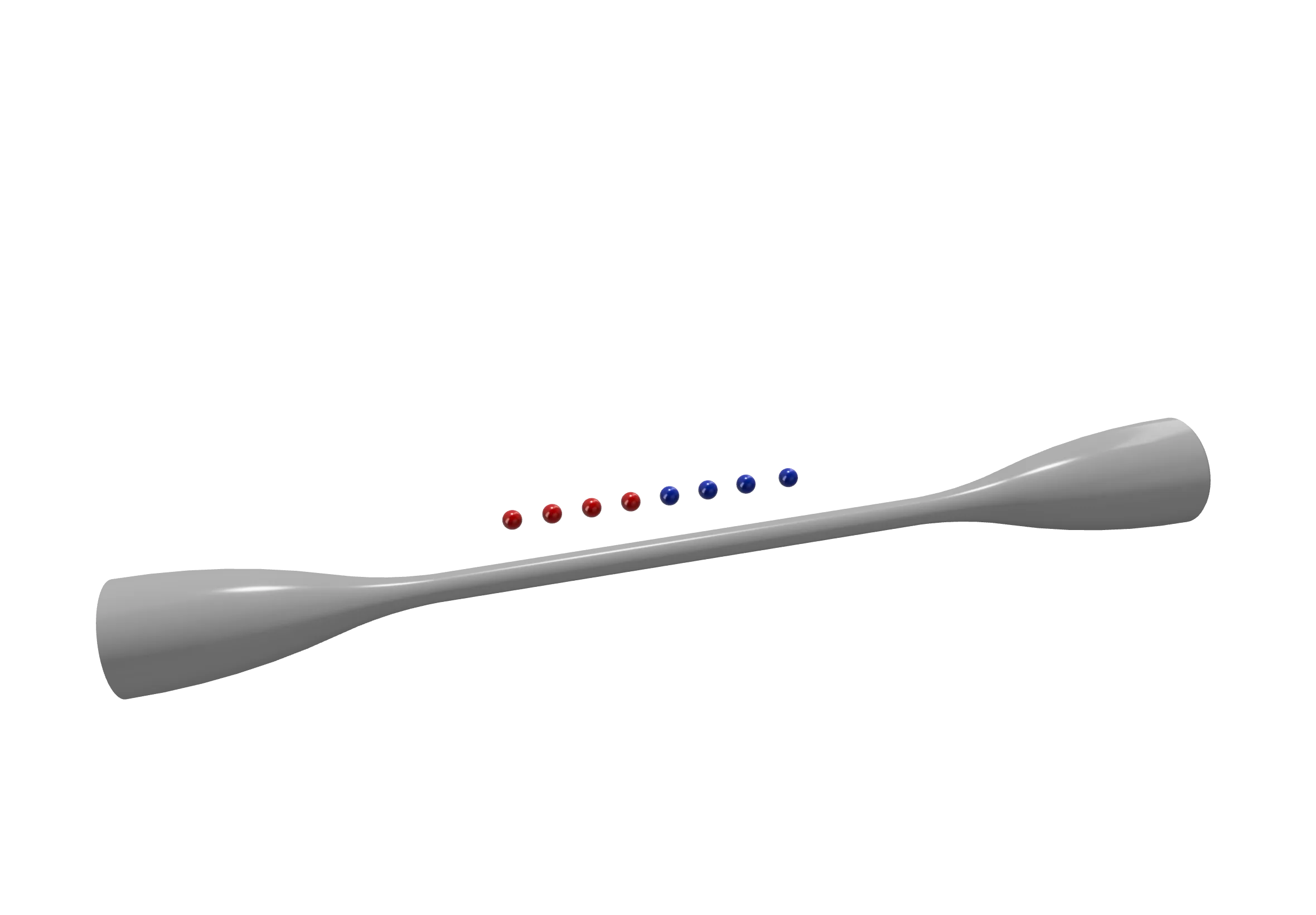
An orchestra without a conductor, where musicians hear each other through a shared wall. That's roughly how the new type of laser works: a few atoms (emitters) sit along a waveguide — a thin track for light on a chip. Light from each atom runs along this track and affects its neighbors. A collective play emerges, where atoms emit in concert, like bows rising in a single instant.
But there's a nuance. Usually in such systems, you pump energy into all atoms to make them shine. The authors of the work took a different route: they proposed pumping only a fraction. The remaining atoms stay "dark"—they don't emit themselves but actively participate in the common cause. These inactive atoms act as a built-in filter: they select the desired frequency and make everyone emit strictly in one rhythm. The result is an ultra-narrow beam directed along the waveguide.
The result is impressive. The light comes out at a frequency very close to the atom's own frequency — the one set by nature itself and almost unchanging. The brightness jitter (noise) is minimal: the parameter g(2)(0) is approximately equal to 1, meaning photons flow in a steady stream, without unpleasant bunches or dips. Such light is an ideal "ruler" for measuring time and distance.
And here we hear that same orchestra again. But now it's clear: the musicians themselves became the conductors, and the previously unheard call-and-response through the wall turned out to be the secret of perfect rhythm. No bulky mirrors, no complex alignment.
In such a laser, mirrors are not needed at all: their role is played by the mutual influence of atoms on each other through the shared waveguide. It's as if musicians kept the rhythm just by listening to their neighbor, without a baton wave.
In Ray Bradbury's novel "Dandelion Wine," the Happiness Machine tuned the soul to a perfect wave — much like the mirrorless laser tunes light to the frequency set by the atom's own nature.