A Cell in a Dark Trap: Dividing Without Photodamage ✛
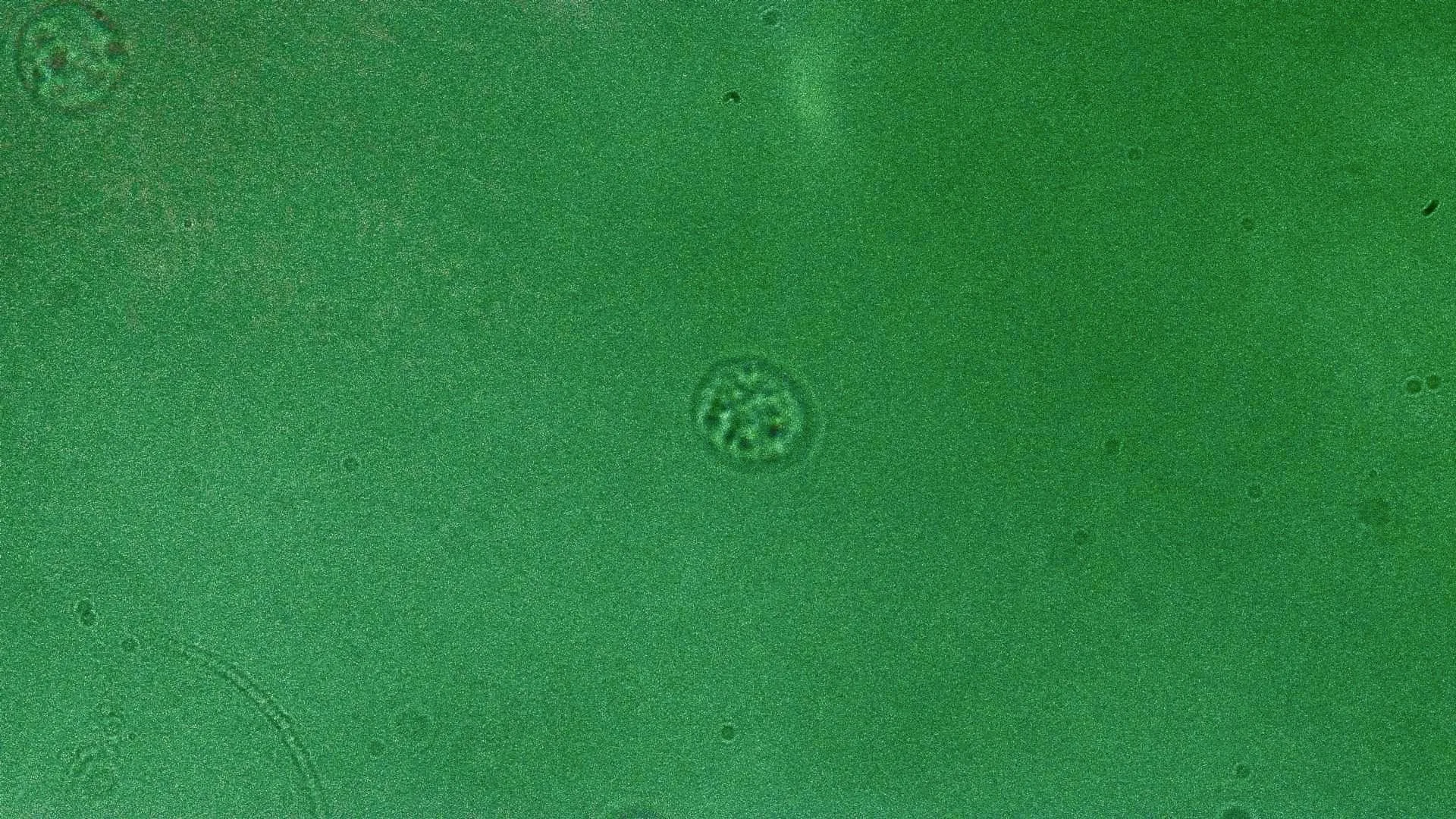
In a dark room, you can hold a glowing sphere without touching it: walls of light push it away but do not burn it. That is roughly how the trap built in Rio de Janeiro for yeast cells works. A conventional optical tweezer, that is, a focused laser beam, acts like tweezers made of light, but the light itself pierces the cell from side to side. Yeast caught in such a beam stop dividing because photons damage their internal machinery. The authors of the new study found a way to leave the cell alone by removing light from its center.
The test was simple: cells were kept in the trap for 10 minutes, for one hour, and for four hours. After the laser was switched off, the yeast scattered, which means that all that time they were indeed held by the trap, not by accidental sticking. Over four hours, the cells managed to complete a full budding cycle and split into two. In a conventional Gaussian tweezer at 30 mW, not a single cell divided in the same time. The area of a colony of five cells in the dark trap doubled, whereas in the conventional tweezer it remained unchanged.
Previously, dark traps were applied to nonliving microparticles, while living cells were held only in conventional tweezers, and researchers put up with the damage. Here it is shown for the first time that yeast in a light cage not only survive but reproduce for hours. This changes the game for biologists: now you can watch a single cell throughout its entire life cycle without interfering. Light becomes not a tool of violence but an invisible hand that gently holds the living thing.
Let us return to the dark room: now the walls of light not only hold but also protect. A yeast cell surrounded by three beams continues to live its ordinary life, as if there were no trap at all. That was precisely the goal: to make light invisible to the living.
Iodixanol, which was added to the medium, was originally developed as a contrast agent for X-ray imaging, and now it helps keep yeast in the dark.
In Arthur C. Clarke's novel 'Rendezvous with Rama,' an alien spacecraft uses light fields to manipulate objects; dark traps take a step toward such 'contactless' manipulation of living organisms.