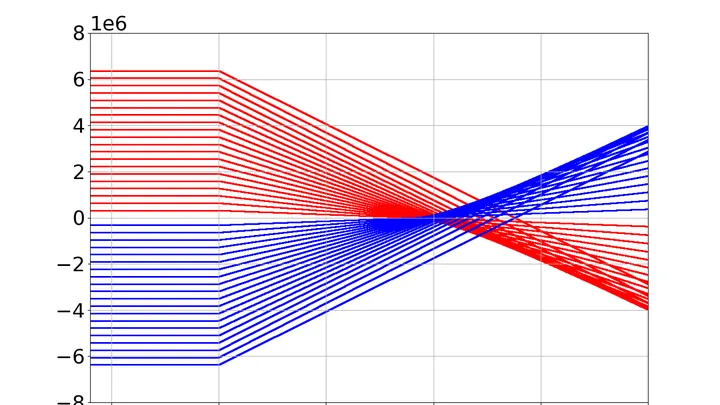
A light trap is a device designed to store photons for a measurable duration, allowing them to accumulate gravitational phase shifts before being released. This concept is central to experiments that aim to detect gravitational effects on light, such as gravitational redshift, using tabletop setups rather than astronomical observations. The trap effectively 'holds' light in a confined space, increasing the interaction time with the gravitational field.
History
The idea of using trapped light to measure gravitational effects gained traction in the 21st century, with proposals for tabletop experiments to complement large-scale gravitational wave detectors. The specific 'pitch-and-catch' technique was developed as a practical approach to realize such measurements.
How it works
The device typically uses highly reflective mirrors or optical cavities to bounce photons back and forth, creating a long effective path length. By trapping light for a controlled time, the gravitational phase shift accumulated by the photons becomes detectable. The 'pitch-and-catch' method involves sending a light pulse into the trap and retrieving it after a precise delay, measuring any frequency shift caused by gravity.
In practice
Light traps are used in precision tests of general relativity, gravitational wave detection, and quantum optics experiments that require long photon storage times.
Fun fact
In a light trap, photons can travel distances equivalent to thousands of kilometers in a compact laboratory setup, amplifying subtle gravitational effects.
In a dark room, you can hold a glowing sphere without touching it: walls of light push it away but do not burn it. That is roughly how the trap built in Rio de Janeiro for yeast cells works. A conventional optical tweezer, that is, a focused laser beam, acts like tweezers made of light, but the light itself pierces the cell from side to side.
Imagine a green beam that, passing through an ingenious optical setup, twists into a three-dimensional funnel of light — an optical vortex. At its heart, like in the eye of a hurricane, the intensity drops to zero. It is there that photons disappear.
A flashlight beam in a dark room can hold a dust mote almost still: that's how optical tweezers work. But light doesn't just push the particle; it also jostles it with random kicks. Each absorbed photon strikes it like an invisible hammer. The authors of the new study have devised a light trap of a special shape.
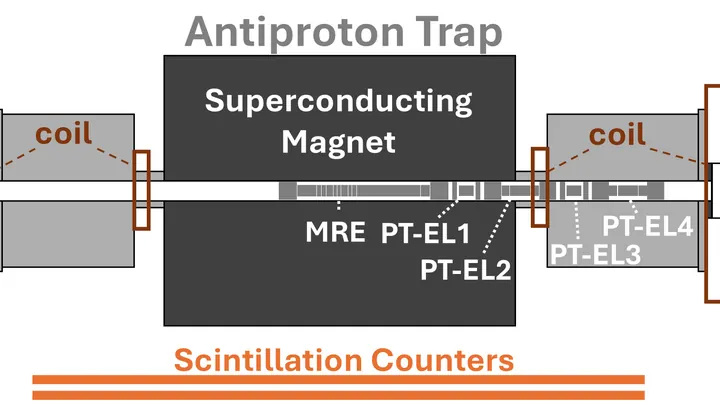
At CERN's antimatter factory, antiprotons are born with the energy of a bullet from a rifle. You can't just put them in a box: they instantly annihilate upon touching ordinary matter. So physicists devised a way to catch them in electromagnetic traps — invisible cages made of fields.
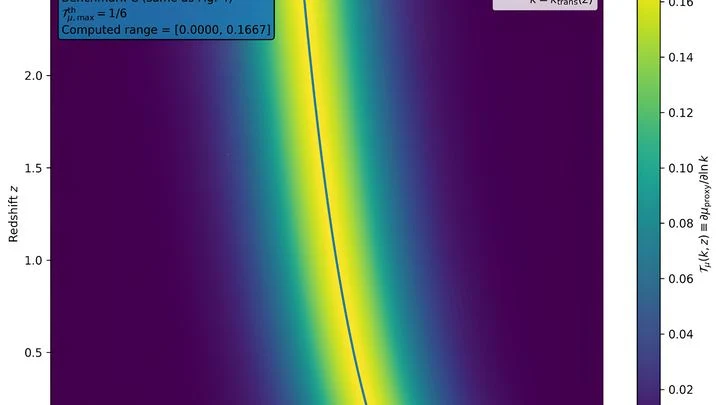
In the dark depths of space lurks invisible matter. It doesn't shine, but its pull holds galaxies together. Usually, we assume dark matter obeys the same laws of gravity as tables and chairs. A new study offers a different perspective: dark matter might subtly alter gravity itself.
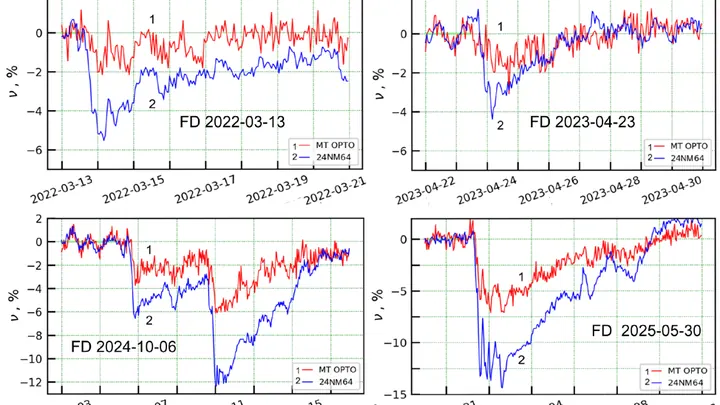
A storm is brewing somewhere far away, and the Geiger counter is already clicking more often. That's how cosmic rays, a stream of charged particles from deep space, make themselves known. When they slam into the atmosphere, they create showers of secondary particles, including muons: heavy cousins of electrons that can reach the ground.
Dark matter doesn't emit or reflect light, yet its gravity holds galaxies together. What it's made of is a mystery. One leading candidate is the axion, an ultra-light particle. Searching for axions is like listening for a very faint radio signal, but the receiver's own noise gets in the way.
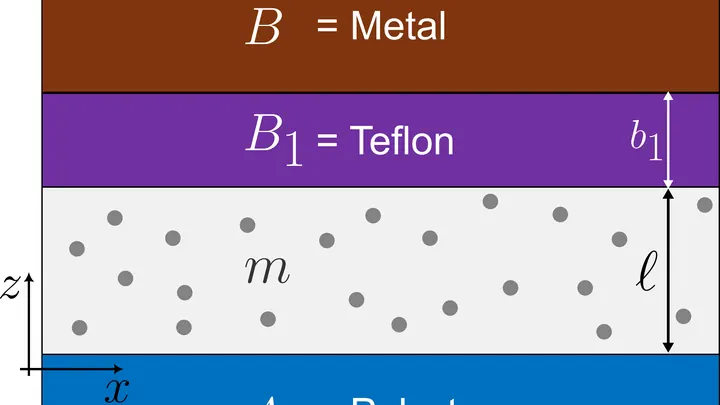
The space between two closely spaced surfaces is far from empty: it's a seething "quantum glue." Within it, quantum fluctuations continuously pop in and out of existence: microscopic bursts of energy in electromagnetic fields that, according to quantum theory, give the vacuum a dynamic structure.
Dark matter is the invisible scaffold of the Universe, revealing itself only through gravity. Vera Rubin, studying the rotation of galaxies, found that stars at the periphery move too fast, as if held by an unseen mass. This became compelling evidence for the existence of dark matter, yet its particles still elude direct detection.
Quantum computers demand reliable memory. In a diamond crystal — carbon — information is stored as the orientation of microscopic magnetic needles (spins) at special defects. Reading these arrows with light was inconvenient: optics are bulky for chips. The new method works like developing photographic film.
Light is a finicky guest. It flies into a cavity but doesn't stay: part of the pulse inevitably reflects and carries away quantum information. Classical single-pass capture schemes hit this limit no matter how much you improve control. Reflection was considered a loss, but the authors of a new study suggest looking at it differently.