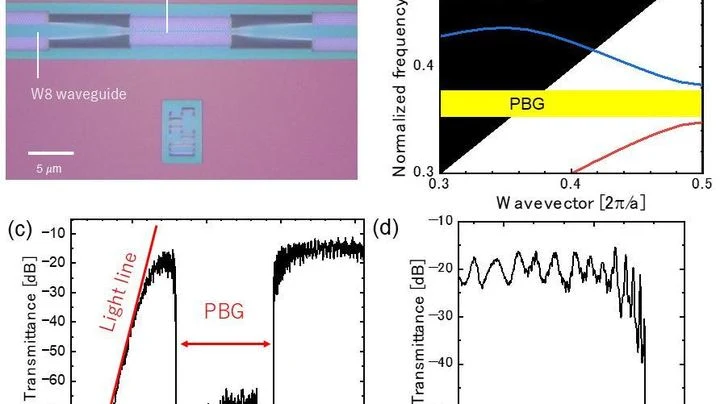
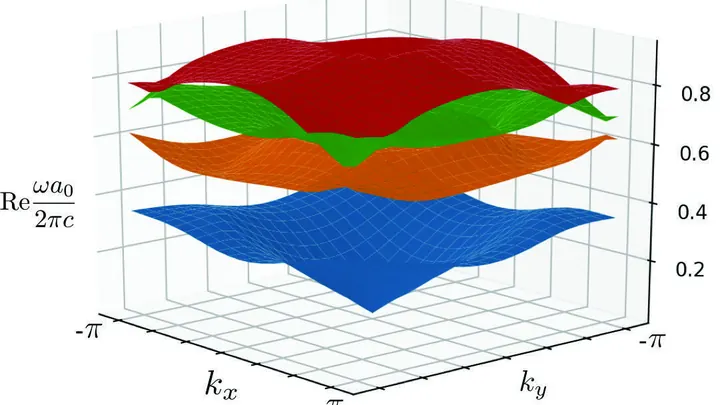
A photonic crystal is an optical material with a periodic variation in its refractive index, arranged on a scale comparable to the wavelength of light. This structure creates a 'photonic band gap' — a range of frequencies for which light cannot propagate through the material, much like the electronic band gap in semiconductors prevents electrons from moving at certain energies. As a result, light is forced to take specific paths, can be confined in tiny volumes, or can be manipulated to flow around sharp corners without scattering.
History
The concept was independently proposed by Eli Yablonovitch and Sajeev John in 1987, drawing on the analogy between electron waves in periodic potentials and light waves in periodic dielectrics.
How it works
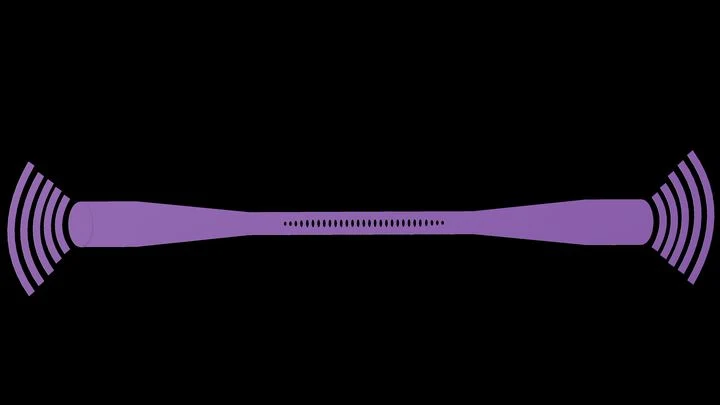
The periodic arrangement acts as a Bragg mirror in all directions: at each interface, lightreflections interfere destructively for certain wavelengths, canceling the forward wave. For frequencies inside the band gap, no propagating modes exist, so light is either reflected or, if a defect is introduced (like a missing rod or a line of altered holes), it becomes trapped in that defect and can only travel along it. This allows waveguides with bends that would normally leak light, or microcavities that confine light to volumes smaller than the wavelength.
In practice
Photonic crystals are used in optical fibers with a hollow core (photonic-crystal fibers), in compact laser cavities, and in integrated photonic circuits for routing light on chips.
Fun fact
The first photonic crystal operating at microwave frequencies was nicknamed 'Yablonovite' after its inventor, and it was made by drilling a triangular array of holes into a dielectric slab.
In a dark room, you can hold a glowing sphere without touching it: walls of light push it away but do not burn it. That is roughly how the trap built in Rio de Janeiro for yeast cells works. A conventional optical tweezer, that is, a focused laser beam, acts like tweezers made of light, but the light itself pierces the cell from side to side.
The laser beam in an optical tweezer is not just a spot of light but a force bag. A particle caught in it usually rolls toward the brightest point, like a ball into a dimple.
An ordinary light bulb is either on or off. But tiny glowing particles, nanocrystals with rare-earth ions, have so far emitted steady light, like small flashlights. Inside such a crystal, there are thousands of emitting ions, and even if one 'gets tired,' the others keep shining. Therefore, blinking, sharp on-and-off switching, was considered impossible for them.
You can make light turn on command, like water in a hose — if you know where to squeeze. That's what electro-optic circuits do: they change the direction of a beam inside a chip using an electric field. The classic material for such tricks is lithium niobate, a crystal that responds to voltage like a string to a pluck.
Waves on the water's surface usually break against any obstacle — a rock, a piling, an island. But what if you arrange obstacles so cleverly that the wave barely notices them? In a new study, scientists assembled a pattern of many points on the water, arranged according to special mathematical rules, and sent waves through them.
In an ordinary room, light vanishes the moment you switch off the lamp. In a tiny silicon nitride cavity, a photon can bounce between the walls 80,000 times before it gets lost. It's like a ball thrown into a room that rebounds off the walls with almost no loss of speed.
A flashlight beam aimed through frosted glass turns into a blurry spot with every extra millimeter of thickness. Scintillators, materials that convert X-rays into visible light, behave much the same way. They underpin medical imaging, baggage screening, and detectors at particle accelerators.
Light, discovered by Maxwell, behaves differently in different media. In a new study, researchers simulated a two-dimensional crystal that absorbs light and has magnetic properties. In it, light waves behave like passengers on a one-way escalator: they relentlessly move toward edges and corners, where they accumulate.
A light beam sent from Earth to a satellite scatters in the atmosphere, like a flashlight in fog. To keep the signal intact, you need short-wavelength light that spreads less. Such light is born in special crystals, but shrinking them to chip size is tough.
A random fiber laser is a thin glass thread through which light travels, but instead of reflecting off mirrors, it reflects off the tiniest irregularities in the fiber itself. Such a laser doesn't produce a steady beam: its light flickers and flares like a candle flame in a draft.
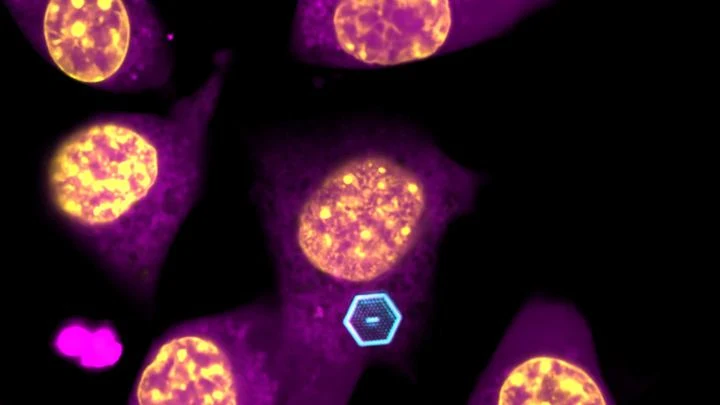
You can trap light in a cage smaller than a speck of dust. Photonic crystals are lattices that stop light from scattering and force it to run in circles. Previously, such structures were grown on a bulky substrate, making them too large for living cells.
A turnstile lets you through only forward, and not a step back. Physicists have implemented a similar principle on a tiny semiconductor chip for single photons — particles of light.
Light consists of portions — photons. Max Planck was the first to understand that light is emitted in quanta. Today, we can guide single photons. When such a photon encounters a fast shutter, it cannot be sliced — half a photon doesn't exist. Instead, a quantum mixture of states with different photon numbers emerges: zero, one, two, three..