A Cell in a Dark Trap: Dividing Without Photodamage ✛
Context
Optical tweezers have helped biologists hold and move individual cells for forty years. But the laser light that creates the trapping force is absorbed by living matter and can stop division or deform the cell. This work sits alongside studies of optical traps for atoms and microparticles, where the same problem of photodamage limits how long experiments can last. The authors took the idea of a dark trap, known from work with microparticles, and applied it to living cells, choosing a medium with the right refractive index.
Methods
The trap was assembled from three Gaussian beams with a wavelength of 780 nm, focused by an objective with a numerical aperture of 1.3. Each beam is offset from the center, so the cell is held in a region where light intensity is minimal. To make the light repel rather than attract the cell, the refractive index of the medium was made higher than that of the cell: iodixanol (Optiprep) was added to the YPG growth medium. For each cell, the positions of the three foci were adjusted individually, guided by the interference pattern shaped like a Maltese cross. Cell positions were tracked from video using the neural network YOLOv11s, trained on 500 labeled frames.
Results
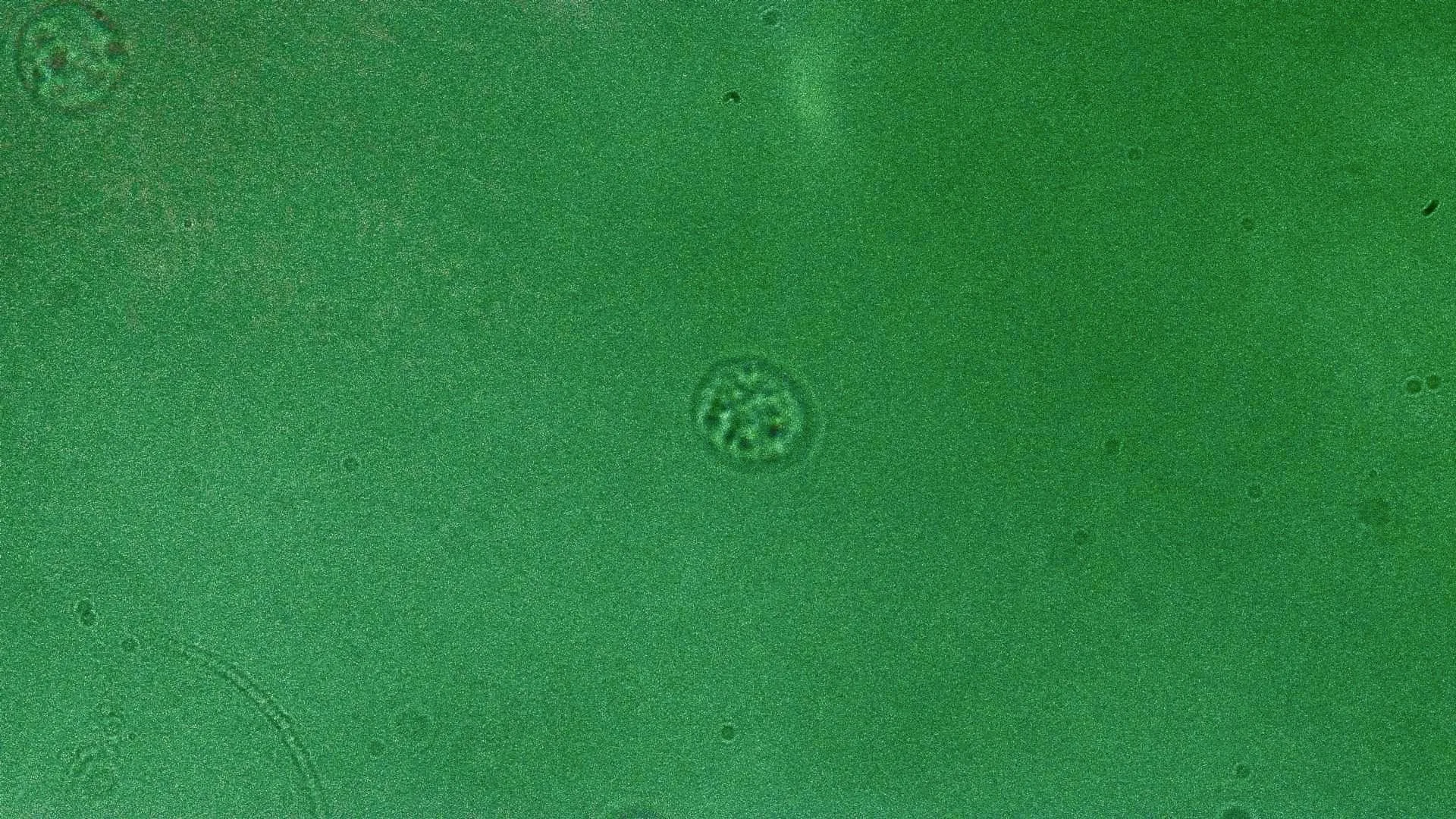
In the dark trap, yeast cells stayed at the center, and after the laser was turned off they scattered, confirming trapping. Over four hours of observation, cells in the dark trap went through a full budding cycle and divided, and the trapping duration (10 minutes, 1 hour, or 4 hours) did not affect the outcome. In a regular Gaussian tweezer at 30 mW, cells did not divide at all during the same time. The average growth curve for five cells in the dark trap showed a doubling in area, whereas in the Gaussian tweezer the area remained unchanged.
Implications
This work shows that a dark trap can hold living cells without noticeable harm to their life cycle. Unlike neighboring studies that used dark traps for nonliving microparticles or examined photodamage in regular tweezers, here cell division in a dark trap is demonstrated for the first time over several hours. This opens the possibility of long-term observations of division and development of individual cells under optical control.
Future development
The number of beams can be increased and the trap geometry adapted to cells of different types and sizes. Individual beams would allow controlled deformation of the membrane to study cell mechanobiology. Dark traps also hold promise for quantum experiments with levitating nanoparticles, where minimizing heating and photon recoil is crucial.
Impact
The method will be useful in cell biology, microbiology, and medical research where living cells need to be held for long periods without damage. It is also relevant for optomechanics and quantum sensors based on levitating particles.
Next steps
Test the trap on other cell types, such as bacteria or mammalian cells, and find suitable media for them. Investigate the effects of prolonged trapping (a day or more) on cell physiology.
Key open problems
In cell biology, an open question remains how long-term optical trapping affects gene expression and epigenetic changes. This work offers a tool that could separate the effects of light from those of the trap itself, but long-term consequences still need to be studied.
The knowledge machine's view
This section is addressed to the author of the paper and their colleagues. Neighbouring works were found by meaning-based search across our archive, not by word overlap. We do not review: we show the field around the work.
What the work does
The authors built a dark optical trap from three offset Gaussian beams, in which Saccharomyces cerevisiae yeast were held and allowed to multiply for four hours. They chose a medium with a refractive index higher than that of the cell so that light would push the cell away from high-intensity regions, and they tracked cell positions using the YOLOv11s neural network.
Where its strength is
The strength of this work lies in directly demonstrating long-term trapping of living dividing cells in a dark trap without noticeable photodamage, which opens the door to experiments previously limited by conventional tweezers.
Where it could go next
- One could examine how refractive index inhomogeneities inside the cell or its motion affect the stability of the dark trap, and adapt the light-control methods described in the work on light confined in a tiny trap.based on: Light Trapped in a Tiny Cage arXiv:2608.13261v1
- For more precise control of cell position and minimization of residual heating, it may be useful to study approaches to reducing laser phase noise discussed in the context of optical lattices.based on: Laser Beam Jitter Heats Atoms in a Trap arXiv:2608.07442v1
Worth trying
- Test whether the dark trap can hold cells at higher laser powers while maintaining viability.
- Use the dark trap for long-term observation of individual cells during differentiation or their response to external stimuli.
- Adapt the method for mammalian cells by selecting a suitable high-refractive-index medium.
Why this may matter
The ability to hold living cells without photodamage for several hours could substantially expand the toolkit for studying cell biology, enabling long-term experiments on individual cells under optical control.
Nearby works in our archive
- Laser Beam Jitter Heats Atoms in a Trapsimilarity 0.52
- Light Trapped in a Tiny Cagesimilarity 0.49
- Laser Capsule: Light That Bursts on Commandsimilarity 0.48
- Light That Twists Timesimilarity 0.48
- A Lens the Size of a Nanoparticlesimilarity 0.48
- Light from Within: How to See 12 Centimeters Deep into the Bodysimilarity 0.47
The archive is sparse around this work: the closest review is only 0.52, against a usual 0.64. It looks like few have drilled nearby.
Iodixanol, which was added to the medium, was originally developed as a contrast agent for X-ray imaging, and now it helps keep yeast in the dark.
In Arthur C. Clarke's novel 'Rendezvous with Rama,' an alien spacecraft uses light fields to manipulate objects; dark traps take a step toward such 'contactless' manipulation of living organisms.
Key numbers
- Laser wavelength: 780 nm
- Power of each beam: 100 mW
- Refractive index of medium: 1.401
- Observation time: 4 hours
- Cell diameter: 3–8 µm