A Magnetic Orchestra from Precipitates: How Fe6GeTe2 Nanoparticles Set a Record Curie Temperature ✛
Picture an orchestra in which violins and trumpets play different parts but together create a powerful sound. In a crystal of the layered magnet Fe5GeTe2 doped with nickel, tiny regions of a different phase, Fe6GeTe2 nanoprecipitates, take on the role of those instruments. It is they, not the nickel itself, that keep the material magnetic at 478 kelvin, that is, at 205 degrees Celsius. This is the highest Curie temperature among bulk van der Waals ferromagnets.
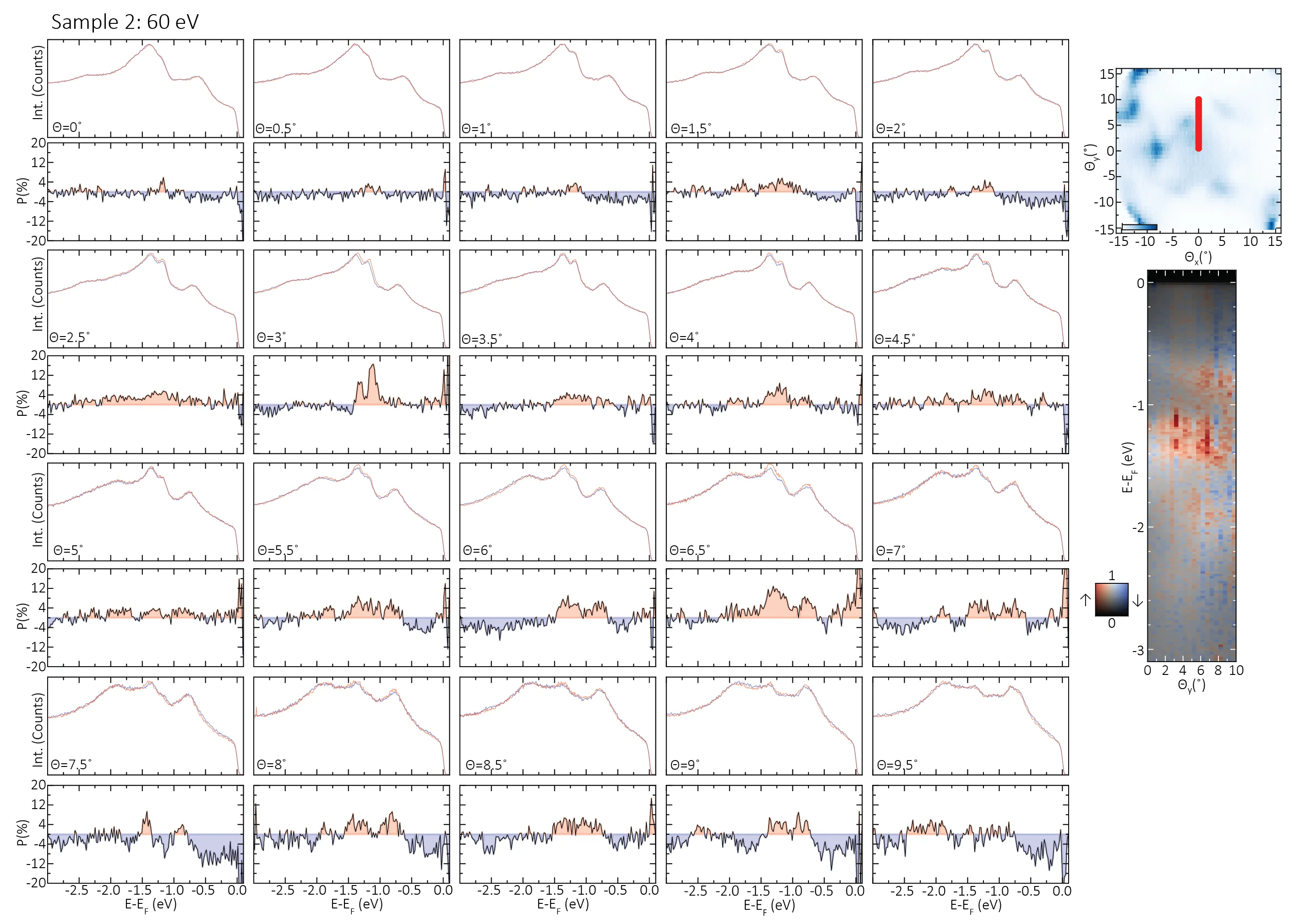
For a long time it was unclear why adding nickel, which is itself nonmagnetic in this system, raises the Curie temperature by more than 170 kelvin even though the overall magnetization drops. The authors examined the crystal from different angles: they probed it with an electron beam in a scanning transmission electron microscope, measured X-ray diffraction at a synchrotron, mapped magnetization with a resolution of about 10 nanometers, and even peered into the spin structure of electronic bands using spin-resolved photoemission. It turned out that in iron-rich domains all iron sites, including the usually half-empty Fe(1), are almost fully occupied. This is the Fe6GeTe2 phase, which in pure form sits on the edge of stability and until now had been grown only epitaxially, with a Curie temperature 25% lower.
So why does the Fe6GeTe2 phase precipitate spontaneously instead of forming a homogeneous alloy? First-principles calculations showed that substituting nickel at the Fe(1) site is energetically more favorable than at Fe(3) by 62 meV/f.u. And at nickel concentrations above 20%, clustering of nickel atoms becomes preferable to a homogeneous distribution. In other words, nickel atoms gather into clusters, leaving regions of pure Fe6GeTe2 that are stabilized by strain from the nickel-rich domains. The lattice parameter c for iron-rich domains is 2% larger than for nickel-rich ones, and the strain fields are oriented at an angle of 60° between domains.
Now the orchestra sounds in harmony. Previously it was unclear why adding nickel to Fe5GeTe2 raises the Curie temperature to a record 478 K even though the overall magnetization drops, and what role the observed phase separation plays. Now it is clear: the high Curie temperature arises from Fe6GeTe2 phase nanoprecipitates stabilized by strain, and within this phase different iron sites divide the functions. This mechanism opens a path to atomic engineering of van der Waals magnetic metals through control of nanoprecipitates, by analogy with classical metallic alloys, where nanoprecipitates have long been used to tune properties. The practical benefit is already visible: the method of controlling nanoprecipitates can be used to create van der Waals magnets with a desired Curie temperature and coercivity, which is important for spintronics and magnetic memory.
The Curie temperature of 478 K in (Ni0.36Fe0.64)5.38GeTe2 is the highest among bulk van der Waals ferromagnets, exceeding the Curie temperature of pure nickel (627 K) by almost 75%, even though nickel in this system is itself nonmagnetic. The resulting Fe6GeTe2 phase in pure form was predicted to lie at the boundary of thermodynamic stability, and until now it could only be grown epitaxially with a Curie temperature 25% lower than in the nanoprecipitates.
The idea of nanoprecipitates that stabilize an unusual phase and give the material record-breaking properties echoes the concept of 'smart dust' from science fiction, where microscopic particles collectively produce a macroscopic response. In Stanisław Lem's novel The Invincible, self-organizing microparticles create complex behavior, much like Fe6GeTe2 nanoprecipitates control the ferromagnetism of the entire crystal.