Magnetic orchestra from precipitates: how Fe6GeTe2 nanoparticles set a record Curie temperature ✛
Context
The family of layered magnets FeNGeTe2 (N=3–7) attracts attention due to ferromagnetism at technologically relevant temperatures up to room temperature and above. In the compound Fe5GeTe2, adding nickel paradoxically raises the Curie temperature by more than 170 K while simultaneously reducing the overall magnetization, which breaks the linear dependence of TC on magnetic moment density observed in the N=3–5 series. Previous studies revealed phase separation into mesoscopic iron-rich and nickel-rich regions, but their microscopic structure and role in enhancing ferromagnetism remained unknown. The work aligns with active research on doped van der Waals magnets, where neighboring studies examine the influence of cobalt, vacancies, and epitaxial interfaces on magnetic properties, yet none directly linked the high-temperature phase to a specific nanoscale precipitate or separated the contributions of different iron sites to local moments and band carriers.
Methods
The authors used a multilevel approach combining structural, magnetic, and electronic methods. Aberration-corrected scanning transmission electron microscopy (STEM) allowed determination of iron site occupancy in iron-rich and nickel-rich domains. High-momentum-resolution synchrotron X-ray diffraction on a single crystal revealed two sets of Bragg reflections corresponding to domains with different lattice parameters, and anisotropic peak broadening indicating directional strain fields. X-ray photoemission electron microscopy with X-ray magnetic circular dichroism (XPEEM-XMCD) on a cleaved surface covered with graphene provided maps of iron, nickel, and magnetization distribution with a resolution of about 10 nm. Scanning tunneling microscopy and spectroscopy (STM/S) at 4.2 K distinguished the electronic structure of the two domains via topography and differential conductance. Spin-resolved angle-resolved photoemission spectroscopy (SR-ARPES) at a synchrotron measured the spin polarization of bands near the Fermi level and deep valence states. All experimental data were compared with first-principles DFT+U calculations including spin-orbit coupling.
Results
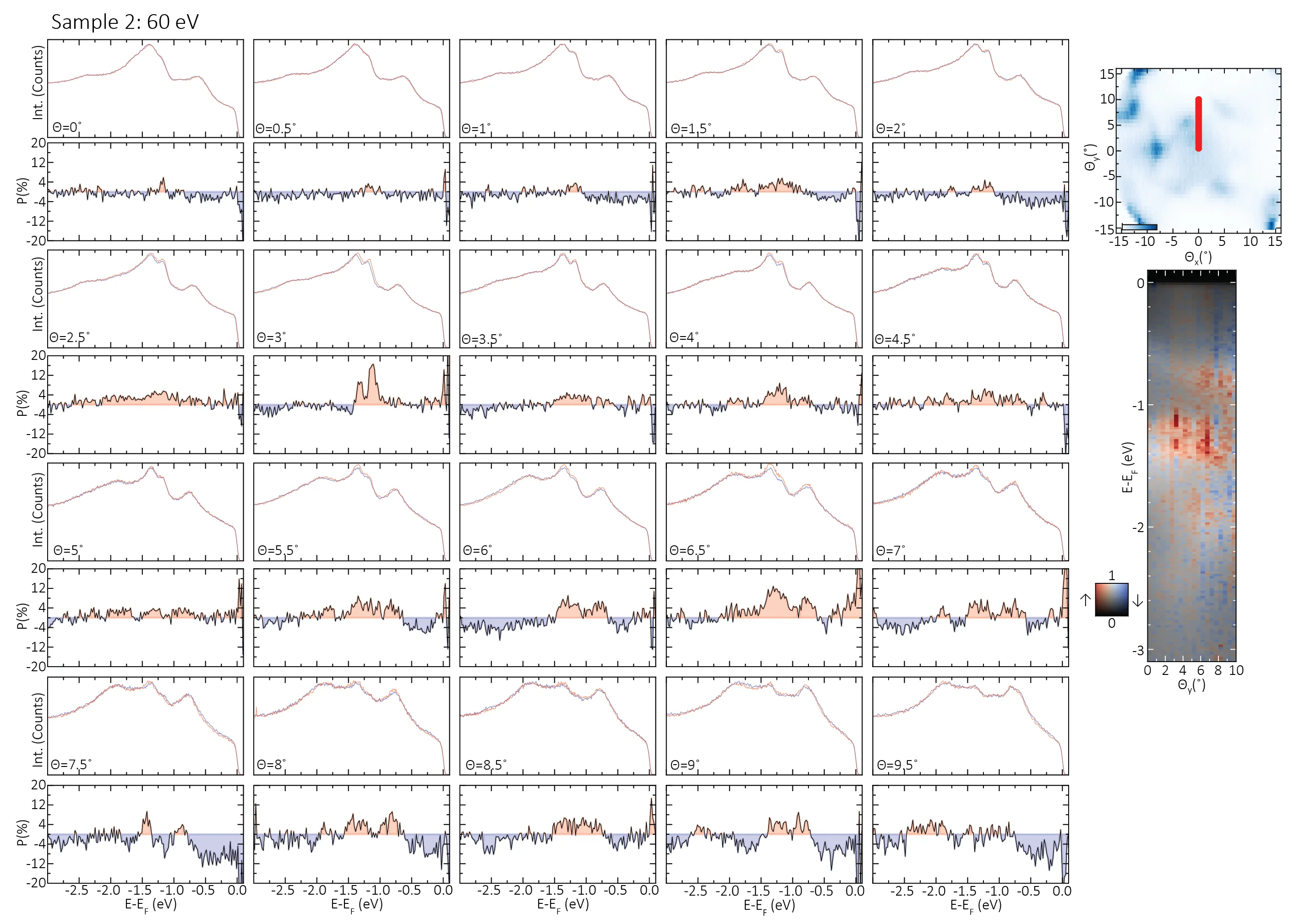
Main result: high-temperature ferromagnetism in (Ni0.36Fe0.64)5.38GeTe2 is caused by nanoscale precipitates of the Fe6GeTe2 phase, stabilized by strain from nickel-rich domains. STEM showed that in iron-rich domains all iron sites, including the usually half-empty Fe(1), are almost fully occupied, corresponding to the Fe6GeTe2 composition. Synchrotron diffraction revealed that the lattice parameter c for iron-rich domains is 2% larger than for nickel-rich ones, and strain fields are oriented at 60° between domains. XMCD maps demonstrated that magnetization is concentrated in iron-rich domains, and the correlation length of magnetic stripes is about 50 nm, four times smaller than the domain size. DFT calculations showed a sharp division of roles among iron sites: Fe(3) has the largest local moment (2.43 μB) and narrow bands, whereas Fe(1) has an almost zero moment (0.01 μB) but dominates the density of states at the Fermi level. Spin-resolved ARPES found coexistence of bands with opposite spin polarization: the β band has a polarization of ~8% (minority), the α band ~4% (majority), and deep valence states at binding energies of 1.4–1.9 eV are almost fully majority-polarized. Energy calculations showed that nickel substitution at the Fe(1) site is energetically more favorable than at Fe(3) by 62 meV/f.u., and at nickel concentrations above 20%, clustering of nickel atoms becomes preferable to homogeneous distribution, explaining the phase separation.
Implications
The work for the first time directly links the record Curie temperature in doped Fe5GeTe2 to a specific Fe6GeTe2 phase forming as nanoscale precipitates, and reveals the division-of-labor mechanism among iron sites: inner atoms create localized moments, while outer ones provide spin-polarized carriers that cross the van der Waals gap. This differs from neighboring studies that either examined doping effects on magnetic properties without identifying the microscopic structure, or considered pure phases without accounting for nanoscale precipitates. Here it is shown for the first time that nanoscale precipitates can stabilize a phase unattainable in bulk form, and that such stabilization is accompanied by a unique electronic landscape with selective contributions from different sites. The results establish a bridge between van der Waals magnets and classical metallic alloys, where nanoscale precipitates have long been used to control properties.
Future development
Further research could aim to control the size, shape, and distribution of Fe6GeTe2 nanoscale precipitates through controlled annealing or stoichiometry changes, which would allow tuning of coercivity and other magnetic characteristics. It is possible to study other dopants, such as cobalt or manganese, to create new phases with even higher Curie temperatures or different magnetic textures. Also promising is investigating the influence of crystal thickness and interfaces on the stability of nanoscale precipitates, which could lead to thin-film devices with tailored magnetic properties. On a fundamental level, the role of strain fields in the formation and dynamics of magnetic domains remains an open question.
Impact
The results will influence the development of spintronic devices based on van der Waals materials, where a high Curie temperature and controllable magnetization are required. The methodology combining microscopy, diffraction, and spin-resolved photoemission can be applied to other layered magnets to reveal hidden phases and their role in macroscopic properties.
Next steps
The immediate step will be a systematic study of how annealing conditions affect the size and density of Fe6GeTe2 nanoscale precipitates and how these parameters correlate with Curie temperature and coercivity. It is also important to check whether the division-of-labor mechanism among iron sites persists in thin films and heterostructures based on Fe5GeTe2.
Key open problems
The work directly addresses a long-standing problem in magnetic materials physics: how to achieve a high Curie temperature in systems with reduced dimensionality and how to reconcile local moments with band carriers. In the context of van der Waals magnets, it shows that nanoscale precipitates can serve as a tool to overcome limitations related to two-dimensionality and to create materials with record characteristics. This opens a path to solving the more general task of atomic engineering of magnetic properties through control of phase composition at the nanoscale.
The knowledge machine's view
This section is addressed to the author of the paper and their colleagues. Neighbouring works were found by meaning-based search across our archive, not by word overlap. We do not review: we show the field around the work.
What the work does
The work uncovers the microscopic mechanism behind a record-high Curie temperature (478 K) in a metallic van der Waals magnet, (Fe,Ni)5+δGeTe2. By combining transmission electron microscopy, synchrotron diffraction, photoemission microscopy, and spin-resolved ARPES with first-principles calculations, the authors show that nanoscale precipitates of the Fe6GeTe2 phase play the key role. Inside these precipitates, three inequivalent iron sites serve different functions: the inner Fe(3) atoms create localized magnetic moments, while the outer Fe(1) atoms generate spin-polarized carriers that cross the van der Waals gap. The energetic favorability of nickel clustering explains why the Fe6GeTe2 phase precipitates spontaneously instead of forming a homogeneous alloy.
Where its strength is
The strength of the work lies in disentangling the contributions of different iron sites to local moments and band carriers, which links the high-temperature phase to a specific nanoscale precipitate and opens a path to atomic engineering through control over such precipitates.
Where it could go next
- It might be interesting to see how similar nanoscale precipitates affect magnetic properties in other doped van der Waals magnets, for example when cobalt is added. Our archive contains a nearby paper on the magnetic alloy Co₂FeGe, where phase coexistence is also observed, but with a different electronic structure.based on: Magnetic Co₂FeGe Alloy: A Metal with Two Faces arXiv:2505.24836
- The idea of tuning magnetic properties through nanoscale precipitates echoes research on epitaxial interfaces and strain. It may be worth considering how the substrate or mechanical stress influences the formation and stability of Fe6GeTe2 precipitates in thin films.based on: Metal from a Failed Reactor: What the Uranium-Iron Alloy Hides arXiv:2607.02918
- The record-high Curie temperature makes this material promising for room-temperature applications. The archive includes a paper on a van der Waals magnet that operates at room temperature in logic devices; it may be worth exploring the integration of Fe6GeTe2 into similar heterostructures.based on: Logic without a field: a van der Waals magnet computes at room temperature arXiv:2609.04600v1
Worth trying
- Test whether the size and distribution of Fe6GeTe2 precipitates can be controlled through synthesis parameters (cooling rate, annealing) to optimize magnetic properties.
- Use spin-resolved ARPES with higher energy resolution to trace in detail the dispersion of spin-polarized bands near the Fermi level and their relationship to local moments.
- Run DFT calculations for various precipitate and interface configurations to predict the optimal morphology for the highest Curie temperature.
Why this may matter
Understanding the microscopic mechanism behind the record Curie temperature in an accessible, technologically viable material could accelerate the development of spintronic devices that operate at room temperature and above, without relying on rare-earth elements.
Nearby works in our archive
- Tiny Magnets with a Fiery Coresimilarity 0.54
- Cold from Iron: How a Cheap Alloy Replaces Rare-Earth Magnetssimilarity 0.52
- Magnetic Co₂FeGe Alloy: A Metal with Two Facessimilarity 0.52
- Turning Heat into Electricity: An Iron-Silicon Filmsimilarity 0.51
- An Atom-Thick Magnet: Power in a Single Layersimilarity 0.51
- Logic without a field: a van der Waals magnet computes at room temperaturesimilarity 0.51
- Metal from a Failed Reactor: What the Uranium-Iron Alloy Hidessimilarity 0.50
The archive is sparse around this work: the closest review is only 0.54, against a usual 0.64. It looks like few have drilled nearby.
The Curie temperature of 478 K in (Ni0.36Fe0.64)5.38GeTe2 is the highest among bulk van der Waals ferromagnets, exceeding the Curie temperature of pure nickel (627 K) by almost 75%, even though nickel in this system is itself nonmagnetic. The resulting Fe6GeTe2 phase in pure form was predicted to lie at the boundary of thermodynamic stability, and until now it could only be grown epitaxially with a Curie temperature 25% lower than in the nanoscale precipitates.
The idea of nanoscale precipitates that stabilize an unusual phase and give the material record properties echoes the concept of 'smart dust' from science fiction, where microscopic particles collectively produce a macroscopic response. In Stanisław Lem's novel 'The Invincible', self-organizing microparticles create complex behavior, similar to how Fe6GeTe2 nanoscale precipitates control the ferromagnetism of the entire crystal.
Key numbers
- Curie temperature: 478 K
- correlation length of magnetic stripes: 50 nm
- difference in lattice parameter c between domains: 2%
- local moment of Fe(3): 2.43 μB
- local moment of Fe(1): 0.01 μB