Magnetic memory is the property of a magnetic material to retain its magnetization state after the external field that set it is removed. This hysteresis—the lag between input and output—is what makes permanent magnets permanent and is the physical basis for all magnetic data storage. Without it, a hard drive would forget everything the moment the write head moved away.
History
The term 'hysteresis' was coined by James Alfred Ewing in 1881, who studied magnetic lag in iron. The first practical magnetic recording used steel wire in the late 19th century, but the modern understanding of retention as an energy-barrier problem emerged with the work of Louis Néel in the 1940s.
How it works
When an external field aligns magnetic moments, the material's energy landscape has multiple local minima separated by energy barriers. After the field is removed, thermal fluctuations can push moments over these barriers, causing relaxation. If the barriers are high compared to thermal energy (k_B T), the state persists for a long time. The coercivity—the field needed to flip the magnetization—quantifies this stability. Materials with high coercivity (like neodymium magnets) retain strong magnetization; low-coercivity materials (like soft iron) lose it easily.
In practice
Magnetic memory is the foundation of hard disk drives, magnetic tape, and magnetic random-access memory (MRAM), where bits are stored as magnetization directions.
Fun fact
The Earth's magnetic field itself is a form of magnetic memory: rocks record the field direction at the time they cool, giving geologists a history of plate tectonics and pole reversals.
Imagine a book with latches on its pages: you can only flip a page if you know how to click its edge. That is roughly how the mechanical metamaterial we are about to discuss works. Each cell is a small mass inside a larger one, connected by an elastic beam. The beam can sit in two stable positions, like a switch.
Inside an MRI magnet, current flows through a closed superconducting loop, like water circling in a bucket after you give it a spin, it just keeps going on its own. To change that current, you heat the loop with a small heater: it stops being superconducting, becomes an ordinary resistor, and then an external source can 'top up' or 'draw off' current.
In a hot mug, water sometimes freezes faster than in a warm one. This paradox is over half a century old and is called the Mpemba effect. It is usually attributed to fluid motion or evaporation. Now physicists have shown that a similar trick is possible without water, just through radiation of heat.
An ordinary phone battery breathes — not with air, but with contact. Inside a solid body, where there are no liquids, lithium presses against the electrolyte (the ion-conducting substance) during charging and pulls away during discharging, like a lung on inhale and exhale. This 'breathing' is not poetry but physics: each cycle creates and destroys the contact points through which current flows.
An ordinary flash drive in your pocket gets warm even when it's just sitting there. Now imagine memory that, in the cold, uses almost nothing, like a thermos that never cools down. A superconductor carries current without loss at liquid-helium temperatures, but it couldn't store data. The new cell changes that.
Ordinary computer memory constantly uses energy to store ones and zeros. Superconductors, on the other hand, carry current with zero loss — if you could build memory from them, it would barely draw any power. The catch is that superconductors can't remember: their state changes too easily.
Uranium ditelluride crystals turned out to be the exception.
Erasing a single bit of information isn't free. In 1961, Rolf Landauer showed that at room temperature, it takes at least about 3 zeptojoules of energy — a tiny but nonzero amount. This limit was considered as ironclad as the conservation of energy.
But what if you could give the system a little nudge?
Ordinary computer memory constantly consumes energy to avoid forgetting what's stored. A superconductor could store data without loss, but it's hard to make it switch.
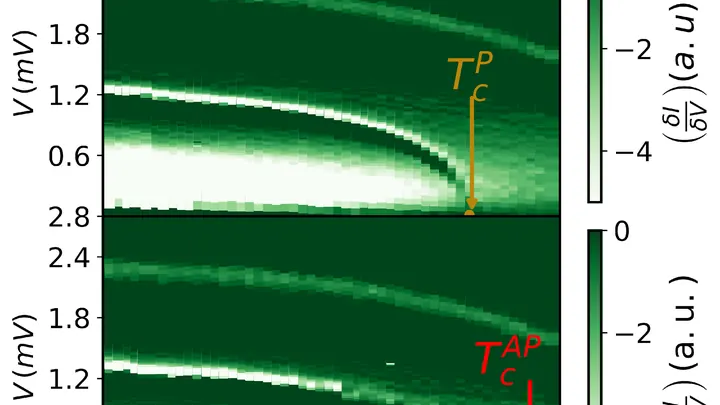
In the new work, a superconductor is sandwiched between two magnetic insulators.
Gravity works like an invisible photographer. When a piece of metal falls, inside it, according to Albert Einstein and the electromagnetism of James Clerk Maxwell, an electric field is born — that's how spacetime curvature…