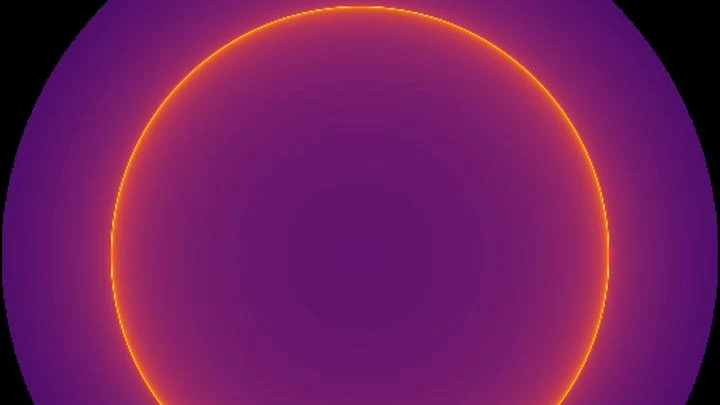
A Bardeen black hole is a theoretical model of a black hole that avoids the central singularity—a point of infinite density—by having a smooth, regular core. Instead of collapsing to a point, the matter is spread out over a small region, and the spacetime curvature remains finite everywhere. This model was proposed to address the breakdown of physics at singularities, suggesting that quantum gravity effects might prevent their formation.
History
The model was introduced by James Bardeen in 1968, who proposed it as a regular black hole solution, though it was initially considered a mathematical curiosity.
How it works
In general relativity, a black hole's singularity is hidden behind an event horizon. The Bardeen model modifies the metric (the mathematical description of spacetime) by introducing a magnetic charge or a similar parameter that acts as a cutoff, smoothing the gravitational field at very small distances. This solution satisfies the Einstein equations but requires the energy-momentum tensor to violate certain energy conditions, meaning the matter has exotic properties like negative pressure.
In practice
Bardeen black holes are used in theoretical studies of quantum gravity and as testbeds for understanding the information paradox and the nature of spacetime singularities.
Fun fact
The Bardeen black hole is often called a 'regular black hole' because it has no singularity, but it still possesses an event horizon, making it a black hole in the traditional sense.
The idea was elegant: take a BTZ black hole (the three-dimensional analog of a regular black hole) and smooth its horizon with a special function. The hope was that inside, the spacetime signature might change — time becoming space, and space becoming time. But the calculations showed otherwise.
An old house. The facade is freshly painted, the stairs don't creak. A pretty picture. But try to move in heavy furniture, and the floorboards give way. The beauty of the facade says nothing about the strength of the floors.
It's much the same with black holes without singularities.
A campfire burns steadily and long. But when the wind blows, the flame flickers out, leaving only embers. A similar story plays out with the gravastar — a hypothetical object that was supposed to replace the black hole.
An ordinary black hole hides a singularity — a point where the laws of physics break down.
Light passing near a massive body slightly changes its path — gravity pulls even on rays. In ordinary situations, a beam of light from a distant star is squeezed as if drawn together by an invisible rubber band. This property is called the null convergence condition: gravity makes light trajectories converge rather than diverge.
At the center of many galaxies lurks an invisible halo of dark matter: it holds the stars at the edges, keeping them from flying apart. For a long time, it was described as a dilute gas of particles, but new work offers a different view: dark matter might gather into a quantum droplet.
In the quantum world, dark matter particles can merge into a single superfluid droplet — a state where matter flows without friction, like an ideal fluid. When near a black hole, this droplet doesn’t just disappear into it but twists into stable vortices, like water swirling around a rock in a stream.
Drop a pebble into a well, and the sound tells you its depth. That's roughly how astrophysicists listen to black holes: after a merger or other disturbance, the hole vibrates, emitting gravitational waves. The frequency and damping of this 'ring' depend on what's inside the hole.
Two heavy balls orbit on the surface of a pond. Ripples spread from them: these are gravitational waves. As the balls spiral closer, the waves carry away energy, and the ripples become more frequent.
You can picture a black hole as a whirlpool in a river: it has an edge, the event horizon, beyond which the current drags everything in irreversibly. At the center lurks the singularity, a point where the familiar laws break down.
When a star burns out and collapses under its own weight, the space around it crumples into a black hole. At the center, according to textbooks, lurks a singularity — a point where density becomes infinite and the laws of physics break down.
A translator retells a complex novel in another language, but only if the plot stands still. Once the characters start moving, the translator loses the thread. That's roughly how the 'double copy' worked — a method linking gravity and electricity. Until recently, it could only handle static black holes, where time plays no role.
Classical black holes, regions of spacetime with gravity so strong that even light cannot escape, according to general relativity, hide a singularity at their center: a point of infinite density and curvature where the known laws of physics break down.
Dark energy is usually seen as an innate property of the cosmos, at work from the very first moments. But a new model suggests it behaved like water on the verge of boiling: long unnoticed, then suddenly kicking in at a critical moment. This scenario is called 'late activation': around 5–7 billion years ago, a shift occurred, and the universe’s expansion began to accelerate.