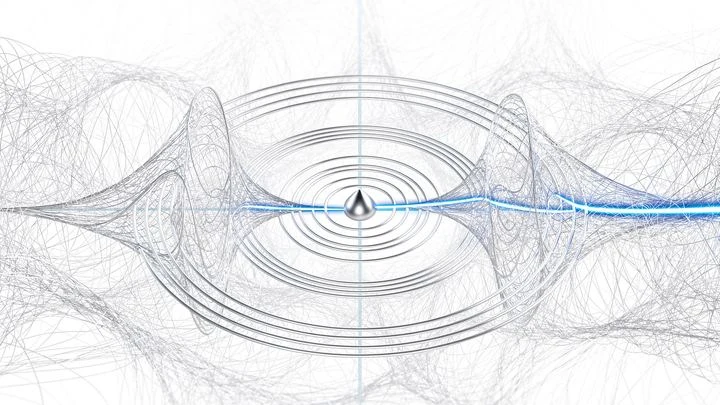
In 1961, Eugene Gross and Lev Pitaevskii independently derived the equation that became the main tool of ultracold atomic physics. In a Bose–Einstein condensate, thousands of particles occupy a single quantum state, forming a macroscopic wave. The equation resembles the Schrödinger equation of quantum mechanics, but with an important addition: a term describing the 'friction' of particles against each other (nonlinearity). Thanks to it, quantum vortices—tiny whirlwinds that align themselves into neat lattices—are born in the condensate. By solving the equation, physicists predict such patterns and verify them in experiments with rubidium, sodium, and potassium.
History
The equation was proposed in 1961 independently by Eugene Gross and Lev Pitaevskii. Gross proceeded from a kinetic approach to superfluidity, Pitaevskii from methods of quantum field theory. Both sought to describe the coherent behavior of many Bose particles. For a long time the work remained a theoretical curiosity, but in 1995, when Eric Cornell, Carl Wieman, and Wolfgang Ketterle first obtained a Bose condensate in a dilute gas (rubidium, sodium), the GP equation instantly became indispensable. Today it serves as the basis for modeling superfluid systems, atom lasers, and quantum simulators.
How it works
The equation is solved numerically to calculate the shape and dynamics of a condensate in traps, the interference of two condensates, and the formation of vortex lattices. It is valid for weakly interacting, dilute condensates at temperatures well below the critical temperature (typically nanokelvins). At higher temperatures or stronger interaction, one must account for thermal clouds and three-body losses, which go beyond the mean-field approximation.
In practice
It is used to design atom lasers and calculate the properties of superfluid helium—a liquid that can flow without friction through the finest capillaries.
Fun fact
If you 'pinch' a condensate with a focused laser beam, solitons—solitary waves that do not spread out over time—will run along it. It is as if a stone thrown into a pond produced not ripples, but a single hump gliding across the water unchanged.
A vacuum cleaner sucks in dust even if there is more of it near the nozzle. The same happens in a tokamak: plasma particles are drawn toward the center, even though their density is higher at the edge. This phenomenon is called particle pinch, and it contradicts the usual rule that everything tends to move from dense regions to sparse ones.
A wave packet is like a traveler who either loses steam and spreads out along the way, holds a steady pace, or gathers into a fist. In a 50-meter flume with water 5 meters deep, scientists tracked how a bell-shaped group of waves behaves when its height is changed but not its width.
If you push water in a narrow channel too fast, a steep wave forms and breaks into foam. In the world of ultracold atoms, cooled to near absolute zero, quantum laws prevent such a wave from breaking. Physicists took a cloud of rubidium atoms stretched into a thin thread and sharply compressed it from one end with a movable wall of light.
A chef tastes tiny morsels from different edges of the plate and tries to reconstruct the recipe of a complex dish. Each morsel offers only a hint of flavor, and the samples are a bit blurred — too much salt here, not enough sugar there. That's roughly how nuclear physicists study the matter inside neutron stars — the densest objects in the universe after black holes.
When two atomic nuclei smash together, a tiny fireball is born. It lives for an instant, but inside, entire epochs pass: compression, heating, expansion. Physicists have learned to eavesdrop on this process, and their "microphone" is the pairs of electrons and positrons that fly out of the ball at different stages.
In the new work, two scenarios were compared.
A black hole isn't just a cosmic vacuum cleaner. If it rotates, it can amplify waves around it, much like a mountain echo repeats sound. For ultralight dark matter (particles billions of times lighter than an electron), this effect, called superradiance, can create a huge cloud.
At the center of attention is a monopole, a special clump of a non-Abelian field (a field where the order of operations changes the result), resembling a magnetic charge without a pair. In this work, it is placed in curved spacetime described by Einstein's equations with a Gauss-Bonnet addition (a correction important at small distances).
89 milliseconds. That's how long a vortex avalanche lasts that abruptly speeds up the rotation of the Vela pulsar — one of the most famous 'glitching' pulsars. Pulsars are rapidly spinning neutron stars born in the collapse of supernovae.
In a quiet room, you can hear the faintest whisper. Likewise, in the hydrogen atom, the lightest of all, an uninvited guest is easier to spot. That guest could be the Z' boson, a mediator particle of a new force predicted by many unification theories. The Standard Model already has its own mediator — the Z boson.
Plasma is not just hot gas; it's an entire orchestra of charged particles, each group playing its own part. Heavy ions (atoms that have lost electrons) set the slow rhythm, while light electrons dart around ten thousand times faster.
The most abundant construction material on Earth, concrete, hides its deepest secrets at nanometer scales. Its strength and tendency to creep slowly under load are governed by a microscopic gel of calcium silicate hydrate (C-S-H), whose structure is as chaotic as a frozen vortex of atoms.
In 1984, the world of crystallography was turned upside down: sharp diffraction peaks with fivefold symmetry were discovered in an alloy of aluminum and manganese – as if nature had mocked the strict theorems forbidding repeating patterns from having axes of order 5, 8, 10, or 12.
At the center of many galaxies lurks an invisible cloud — a halo of dark matter. If this matter is cold and light enough, it behaves like a superfluid: it flows without friction, and any rotation in it twists into tiny quantum vortices — threads the size of an atomic nucleus.
An endless ocean where every wave carries information about what happens in the depths. That is roughly how our Universe works under the holographic principle: the physics inside a volume can be described by processes on its boundary.
At temperatures billionths of a degree above absolute zero, a Bose–Einstein condensate emerges — a state where thousands of atoms march in a single quantum key.
A regular object moves along a predictable path, like a ball. In the quantum world, a particle is smeared into a probability cloud. To find order in this fog, scientists have recast Schrödinger's equation in the language of flowing water.
A lone potassium atom enters a dense cloud of sodium atoms cooled to near absolute zero. Such a medium is called a Bose–Einstein condensate — all particles merge into a single quantum wave. One might expect the impurity to simply pick up a single neighbor and form a pair. But the experiment showed something else.
A quantum system is like an island gradually eroded by the ocean. The waves, representing environmental influence, wash away the shores, stripping the island of its unique contours. The GKLS equation (Gorini–Kossakowski–Lindblad–Sudarshan) describes exactly how quickly this 'quantumness' fades.
But every wave has an energy source.
In the quantum world, particles can merge into a single liquid that flows without friction. One of its most mysterious forms is the fractional quantum Hall liquid. In it, electrons or atoms move as a single vortex, and their charge splits into fractions, like a pie cut into perfectly equal slices.
Picture a pot of boiling soup, but every grain in it is not just a point but a tiny top spinning around its own axis. That's the world of spin-1 particles. For example, some short-lived mesons born in accelerator collisions.
At the center of many galaxies lurks an invisible halo of dark matter: it holds the stars at the edges, keeping them from flying apart. For a long time, it was described as a dilute gas of particles, but new work offers a different view: dark matter might gather into a quantum droplet.
The early universe expanded at an unimaginable rate — faster than light could cross it. In this boiling cauldron, any region of space resembled an open can of paint: its boundaries continuously captured new 'vapor' from outside, while some of its own contents irrevocably escaped.
A pot of water always boils the same way: hit 100 degrees and bubbles start. Quantum fluids are different. When a cloud of atoms is cooled to near absolute zero, it can turn into a single matter wave — a Bose–Einstein condensate. But the transition itself, it turns out, can happen in three different ways.
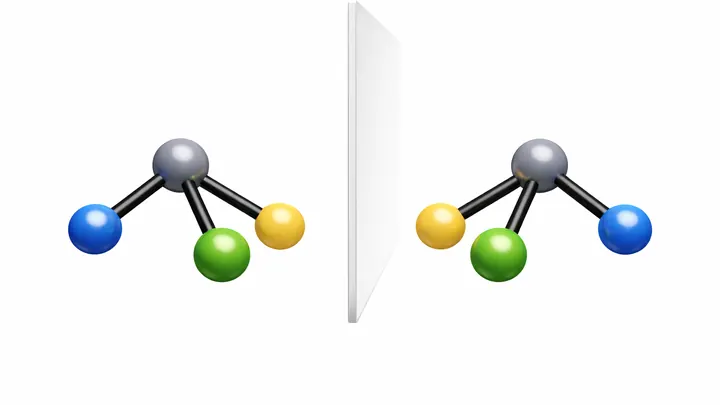
Many molecules, like gloves, come in left- and right-handed versions. Their energy difference, caused by the weak interaction, is minute, like a whisper in a noisy room. Physicists have figured out how to turn that whisper into a chorus. A mixture of precursor molecules in an ultracold gas yields mirror-image pairs.
Spacetime flows like a river, and a black hole is a whirlpool. Particles in this flow are like waves with their own rhythm: alternating crests and troughs. It turns out the whirlpool shifts the wave's rhythm from a distance, without even sucking it in.
In the quantum world, dark matter particles can merge into a single superfluid droplet — a state where matter flows without friction, like an ideal fluid. When near a black hole, this droplet doesn’t just disappear into it but twists into stable vortices, like water swirling around a rock in a stream.
The universe is not a solid monolith, but a canvas of countless quantum threads. Spacetime doesn't flow like water, but vibrates like a tapestry in the wind. For a long time, physicists only saw the overall pattern, neglecting the tremor of individual threads.
A drop of honey spreads slowly across a table, while water spreads quickly. The resistance to flow, viscosity, differs from one fluid to another. But what if the viscosity changes on the fly, as the substance compresses or expands?
Sometimes an unwelcome guest sneaks into the equations, like a creaky floorboard that unsettles the whole house. In gravity theories, if you add curvature-squared terms to the equations (which you need to describe very strong fields), a ghost particle appears — heavy but with negative energy.
A tightrope walker steps along a taut wire. Each step is a search for balance, an instant calculation of forces. In much the same way, Einstein's equations describe how matter and energy cause spacetime to curve.
A pot of water has just been stirred: the whirlpools and eddies gradually calm down, and the liquid becomes smooth. A similar process, but in the quantum world, occurs in superfluid helium or in a cloud of ultracold atoms.
A distant orchestra plays a symphony, but the recording is full of noise. The melody is written for two instruments, yet a third voice seems to break through the static — quiet and unfamiliar. This is how astrophysicists listen to gravitational waves, trying to catch the slightest deviations from Einstein's predictions.
Picture two choirs in soundproof rooms on a wobbly stage. They sing, but can't hear each other — the air doesn't carry the tune. Yet if the stage trembles, its vibrations link their songs. That's the idea behind a new test for quantum gravity.
A drop of ink in a glass of water spreads evenly, but in a cup with chunks of fruit jelly, the ink will take winding paths — sometimes getting stuck, sometimes slipping through. Similarly, molecules in living cells or porous materials don't move on a smooth field but through a disordered medium: denser in some places, thinner in others.
A cold cloud of atoms is like a swarm of fireflies drawn to one another. The attraction between atoms tries to pack them into a single dense ball. But quantum jitter, the unavoidable motion of particles, keeps the ball from collapsing. When the attraction is strong, the cloud breaks into separate clumps.
A thrown stone falls with acceleration, and from the fall time you can calculate the force of gravity. Scientists repeat this experiment with a cloud of atoms cooled to near absolute zero. Such a cloud falls in a vacuum chamber, and laser pulses split its waves, like light in an interferometer.
Water in a cup cools down in minutes. Gas in a room spreads evenly in seconds. But if you trap atoms in a tube as thin as a laser beam and give them a good kick, they will take several seconds to "cool" toward equilibrium — an eternity by atomic standards.
In an orchestra where every musician plays the same note, the sound merges into a powerful unison. This is how a Bose–Einstein condensate is born: many boson particles at extremely low temperatures behave as a single entity.
Magnetic waves in an ultracold gas behave like elastic cords. Two or three such cords can twist into a single knot that breathes: it contracts and expands, but never unravels. For the first time, scientists assembled such knots in the lab and confirmed that their breathing matches calculations exactly.
The gas consisted of two atomic species that do not mix, like oil and water.