Light-induced superconductivity is a phenomenon where exposing certain materials to intense, brief pulses of light can temporarily make them superconduct — conduct electricity with zero resistance — at temperatures far above their normal transition point. This is not the same as conventional superconductivity, which requires cooling materials to extremely low temperatures; here, light energy briefly reorganizes the material's electrons into a paired state that flows without loss. The effect is particularly striking in materials like fullerenes (carbon spheres) and cuprates, where light can trigger superconductivity at or near room temperature, albeit only for picoseconds.
History
The concept gained prominence in the 2010s, with experiments by Andrea Cavalleri's group at the Max Planck Institute for the Structure and Dynamics of Matter demonstrating light-induced superconductivity in cuprates and fullerenes. The specific mechanism for fullerenes was proposed and tested around 2023–2024.
How it works
In a superconductor, electrons form Cooper pairs that move coherently without scattering. Normally, this pairing is mediated by lattice vibrations (phonons) and only occurs at low temperatures. Light pulses can transiently excite the material's lattice or electronic structure, creating a new configuration where pairing is much stronger. For example, in fullerenes, mid-infrared light pulses can distort the molecular lattice, enhancing the coupling between electrons and phonons enough to allow pairing at higher temperatures. The effect is fleeting — the superconducting state decays within a few picoseconds — but it reveals pathways to room-temperature superconductivity that are inaccessible through static conditions.
In practice
While the effect is too short-lived for direct technological use, it informs the search for materials that could sustain superconductivity at room temperature, potentially revolutionizing power transmission and magnetic levitation.
Fun fact
In some experiments, light pulses have induced superconductivity in fullerenes at temperatures as high as 100 K, which is about 40 K above their normal superconducting transition temperature.
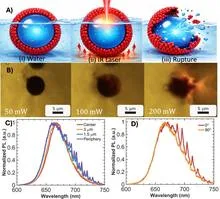
A tiny capsule, like a soap bubble but with a shell of glowing crystals, behaves like a laser. While its wall is intact, light circulates, amplifies, and escapes as a narrow, bright beam. Once the wall bursts, the beam turns into a dim spot. Such a capsule is a colloidosome, and it can change its glow on command.
Light from many tiny emitters — atoms or artificial "quantum dots"—usually scatters in all directions, like a crowd where everyone shouts on their own. But if you make them "sing in chorus," the flash becomes many times brighter.
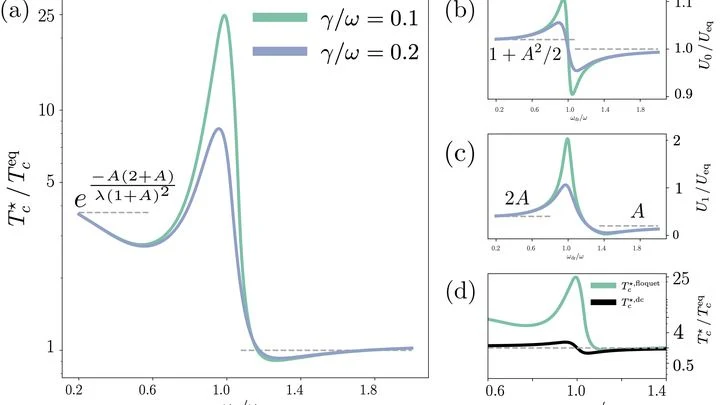
An ordinary superconductor works only in nature's freezer — at temperatures below minus one hundred degrees. The carbon-ball material K₃C₆₀ is no exception: without cold, it resists current like a crowd in a narrow corridor. But physicists noticed something strange: if you shine a laser on it, it starts conducting without loss even in warmth.