Laser Capsule: Light That Bursts on Command ✛
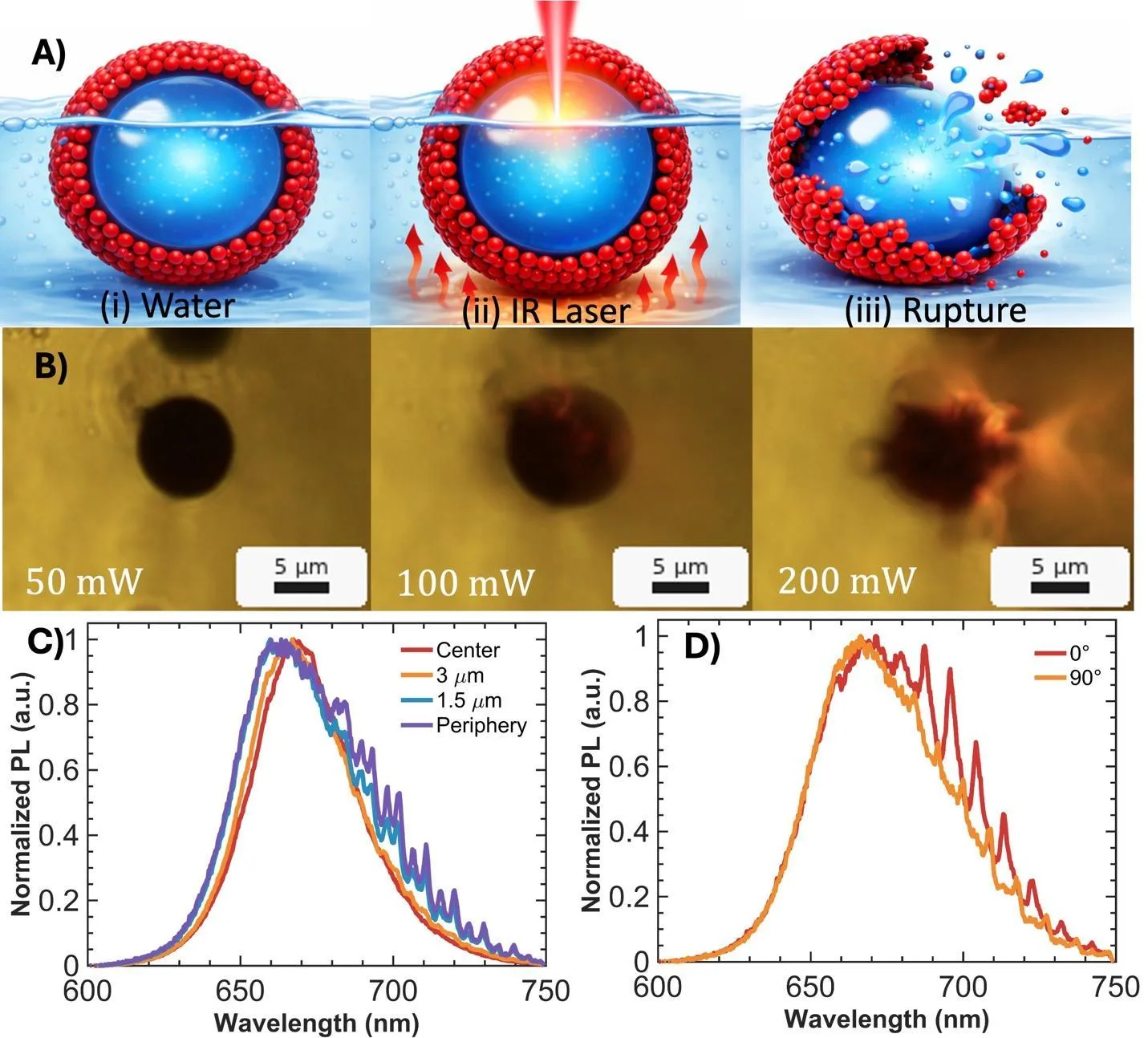
A tiny capsule, like a soap bubble but with a shell of glowing crystals, behaves like a laser. While its wall is intact, light circulates, amplifies, and escapes as a narrow, bright beam. Once the wall bursts, the beam turns into a dim spot. Such a capsule is a colloidosome, and it can change its glow on command.
The capsule's shell was assembled from quantum dots quantum dots. Inside is a drop of oil. While the shell is continuous, light entering it reflects off the walls and runs in a circle, like sound in a circular gallery. This is called a whispering-gallery mode. If the wall cracks, light no longer circulates and scatters in all directions.
There are three ways to break the capsule: dry it, heat it, or shine an infrared laser on it. When heated, the rupture temperature depends on the oil molecule length: the longer the molecule, the lower the temperature. For oil with 18 carbon atoms, the shell bursts at just 23 °C—a bit warmer than room temperature.
Before this work, it was unclear whether a thin shell could confine light well enough for lasing when the core is liquid rather than solid. It turns out it can: an intact capsule emits a narrow laser beam with a threshold of 2.8 mJ/cm². After rupture, the laser emission disappears, replaced by a broad band.
Such switchable microlasers could find use in bioimaging, sensing, and labeling. And controlled release of contents opens the door to targeted delivery of substances at the microscale. A capsule that bursts on command is not just a beautiful experiment but also a tool for precise work with light and matter.
The colloidosome shell occupies only 17% of the volume of an equivalent solid sphere, and requires 83% fewer quantum dots. Yet lasing is preserved because light circulates precisely along the shell.
The idea of a microcontainer that releases its contents on command evokes drug capsules from science fiction, such as those in the series 'Star Trek'. Here, instead of a drug, we have quantum dots, and the signal is an infrared laser beam.