Quantum Dot Colloidosomes: A Laser That Breaks on Command ✛
Context
Miniature lasers made of quantum dots are usually assembled into dense spheres, or supraparticles. Their optical properties are fixed once and for all: size, composition, geometry. Retuning such a laser after assembly is nearly impossible. Related work includes studies on quantum coherence in lattices and microcavities, but these do not address the problem of controlled destruction. This paper fills the gap between stable microlasers and stimulus-responsive capsules that can release their contents but cannot lase.
Methods
Colloidosomes were assembled in a microfluidic device of the 'source-sink' type. Oil droplets containing CdSe/CdS quantum dots in toluene were mixed with a hexadecane emulsion. The toluene diffused into small sink droplets, while the quantum dots settled at the oil-water interface, forming a continuous shell. By varying the alkane fraction from 0 to 0.05%, a morphological series was obtained: solid spheres, closed colloidosomes, and porous shells. Optical properties were measured under excitation with 500 nm pulses of 2 ns duration and a continuous-wave 976 nm laser.
Results
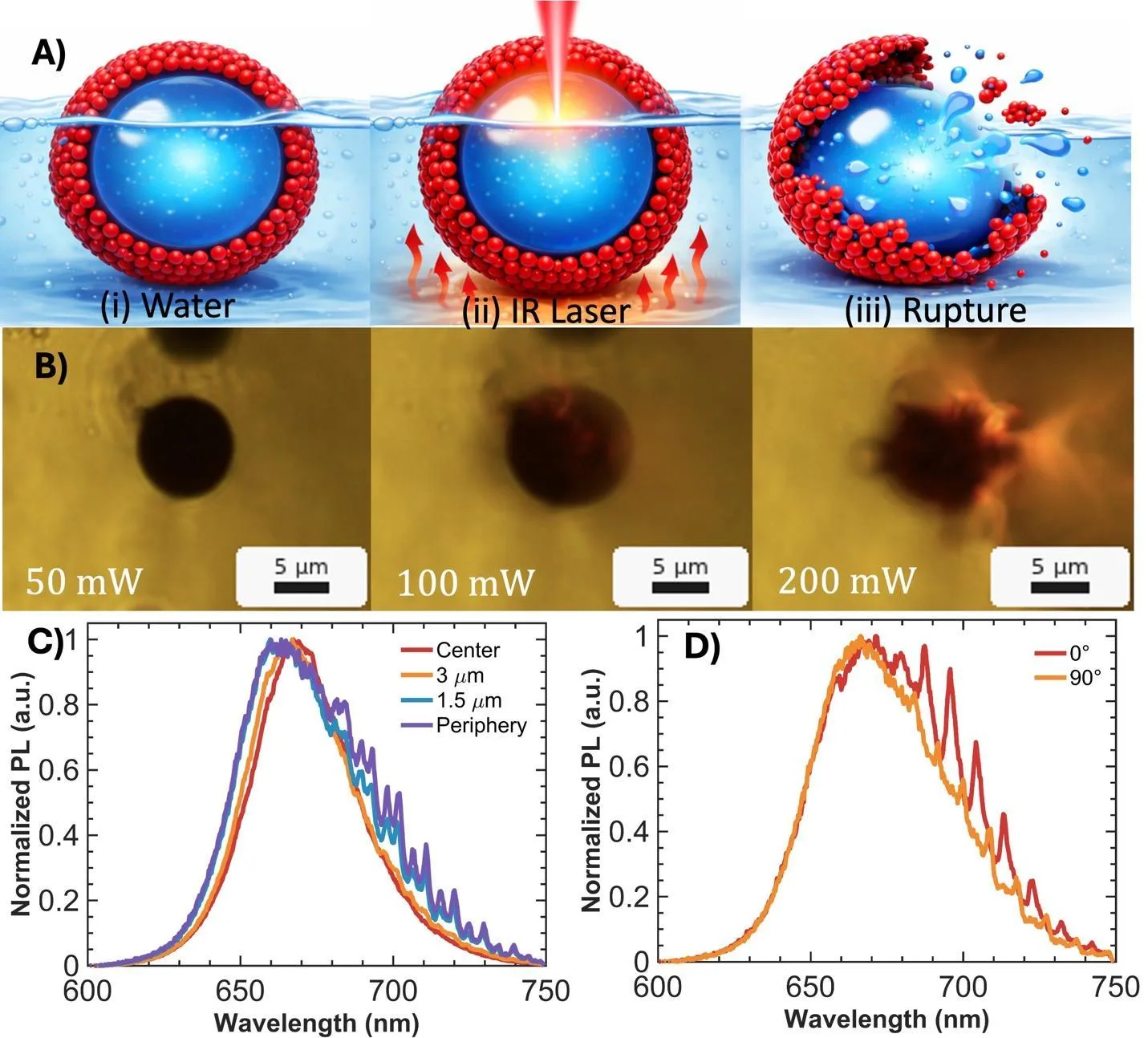
An intact colloidosome with a shell about 300 nm thick exhibits lasing with a threshold of approximately 2.8 mJ/cm². At an energy density of 4.2 mJ/cm², a single line at 668.7 nm with a width of 3.7 nm dominates, while at 14.0 mJ/cm² three modes appear with widths of 2.2–3.5 nm. Porous shells do not produce narrow lines even at 84 mJ/cm²; their spectrum remains broad. Colloidosomes rupture through three pathways: when a drying front passes, upon uniform heating (the rupture temperature decreases with increasing alkane chain length: 30 °C for C14, 26 °C for C16, 23 °C for C18), and when focusing a 976 nm infrared laser with 200 mW power. After rupture, the laser modes disappear and the emission becomes broadband.
Implications
This work shows that for lasing, what matters is not a solid core but the continuity of the shell. This distinguishes it from neighboring studies where the optical response is determined by the entire mass of the supraparticle. Here, a 300 nm thick shell confines light while simultaneously serving as a weak point for controlled destruction. This approach combines photonic function and mechanical fragility in a single self-assembled structure.
Future development
One could systematically vary the shell thickness and search for an optimum between light confinement and material economy. It would be interesting to test how shell roughness and quantum dot packing affect the lasing threshold. Another path is to replace the liquid core with a substance sensitive to specific stimuli to achieve a selective response.
Impact
Switchable microlasers could be useful in bioimaging, sensing, and labeling. Controlled release of contents paves the way for targeted delivery of substances at the microscale.
Next steps
Measure the passive quality factor of the resonator for different shell thicknesses and compare with calculations. Check the reproducibility of the lasing threshold on a large sample of colloidosomes.
Key open problems
For photonics, a key unresolved challenge is creating tunable light sources without an external resonator. This work proposes a mechanism for irreversible switching via shell destruction, but questions remain about reversibility and durability of such structures.
The knowledge machine's view
This section is addressed to the author of the paper and their colleagues. Neighbouring works were found by meaning-based search across our archive, not by word overlap. We do not review: we show the field around the work.
What the work does
The study assembles colloidosomes, microcapsules with shells made of quantum dots, which, while intact, act as lasers with whispering-gallery modes. The shells break down upon drying, heating, or infrared irradiation, after which laser emission gives way to broadband luminescence. It is shown that lasing requires a continuous shell, not a solid core.
Where its strength is
Combining a photonic function with controllable mechanical fragility in a single self-assembled structure. The continuity of the shell as a key condition for lasing paves the way for switchable light sources.
Where it could go next
- It might be interesting to see how similar whispering-gallery-mode microresonators are used for trapping and detecting molecules, which could suggest whether colloidosomes can be used as sensors before or after rupture.based on: Droplets of Light Catch Molecules arXiv:2602.18704
- A related work on mirrorless miniature lasers could help understand how to optimize the shell's quality factor and lasing threshold in such structures.based on: A Tiny Laser with No Mirrors arXiv:2607.06556
- It may be worth comparing with approaches where light is confined in glass microstructures to assess how competitive colloidosomes are as transducers or light sources.based on: Light Trapped in Glass: Miniature Beam Transformers arXiv:2602.07222
Worth trying
- Test whether lasing persists when the shell is partially damaged (for example, when pores appear), which would provide information about tolerable defects.
- Use colloidosomes as sensors: after rupture, the contents could interact with the environment, and a change in the emission spectrum would signal this.
- Try different quantum dots or shell compositions to lower the lasing threshold and tune the wavelength.
Why this may matter
Such structures could serve as the basis for switchable micro light sources, sensors with optical response, and targeted delivery systems with controlled release, where laser emission acts as an indicator of the state.
Nearby works in our archive
- A Pocket-Sized Source of Quantum Lightsimilarity 0.54
- A Tiny Laser with No Mirrorssimilarity 0.53
- Droplets of Light Catch Moleculessimilarity 0.53
- Tiny Laser Twists Light for Faster Chipssimilarity 0.53
- Glowing Knots on a Chipsimilarity 0.52
- Light Trapped in Glass: Miniature Beam Transformerssimilarity 0.51
The archive is sparse around this work: the closest review is only 0.54, against a usual 0.64. It looks like few have drilled nearby.
The colloidosome shell occupies only 17% of the volume of an equivalent solid sphere, and requires 83% fewer quantum dots. Yet lasing is preserved because light circulates precisely along the shell.
The idea of a microcontainer that releases its contents on command evokes drug capsules from science fiction, such as those in the series 'Star Trek'. Here, instead of a drug, we have quantum dots, and the signal is an infrared laser beam.
Key numbers
- lasing threshold: 2.8 mJ/cm²
- laser linewidth: 2.2–3.7 nm
- shell thickness: 275 ± 50 nm
- colloidosome diameter: 9.58 ± 2.48 μm
- rupture temperature for C18: 23 °C