مستعر أعظم من طفولة الكون سريع
يعمل العنقود المجري الهائل كعدسة عملاقة. ثقله يحني نسيج المكان، وضوء الأجرام البعيدة، أثناء التفافه حول هذا الانحناء، يتضخم وينقسم إلى صورتين. هذا المكبر الطبيعي هو ما ساعد تلسكوب جيمس ويب على رصد وميض خافت لـمستعر أعظم في مجرة بالغة الصغر على حافة الكون المرئي.
انفجر المستعر الأعظم SN Eos عندما كان عمر الكون مليار سنة فقط. ضوؤها استغرق 13 مليار سنة ليصل إلينا، وفي طريقه حرفه الزمكان الخاص بالعنقود، مما خلق صورًا متعددة. طيف الوميض — الضوء المحلل — أظهر أن النجم الأصل لم يحتوِ تقريبًا على عناصر أثقل من الهيليوم. يطلق علماء الفلك على هذه العناصر اسم «المعادن» (ليست الحديد ولا النحاس، بل كل ما هو أثقل من الهيليوم). هذا أول دليل مباشر على أن النجوم الضخمة كانت تولد في كون فتي فقير بالمعادن.
كل اكتشاف كهذا هو عدسة إضافية نرى من خلالها الحقبة المبكرة بوضوح أكبر. إنها تسمح لنا بحساب كم مرة اشتعلت النجوم الأولى وكم كانت سرعة نمو المجرات.
الملخص الأصلي
كما كتبه المؤلفون، بالإنجليزية arXiv:2601.04156v2
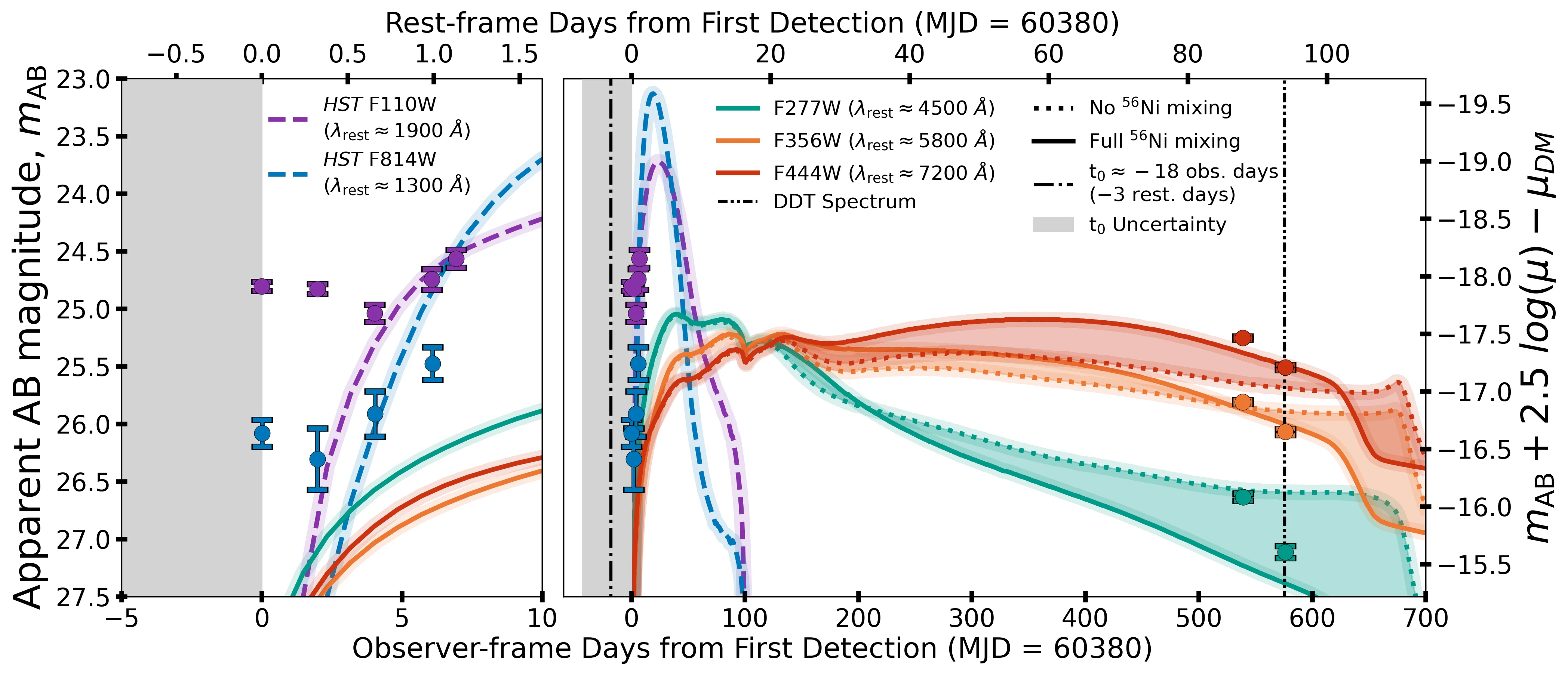
Observing supernovae (SNe) in the early Universe (z > 3) provides a window into how both galaxies and individual stars have evolved over cosmic time, yet a detailed study of high-redshift stars and SNe has remained difficult due to their extreme distances and cosmological redshifting. To overcome the former, searches for gravitationally lensed sources allow for the discovery of magnified SNe that appear as multiple images - further providing the opportunity for efficient follow-up. Here we present the discovery of "SN Eos": a strongly lensed, multiply-imaged, SN II at a spectroscopic redshift of z = 5.133 +/- 0.001. SN Eos exploded in a Lyman-{\alpha} emitting galaxy when the Universe was only ~1 billion years old, shortly after it reionized and became transparent to ultraviolet radiation. A year prior to our discovery in JWST data, archival HST imaging of SN Eos reveals rest-frame far ultraviolet (~1,300{\AA}) emission, indicative of shock breakout or interaction with circumstellar material in the first few (rest-frame) days after explosion. The JWST spectroscopy of SN Eos, now the farthest spectroscopically confirmed SN ever discovered, shows that SN Eos's progenitor star likely formed in a metal-poor environment (<= 0.1 Z_{\odot}), providing the first direct evidence of massive star formation in the metal-poor, early Universe. SN Eos would not have been detectable without the extreme lensing magnification of the system, highlighting the potential of such discoveries to eventually place constraints on the faint end of the cosmic star-formation rate density in the very early Universe.
في لحظة انفجار SN Eos، لم تكن الأرض ولا الشمس موجودتين. لقد ظهرتا بعد 8 مليارات سنة فقط.