Training a Neural Net on Two Decades of Data: A Simulator for El Niño
A translator at negotiations keeps a draft speech at hand but adjusts the translation based on the live conversation. Similarly, the new algorithm trains a neural net to predict El Niño: a long simulation from a coarse climate model serves as the draft, while a short record of satellite observations is the live conversation that corrects each step.
El Niño is an anomalous warming of water in the eastern tropical Pacific that affects rainfall and crops worldwide. Observations are scarce: only three strong events have been recorded during the satellite era. Physical models make errors, and conventional neural nets lack data. The new method generates about 30,000 weekly samples from a simple model that couples ocean temperature, thermocline depth, and wind bursts. These samples prompt the neural net to update its parameters, and then a short observational record checks whether this reduces error on real data. If it does, the update is accepted; if not, it is rejected.
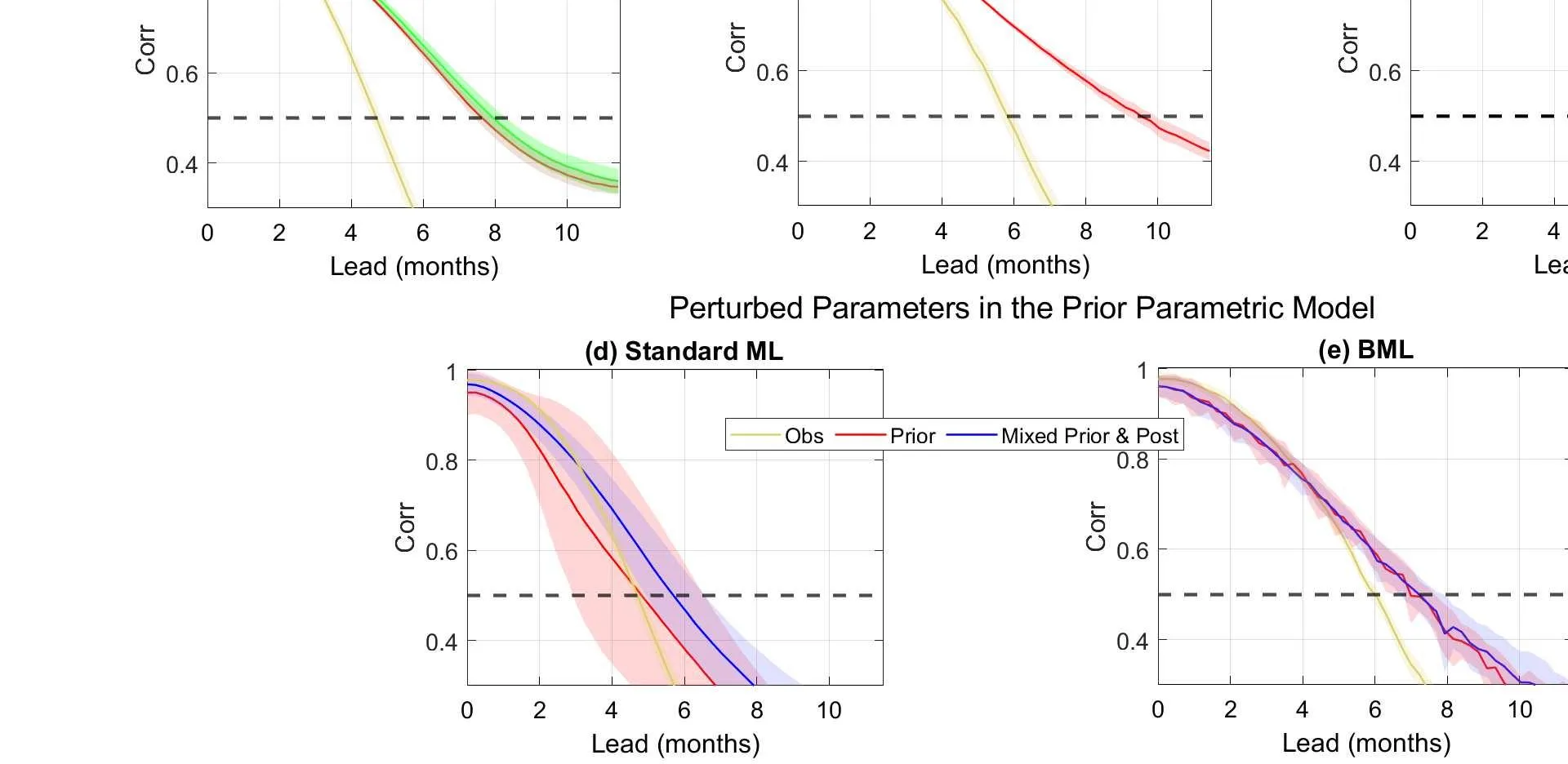
The result: forecasts retain skill up to 9.5 months ahead, whereas a simple persistence forecast holds for 5 months and an ensemble of physical models for 6. The algorithm overcomes the spring predictability barrier and reduces uncertainty. The method applies to any geophysical system with limited observations, provided a reasonable approximate model exists.
The wind bursts in the western Pacific that the authors include in the model operate on intraseasonal timescales: the forecast uses data from only the last 8 days, whereas temperature and thermocline are taken over 8 weeks. This mismatch in input timescales turned out to be key to extending forecast skill.