A Bayesian Trainer for El Niño: How to Train a Neural Network on Twenty Years of Data
Context
El Niño–Southern Oscillation (ENSO) remains the dominant source of interannual climate variability, affecting rainfall, crops, and economies worldwide. Classical ensemble forecasts based on physical models suffer from model errors, while machine learning methods run into the short observational record: only three strong El Niños have been recorded during the satellite era. Neighboring papers in the archive apply neural networks to climate data, but mostly use large datasets or standard training; this paper stands apart by proposing a Bayesian scheme that systematically uses a coarse model to compensate for the lack of data.
Methods
The authors build a Bayesian learning algorithm (BML) for a feedforward neural network. As prior information, they generate a long time series (about 30,000 weekly samples) from a three-dimensional stochastic model describing the interaction of sea surface temperature in the Niño 3 region, thermocline depth in the western Pacific, and wind bursts. The short observational record (1983–1999 or 2001–2020) serves as the likelihood function: at each gradient descent step, a parameter update is proposed based on the prior data, then accepted or rejected depending on whether it reduces the error on the observations. This two-step cycle resembles Bayesian Markov chain Monte Carlo but yields a single point estimate of the network.
Results
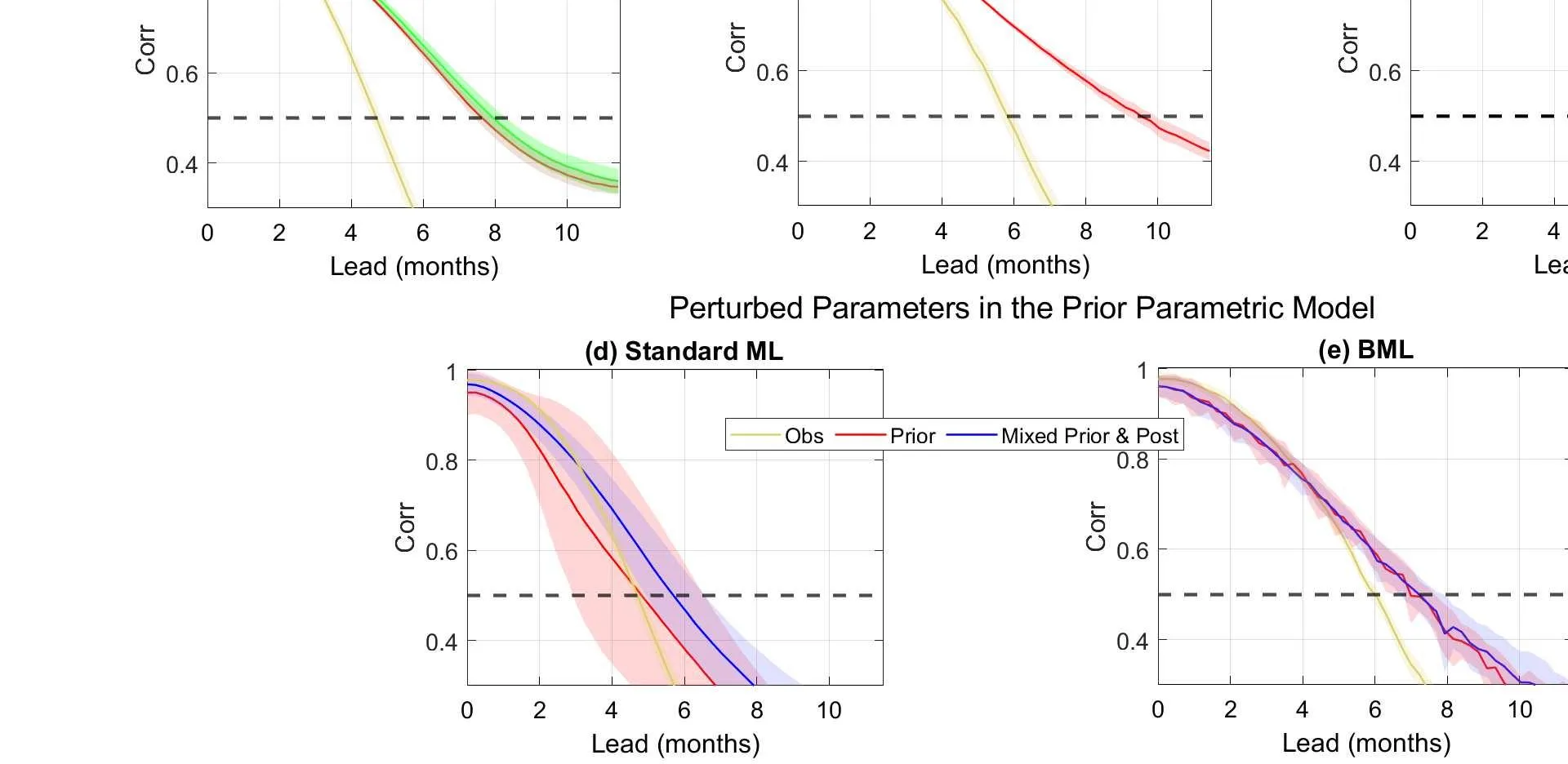
The BML forecast using only Niño 3 temperature retains skill up to 7.5 months, and with thermocline and wind bursts added, up to 9.5 months. This is noticeably better than both the persistence forecast (5 months) and the ensemble forecast based on a physical model (6 months). The algorithm largely overcomes the spring predictability barrier: for starts from February to August, correlation remains above 0.5 for nearly 10 months, and for April the useful forecast extends to 9 months. BML also reduces uncertainty: the 95% confidence interval of skill is noticeably narrower than with standard training, and results are robust to random perturbations of the prior model parameters.
Implications
This work differs from neighboring studies in that it is the first to systematically combine a coarse physical model and short observations in a unified Bayesian training loop, rather than simply concatenating data or using standard regularization. This allows extracting benefit from an imperfect model without requiring expensive data assimilation schemes. The approach is in principle applicable to any geophysical system with limited observations, provided a reasonable approximate model exists.
Future development
The method can be extended to forecast spatiotemporal patterns of ENSO diversity, and also tested with operational models as priors. An interesting question is at what observational record length standard training catches up with BML; the authors plan to study this in a controlled environment with known dynamics. Inclusion of tropical and extratropical precursors may further improve the forecast.
Impact
The method could improve seasonal El Niño forecasts at operational centers, especially under limited data conditions. It is also useful for other geophysical problems where observations are sparse and models are imperfect.
Next steps
Test BML with more realistic models as priors and with other predictor variables. Assess how the length of the training sample affects the method's comparative advantage.
Key open problems
The paper directly addresses the problem of data scarcity in machine learning for climate forecasting, as well as the long-standing question of the ENSO spring predictability barrier. It shows that even a coarse physical model can serve as useful prior knowledge, reducing the variance of estimates without introducing large bias.
The wind bursts in the western Pacific that the authors include in the model operate on intraseasonal timescales: the forecast uses data from only the last 8 days, whereas temperature and thermocline are taken over 8 weeks. This mismatch in input timescales turned out to be key to extending forecast skill.
Key numbers
- training record length: about 30,000 weekly samples from the model
- BML forecast skill: 9.5 months
- persistence forecast skill: 5 months
- ensemble forecast skill: 6 months
- correlation threshold for skill: 0.5