Neural Network Learns from a Draft: How a Crude Model Helps Predict El Niño
An interpreter at an important negotiation keeps a draft of their speech at hand but checks against the live conversation as they go: if what is said diverges from the prepared text, they adjust the translation on the fly. Similarly, a new algorithm trains a neural network to predict El Niño: a long simulation from a crude climate model serves as the draft, while a short record of satellite observations is the live conversation that corrects every step.
El Niño, the anomalous warming of water in the eastern Pacific Ocean, affects rainfall, crops, and food prices worldwide. But reliable observations are scarce: only three strong events have been recorded during the satellite era. Physical models make systematic errors, and conventional neural networks require large datasets that do not exist. This is where the Bayesian trainer steps in.
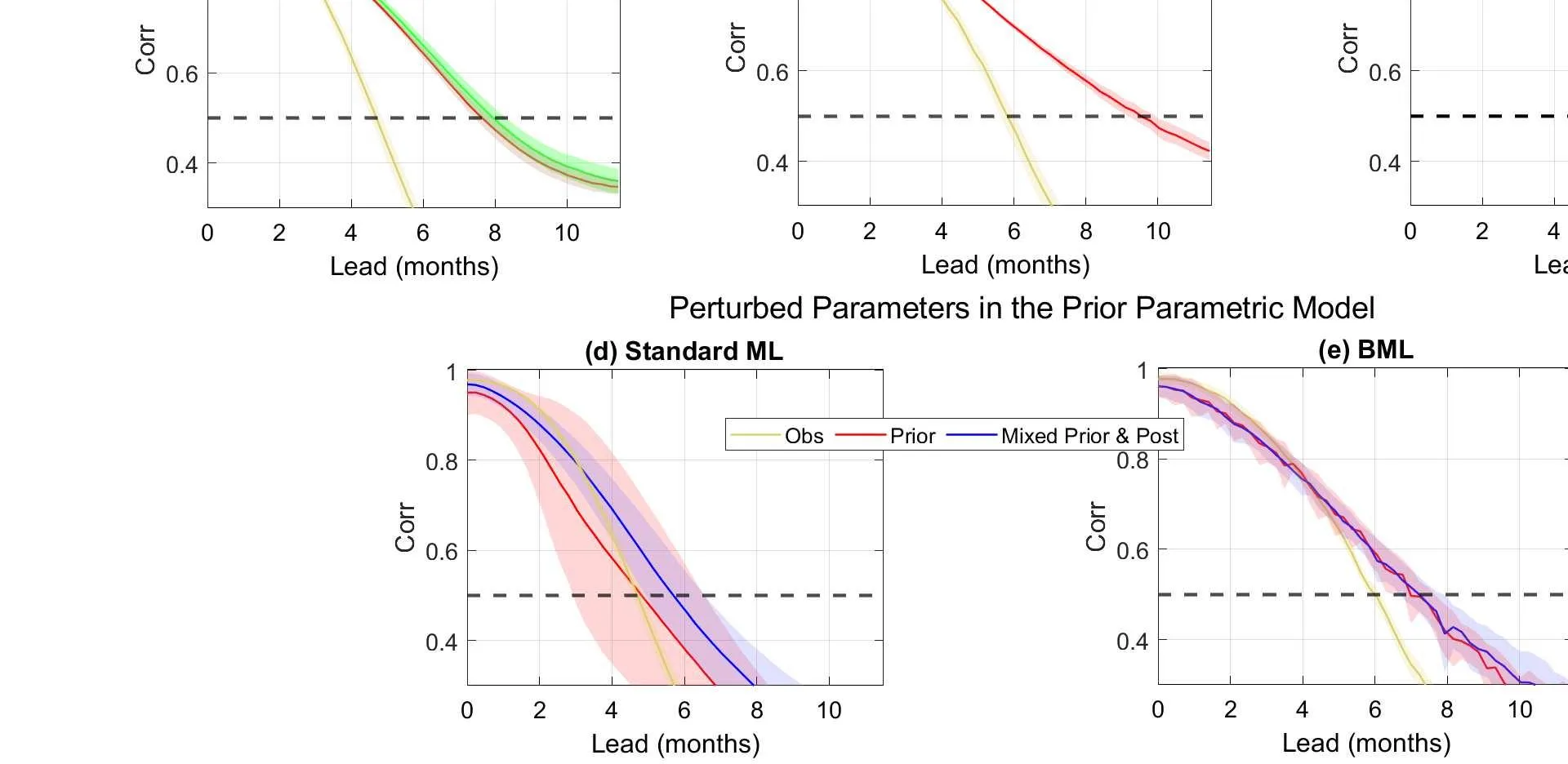
The result is impressive: the forecast retains skill up to 9.5 months ahead, whereas a persistence forecast (simply "tomorrow like today") holds for 5 months, and an ensemble of physical models for 6. The algorithm largely overcomes the spring predictability barrier: for starts from February through August, correlation remains above 0.5 for almost 10 months, and for April the useful forecast extends to 9 months. Moreover, the 95% confidence interval of skill is notably narrower than with standard training, and results are robust to random perturbations of model parameters.
An interpreter who checks against the draft but adjusts based on the live conversation ultimately delivers an accurate translation. Likewise, this neural network, trained on a crude model and corrected by observations, predicts El Niño further and more reliably than either source alone. The method applies to any geophysical system with limited observations, provided a reasonable approximate model exists.
The wind bursts in the western Pacific that the authors include in the model operate on intraseasonal timescales: the forecast uses data from only the last 8 days, whereas temperature and thermocline are taken over 8 weeks. This mismatch in input timescales turned out to be key to extending forecast skill.