Why 2023 Was So Hot: Clouds Stopped Protecting Earth ✛
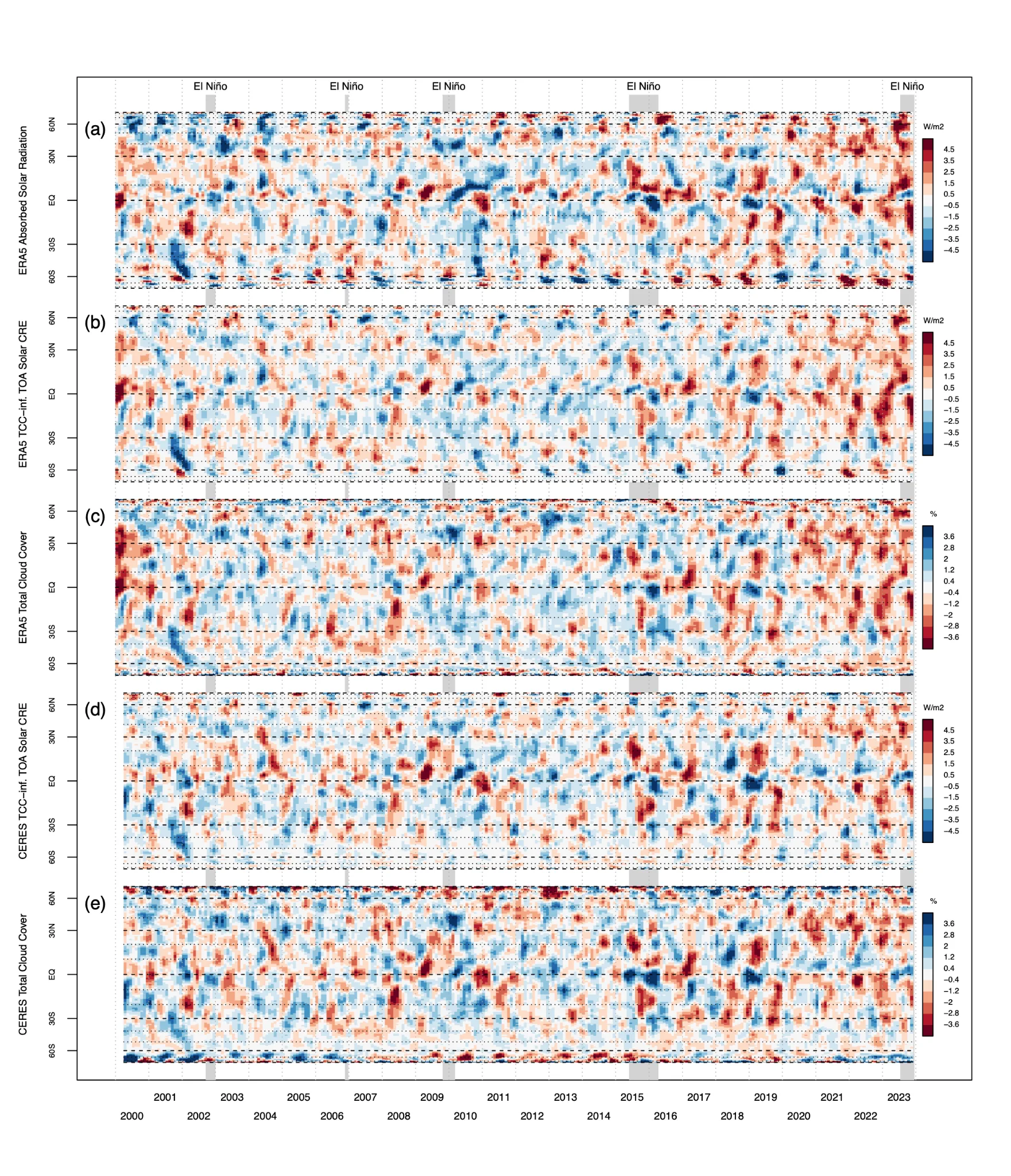
In the summer of 2023, extraordinary heat gripped the world, and thermometers broke records. Scientists knew that greenhouse gases were warming the atmosphere, and a warm El Niño current had started in the Pacific Ocean. But even together, these causes did not explain why temperatures spiked so dramatically. It turned out that Earth itself was reflecting less sunlight, as if it had taken off its sunglasses. These sunglasses are low clouds, which usually cover the planet and bounce some heat back into space. In 2023, there were fewer of them, and sunlight began to heat the surface more intensely.
Satellites showed that low clouds decreased by 4% compared to the usual level. They disappeared most over the Atlantic Ocean and in northern latitudes. As a result, Earth absorbed extra energy, roughly equivalent to shining light from one and a half light bulbs on every square meter of surface. This energy added about 0.23°C to the temperature in 2023, and almost all of that contribution came from clouds. For comparison, El Niño added only 0.07°C. So clouds played the main role in the anomalous heat.
Now scientists are trying to understand why there are fewer clouds. This could be a natural climate fluctuation that will pass over time. Or it could be due to new rules for ship fuel, which have reduced the particles in the air that help clouds form. But there is also a worrying possibility: as the planet warms, low clouds dissipate, which leads to even more warming, creating a vicious cycle. If so, the heat will only get worse, and humanity needs to urgently cut greenhouse gas emissions. The question is whether Earth's sunglasses will return or are they cracked for good.
In 2023, Earth absorbed sunlight as if a reflective film the size of the entire Arctic Ocean had vanished from its surface. The absorbed radiation anomaly of +1.82 W/m² is equivalent to the extra heating from about 300 million constantly running electric kettles.
The scenario of clouds ceasing to reflect light and the planet heating rapidly echoes Kim Stanley Robinson's novel 'The Ministry for the Future,' where climate catastrophe begins with an unexpected heat shock. Only in reality, the culprits are not futuristic technologies but ordinary low clouds.