Earth Stops Reflecting Light: Record-Low Albedo Explains 2023's Anomalous Heat ✛
Context
This study stands apart from other investigations of 2023's climate anomalies: neighboring papers dissect record ocean temperatures, sea ice anomalies, and contributions from specific factors like the Hunga Tonga eruption or new shipping fuel regulations. But most focus on individual regions or mechanisms, whereas this paper is the first to piece together the planet's global energy budget, showing that the main culprit was Earth itself, or more precisely, its cloud cover, which stopped reflecting sunlight. This raises the question of whether a long-predicted but observationally elusive low-cloud feedback is beginning to manifest, potentially accelerating warming more than models expected.
Methods
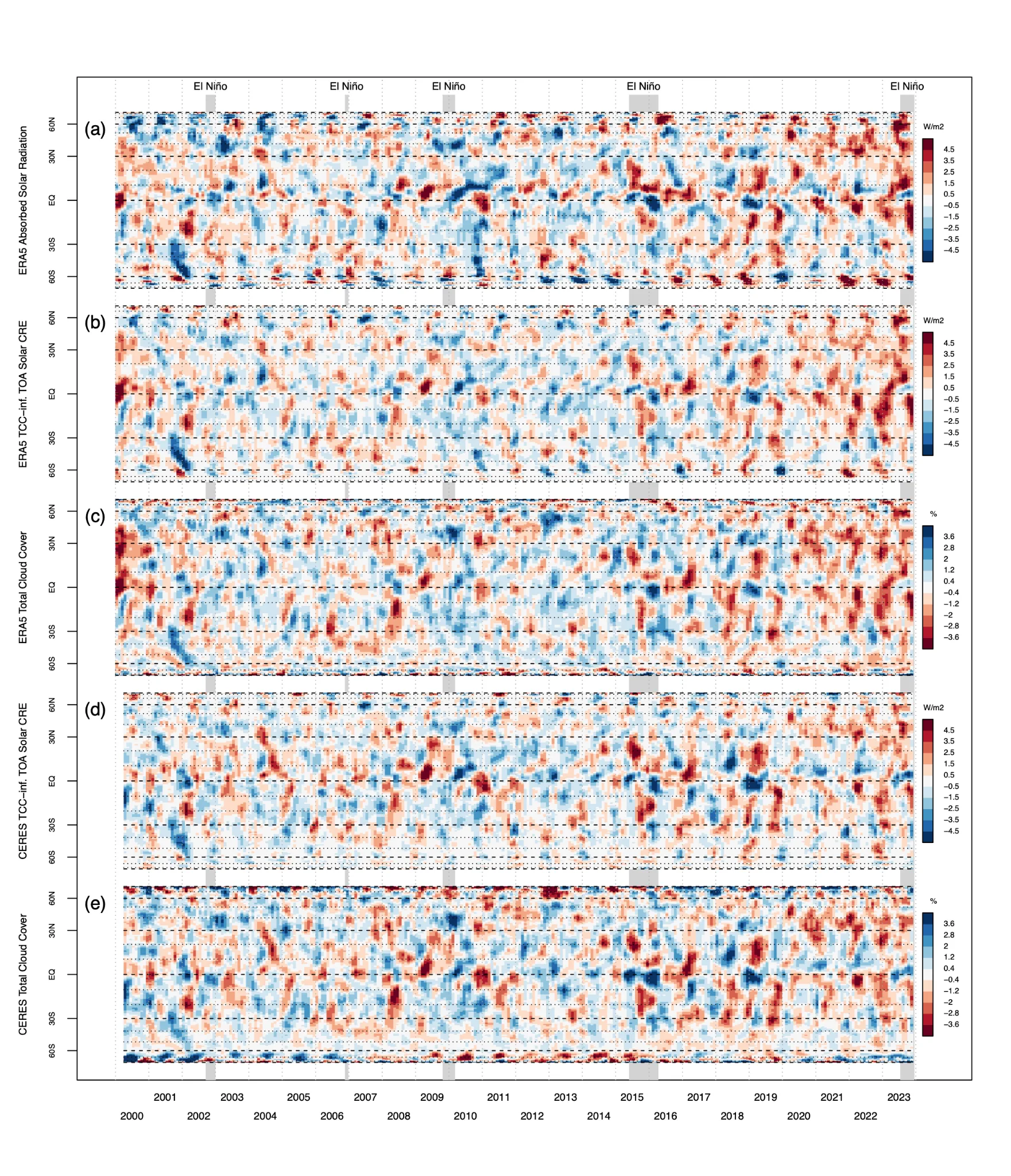
The authors used two independent datasets: CERES-EBAF satellite measurements of the radiation budget and the ERA5 reanalysis, which blends observations with an atmospheric model. For each dataset, they calculated anomalies in absorbed solar radiation, planetary albedo, and cloud cover relative to the 2001–2022 average. Then, using empirical power-law functions calibrated on 2001–2014 data, they estimated the contribution of total cloud cover changes to absorbed radiation anomalies. To translate radiation anomalies into a temperature response, they applied a two-layer energy balance model with parameters from the CMIP5 ensemble. They separately isolated the El Niño contribution using a composite of nine past events and linear regression on the Niño 3.4 index.
Results
The headline result: planetary albedo in 2023 hit a record low for the entire satellite era and, according to ERA5, likely the lowest since the 1940s. The anomaly in absorbed solar radiation was +1.82 W/m² in CERES and +1.33 W/m² in ERA5. The albedo decline is primarily due to reduced low cloud cover: the global low-cloud anomaly in 2023 reached -1.5%, which, given an average coverage of about 38%, translates to a relative reduction of 4%. The largest contributions came from northern mid-latitudes and the tropics, particularly the Atlantic Ocean. The energy balance model shows that radiation anomalies since December 2020 could have added about 0.23°C to 2023's global temperature, with 0.20°C from cloud changes and 0.03°C from reduced sea ice and snow in polar regions. The El Niño contribution was estimated at just 0.07°C, and the solar cycle at 0.03°C.
Implications
Unlike neighboring studies that examine individual regional anomalies or specific events, this paper links the global temperature spike to a fundamental shift in the planet's energy balance and, for the first time, quantitatively demonstrates that a record-low albedo, driven by reduced low clouds, can close nearly the entire 'unexplained' gap of 0.2°C. If this trend is not merely internal climate variability but reflects an emerging positive low-cloud feedback, then Earth's climate sensitivity may be closer to the upper end of estimates, and the remaining carbon budget for 1.5°C could be smaller than assumed.
Future development
The key question is to disentangle the contributions of three mechanisms to the low-cloud decline: internal variability (e.g., the Atlantic Multidecadal Oscillation), indirect aerosol effects from stricter shipping fuel rules, and the low-cloud feedback itself. This will require more detailed satellite data on cloud properties (e.g., MODIS), long-term observational records, and targeted model experiments with isolated forcings. If the feedback is confirmed, it would force a revision of warming projections and carbon budget estimates, and could shift climate policy toward more aggressive emissions cuts.
Impact
The results directly affect estimates of climate sensitivity, projections of global warming, and calculations of remaining carbon budgets under the Paris Agreement. They are also important for interpreting future satellite data and for calibrating climate models, particularly regarding cloud feedbacks.
Next steps
Immediate next steps include analyzing more detailed satellite products on cloud properties (MODIS) to refine low-cloud trends and their causes, as well as conducting model experiments with aerosol forcings switched off and internal variability fixed, to isolate a potential feedback.
Key open problems
This work addresses one of the central unsolved problems in climatology: the magnitude of the low-cloud feedback, which remains the largest source of uncertainty in estimates of equilibrium climate sensitivity. If the observed low-cloud trend turns out to be a manifestation of this feedback, the range of plausible sensitivity values would narrow but shift upward, exacerbating the problem of models underestimating future warming.
The knowledge machine's view
This section is addressed to the author of the paper and their colleagues. Neighbouring works were found by meaning-based search across our archive, not by word overlap. We do not review: we show the field around the work.
What the work does
The authors analyzed CERES satellite data and ERA5 reanalysis, calculated anomalies in absorbed solar radiation, albedo, and cloudiness, and then used an energy balance model to estimate the contribution of low clouds to the record warming of 2023. They showed that the decrease in planetary albedo due to reduced low cloud cover added about 0.2°C to the global temperature, closing the gap between observations and the expected contribution of known factors.
Where its strength is
This work is the first to quantitatively link the 2023 global temperature jump to the planetary albedo anomaly, using two independent datasets and an energy balance model. It provides a basis for further study of cloud feedback in observational data.
Where it could go next
- It might be interesting to compare the obtained estimate of cloud contribution with the results of the analysis of internal climate variability presented in the work on Earth's self-warming, to separate the anthropogenic trend from natural fluctuations.based on: Earth Can Heat Itself Up arXiv:2601.13678
- Closely related is the study of the atmosphere of a small icy body beyond Neptune, which also examines processes affecting the radiation balance; perhaps their methods for analyzing cloud cover and albedo could be useful for testing the robustness of the identified trend.based on: Atmosphere found on a small icy body beyond Neptune arXiv:2605.02243
Worth trying
- Check whether the low cloud anomaly persists in 2024, using updated CERES-EBAF data.
- Apply the composite method to other climate models to assess how often such events occur in simulations.
- Investigate regional features of cloud reduction over the Atlantic, using sea surface temperature data.
Why this may matter
If the reduction in low clouds turns out to be not just internal variability but a manifestation of a positive feedback, it could mean that Earth's climate sensitivity is higher than previously thought, and the 1.5°C threshold might be reached sooner.
Nearby works in our archive
- Surprise Planet Around a Young Starsimilarity 0.49
- A Lava World with a Cool Facesimilarity 0.48
- The Planet Still: LHS 1140b's Helium Exhalesimilarity 0.47
- Atmosphere found on a small icy body beyond Neptunesimilarity 0.47
- A Christmas Tree on the Sun: How a Flare Paints a Pattern in Radio Wavessimilarity 0.47
- The Sun Pulls Electrons Back, Yet They Still Escapesimilarity 0.47
- Earth Can Heat Itself Upsimilarity 0.46
The archive is sparse around this work: the closest review is only 0.49, against a usual 0.64. It looks like few have drilled nearby.
In 2023, Earth absorbed sunlight as if a reflective film the size of the entire Arctic Ocean had vanished from its surface. The absorbed radiation anomaly of +1.82 W/m² is equivalent to the extra heating from about 300 million constantly running electric kettles.
The scenario of clouds ceasing to reflect light and the planet heating rapidly echoes Kim Stanley Robinson's novel 'The Ministry for the Future,' where climate catastrophe begins with an unexpected heat shock. Only in reality, the culprits are not futuristic technologies but ordinary low clouds.
Key numbers
- 2023 temperature anomaly: 1.48°C above pre-industrial levels
- unexplained gap: 0.2°C
- absorbed radiation anomaly: +1.82 W/m² (CERES)
- low cloud anomaly: -1.5% (relative reduction 4%)
- albedo contribution to 2023 temperature: 0.23°C