Earth Took Off Its Sunglasses: Why 2023 Was Anomalously Hot ✛
In the summer of 2023, thermometers around the world registered numbers that even the boldest forecasts had not anticipated. The planet's average temperature rose to 1.48°C above pre-industrial levels, a jump of 0.17°C that broke the previous record as if the climate had suddenly shifted gears. Scientists knew that greenhouse gases were still heating the atmosphere and that El Niño was brewing in the Pacific, a warm current that typically adds to the heat. But even together, these factors left a puzzling gap of about 0.2°C that no familiar cause could explain. The answer came from an unexpected direction: the planet itself stopped reflecting sunlight, as if it had taken off its sunglasses.
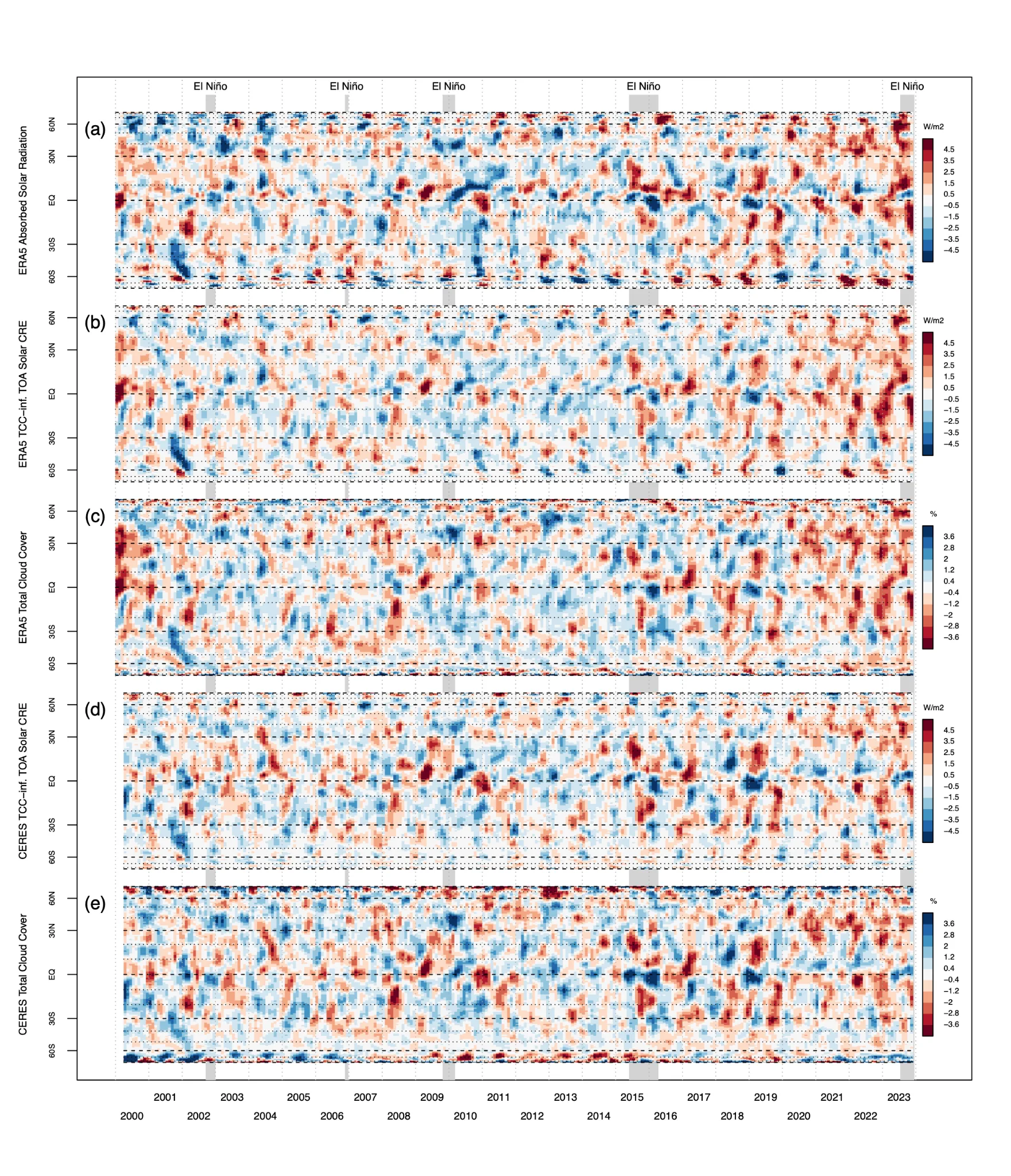
Satellite measurements of the radiation budget from CERES showed that in 2023 Earth absorbed 1.82 W/m² more sunlight than the average over the previous two decades. That is equivalent to every square meter of the planet's surface receiving extra power from one and a half constantly burning incandescent light bulbs. The main culprit turned out to be low clouds, those fluffy white blankets that usually cover oceans and land up to two kilometers high. Their cover shrank by 1.5% compared with the average level, a relative reduction of 4%. The decline was especially pronounced over the northern mid-latitudes and the tropics, and most of all over the Atlantic Ocean. Fewer clouds mean less reflected light, which means a hotter surface.
To understand how much heat the disappearing clouds added, scientists built a simplified model of Earth's heat balance. It works like an accounting ledger, where income is solar energy and expenses are heat radiating back into space. The model showed that, since December 2020, anomalies in absorbed radiation could have added about 0.23°C to the 2023 global temperature. Of that, 0.20°C came from cloud changes, and the remaining 0.03°C from the reduction of sea ice and snow in polar regions. For comparison, the contribution from El Niño was estimated at just 0.07°C, and from the solar cycle at 0.03°C. So clouds played the role of lead conductor in the anomalous heat, not the usual climate orchestra.
But why are there fewer clouds? That is the key question, and the answer will determine how alarming the future will be. One possibility is natural climate variability, such as the Atlantic Multidecadal Oscillation, which slowly reshuffles ocean currents and cloud cover. Another is stricter rules on ship fuel, which have reduced the amount of aerosols entering the atmosphere, aerosols that help clouds form. And a third, most worrying possibility is that very low cloud feedback that models have long predicted but observations had not yet caught. If the trend continues, Earth's climate sensitivity will be closer to the upper end of estimates, and the remaining carbon budget for 1.5°C will be smaller than previously thought.
Earth took off its sunglasses in 2023, and the world felt it on its skin. Now the task for scientists is to understand whether it did so by chance, because of natural fluctuations, or whether the glasses are permanently cracked, setting off a feedback loop that will heat the planet faster. The answer will determine how urgently humanity needs to cut greenhouse gas emissions. If clouds continue to thin, each successive year could bring new heat records, and the 1.5°C threshold would then be not a distant line on a graph, but a milestone already passed.
In 2023, Earth absorbed sunlight as if a reflective film the size of the entire Arctic Ocean had vanished from its surface. The absorbed radiation anomaly of +1.82 W/m² is equivalent to the extra heating from about 300 million constantly running electric kettles.
The scenario of clouds ceasing to reflect light and the planet heating rapidly echoes Kim Stanley Robinson's novel 'The Ministry for the Future,' where climate catastrophe begins with an unexpected heat shock. Only in reality, the culprits are not futuristic technologies but ordinary low clouds.