Three Translators and the Dance of the Vortex ✛
A vertical pipe with a sudden expansion is a classic testbed for turbulence. Air swirling like a tornado rushes into a wider chamber and spawns vortices, recirculation zones, and regions where glass particles 45 μm in diameter, about half the thickness of a human hair, dart along intricate paths. Martin Sommerfeld and his colleague Hui Qiu measured velocities in such a flow back in the 1990s, and their experiment has since become a benchmark for validating two-phase flow models. Three popular versions of the k-ε model (a way to estimate turbulent fluctuations through kinetic energy and dissipation) claim to accurately describe this dance of vortices. Each is like a translator who hears the same music but renders it in their own style.
The translators differed in the details. The standard k-ε model, the oldest and simplest, turned out to be the most faithful: its velocity profiles matched the experiment in all four cross-sections (x = 3, 52, 112, and 155 mm). The realizable model, developed later to fix the standard model's shortcomings, erred in the radial velocity: far from the jets it gave an excessively strong inward flow, and near the wall an outward flow, whereas in the experiment the flow was directed inward. The RNG model, derived from statistical mechanics, produced additional recirculation zones at the start of the central bubble, false vortices that were not seen in the experiment. In terms of computational time for a 0.5 s interval, the standard model also proved fastest: 17.13 hours versus 19.44 for RNG and 24.81 for the realizable model (45% longer).
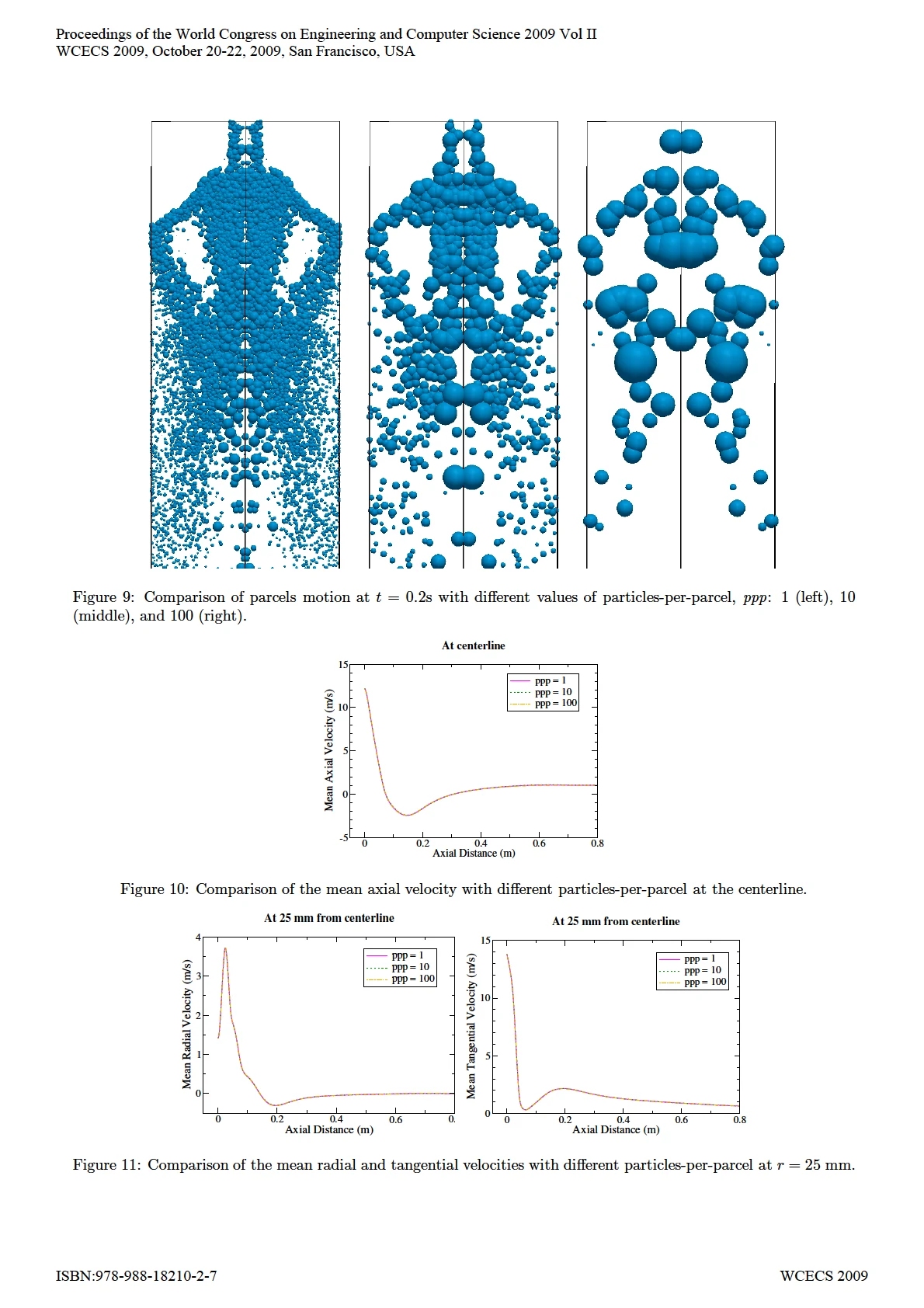
Particles can also be described in different ways: track each one individually (the Lagrangian approach, following every particle along its path) or group them into parcels, where a hundred identical particles move as one. Logic suggests that grouping will save time, since there are fewer equations of motion. But in this test, the saving was only 4.2% (31.15 hours versus 29.84), almost nothing. The reason is simple: the main computational load comes from solving the gas-phase equations, and there are few particles in the flow. The mean gas velocity profiles with grouping into parcels of up to 100 remained unchanged, the difference being imperceptible.
This work gives engineers a clear benchmark: for swirling two-phase flows with moderate particle loading, the standard k-ε model remains a reasonable compromise between accuracy and computational cost. The realizable model, despite theoretical improvements, can give qualitatively wrong radial velocity, and RNG can produce spurious vortex structures. The parcel approach to particles is justified only at high dispersed-phase concentrations, when the saving in the number of particle equations of motion becomes noticeable. Today this knowledge applies to the design of pulverized-coal furnaces, cyclone separators, and gasification systems with CO2 capture, where predicting particle distribution and recirculation zones is important.
Ahead lies the natural next step: repeat the comparison at higher particle loading (above 0.034 kg/kg) and stronger swirl (swirl number greater than 0.6), typical of real burners. It may be necessary to adapt wall functions (an approximate description of the flow near the wall) or switch to models that resolve the viscous sublayer for better description of secondary flows. But it is already clear: in the world of turbulent two-phase flows, a reliable translator matters more than a fashionable one.
Glass particles with a diameter of 45 μm are about half the thickness of a human hair. At a loading of 0.034 kg/kg, there were about 12,000 individual particles in the flow, but their total mass was less than 4% of the air mass.