Three Turbulence Models versus a Single Vortex ✛
Context
Modeling energy systems, such as pulverized-coal boilers and carbon-capture gasifiers, requires accurate descriptions of turbulence and particle motion. The experiment by Sommerfeld and Qiu on a particle-laden swirling flow has become a benchmark test for validating gas-dispersed flow models. Previously, this case was studied using Euler–Lagrange methods with RANS and LES, as well as Euler–Euler approaches, but a systematic comparison of three popular k-ε models in a single setup was lacking. This work falls within the line of numerical studies of two-phase swirling flows, where neighboring works address vortex rings, quantum vortices, and turbulence, but here the focus is on selecting a turbulence model for practical engineering calculations.
Methods
The air was described by unsteady Favre-averaged Navier–Stokes equations, closed with three variants of the k-ε model: standard, RNG, and realizable. For the particles, a Lagrangian approach was used, accounting for drag, gravity, and buoyancy; turbulent velocity fluctuations of the gas were modeled using a discrete random walk algorithm. The computational domain was a three-dimensional wedge with a 5° angle and a grid of 240×182 nodes (40,080 cells), refined near the walls and between jets. Glass particles with a diameter of 45 μm were injected at a mass flow rate of 0.34 g/s. To test the parcel approach, particles were grouped into parcels of 1, 10, or 100 particles. The simulation time was 0.6 s, with averaging over the last 0.1 s.
Results
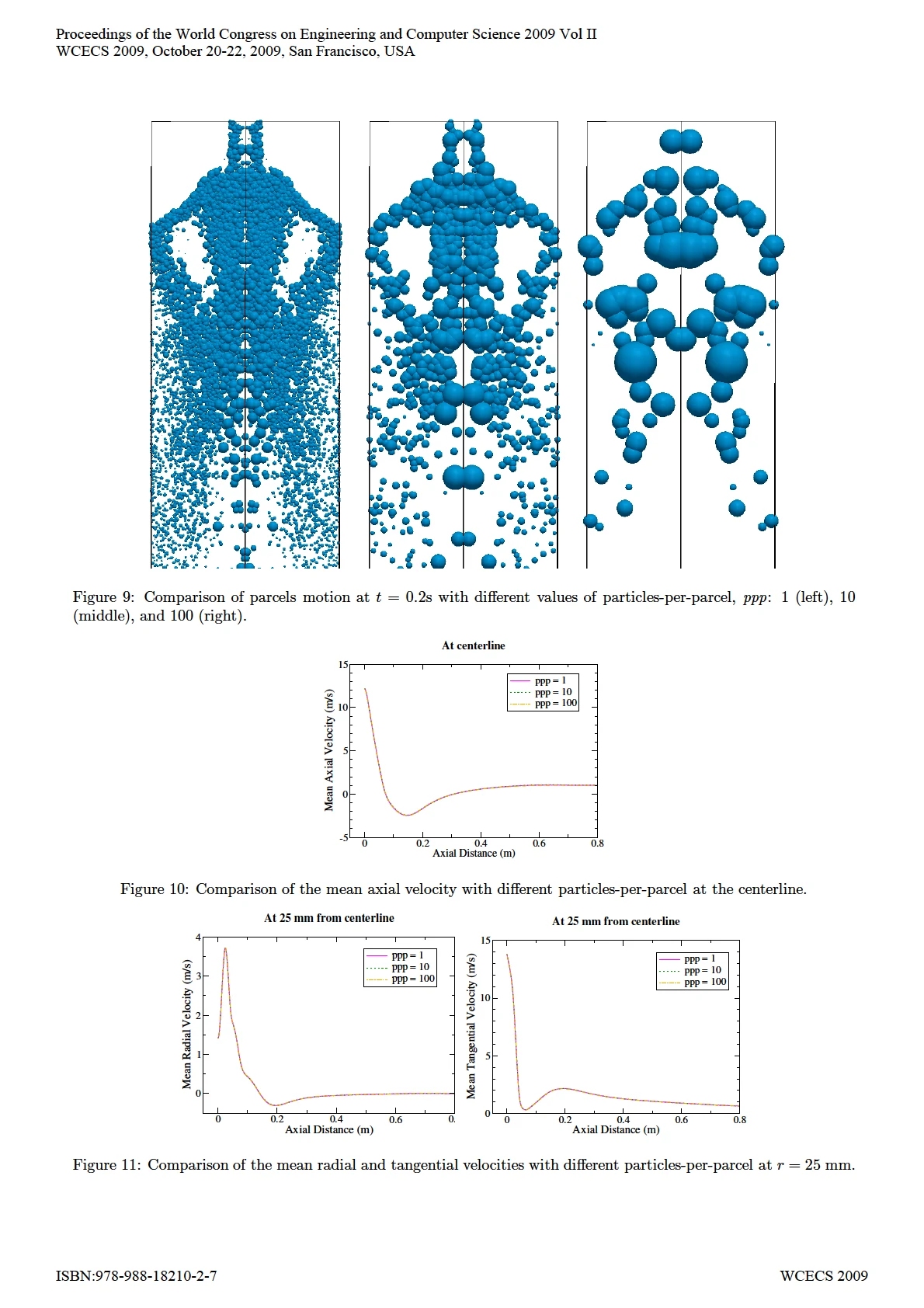
The standard k-ε model gave the best agreement with the experimental mean velocity profiles at all four cross-sections (x = 3, 52, 112, and 155 mm). The realizable model incorrectly predicted the radial velocity: away from the jets, it produced an excessively strong inward flow, and near the wall an outward flow, whereas in the experiment the flow was directed inward. The RNG model generated additional recirculation zones at the start of the central bubble, which were not present in the experiment. In terms of computation time for a 0.5 s interval, the standard model was the fastest (17.13 h), RNG took 19.44 h, and realizable took 24.81 h (45% longer than standard). Grouping particles into parcels of up to 100 particles barely changed the mean gas velocity profiles: the difference was imperceptible. However, the time saving was only 4.2% (31.15 h vs. 29.84 h), because the main computational load came from solving the gas-phase equations due to the low particle concentration.
Implications
This work gives engineers a clear guideline: for swirling two-phase flows with moderate particle loading, the standard k-ε model remains a reasonable compromise between accuracy and computational cost. The realizable model, despite theoretical improvements, can produce qualitatively incorrect radial velocity, and the RNG model can yield spurious vortex structures. The parcel approach is justified only at high dispersed-phase concentrations, when the savings in the number of particle equations become noticeable. Compared with neighboring works that focus on novel methods (meshless vortex rings, quantum plasma simulators), this study validates the applicability of classical models to a practical energy problem.
Future development
A natural next step is to repeat the comparison at higher particle loadings (above 0.034 kg/kg) to determine when grouping starts to affect accuracy and when time savings become significant. It would also be useful to test the models on flows with stronger swirl (swirl number greater than 0.6), typical of real burners. Adaptation of wall functions or a switch to models that resolve the viscous sublayer may be needed to better describe secondary flows.
Impact
The results are directly applicable to the design of pulverized-coal furnaces, cyclone separators, and gasification systems with CO2 capture, where predicting particle distribution and recirculation zones is important. The findings on computational cost will help optimize engineering CFD calculations.
Next steps
Conduct a similar comparison at particle loadings of 0.1–0.5 kg/kg and swirl numbers of 0.8–1.0. Investigate the sensitivity of the results to the grid and time step to confirm solution independence.
Key open problems
In the field of CFD for two-phase flows, the reliable modeling of turbulent particle dispersion remains an open question: the discrete random walk algorithm gives different results depending on the turbulence model, and there is no universal recipe. Also unresolved is the prediction of secondary recirculation zones under strong swirl, which is directly related to the choice of turbulence model and near-wall closure.
The knowledge machine's view
This section is addressed to the author of the paper and their colleagues. Neighbouring works were found by meaning-based search across our archive, not by word overlap. We do not review: we show the field around the work.
What the work does
This study numerically simulates a swirling airflow carrying glass particles in a vertical pipe with a sudden expansion. Three versions of the k-ε turbulence model (standard, RNG, and realizable) and two approaches to particle description (individual and parcel-based) are compared. The standard model matches the experimental velocity profiles best, while the realizable model incorrectly predicts the radial velocity. Grouping particles into parcels of up to 100 particles barely changes the mean gas field and saves only 4% of computational time due to the low particle loading.
Where its strength is
The work provides a clear, practical comparison of three popular turbulence models in a unified setup with validation against a reference experiment, allowing engineers to make informed model choices for swirling two-phase flows.
Where it could go next
- It might be interesting to see how mesh-free approaches, as described in the review on vortex rings, could complement or replace RANS modeling for capturing unsteady vortex structures in swirling flows.based on: Vortex Rings Without a Grid arXiv:2601.06942
- Closely related is the work on droplets in an air vortex, which may address aspects of the dispersed phase in swirling flows; comparing with it could clarify how to transfer the findings to other particle types or conditions.based on: Droplets in a Whirlwind of Air arXiv:2603.08407
Worth trying
- Investigate whether machine learning methods, similar to those used in the work on neural network acceleration of molecular collision calculations, could speed up gas-phase simulations.
- Compare the behavior of the realizable k-ε model in the same test at higher swirl numbers to determine whether its error is systematic.
- Assess the impact of particle grouping at significantly higher mass loadings, where time savings could become substantial.
Nearby works in our archive
- Vortex Rings Without a Gridsimilarity 0.56
- Droplets in a Whirlwind of Airsimilarity 0.53
- How a Neural Network Speeded Up Molecular Collision Calculationssimilarity 0.53
- Triple Quantum Entanglement: The Whole Is Greater Than the Sum of the Pairssimilarity 0.53
- Giant Vortices in Superfluid Helium: A Rebellion Against Thermodynamicssimilarity 0.52
- Bubbles in the early universe hide gravitational wavessimilarity 0.51
The archive is sparse around this work: the closest review is only 0.56, against a usual 0.64. It looks like few have drilled nearby.
Glass particles with a diameter of 45 μm are about half the thickness of a human hair. At a loading of 0.034 kg/kg, there were about 12,000 individual particles in the flow, but their total mass was less than 4% of the air mass.
Key numbers
- swirl number: 0.47
- Reynolds number: 52400
- particle diameter: 45 μm
- particle loading: 0.034 kg/kg
- time saving with grouping: 4.2%