Simple

How a Photon Splits: An Experiment with a Single Particle

Original: "Experimental evidence for the physical delocalization of individual photons in an interferometer"
arXiv:2505.00336v2 · 2025-05-01 · CC BY · ⏱ 1 min · Quantum Physics
A single photon can be in two places at once, and its position is only determined by a future measurement.
Abstract

A photon in an interferometer can take two paths at once. We used to think detectors erased that duality. But weak interactions reveal just how 'fuzzy' the photon was. The real kicker: the rarer the detection, the more localized the photon had been—like the future decides what happened in the past.

Links in the knowledge graph 1

A photon resembles a runner who, at a fork, runs down both paths at once. A century ago, Niels Bohr thought it impossible to determine the exact path and simultaneously see the wave pattern—like trying to see both the face and the back of a person's head. The new experiment shows: the runner doesn't hide the path but is in a superposition, smeared across all trails.

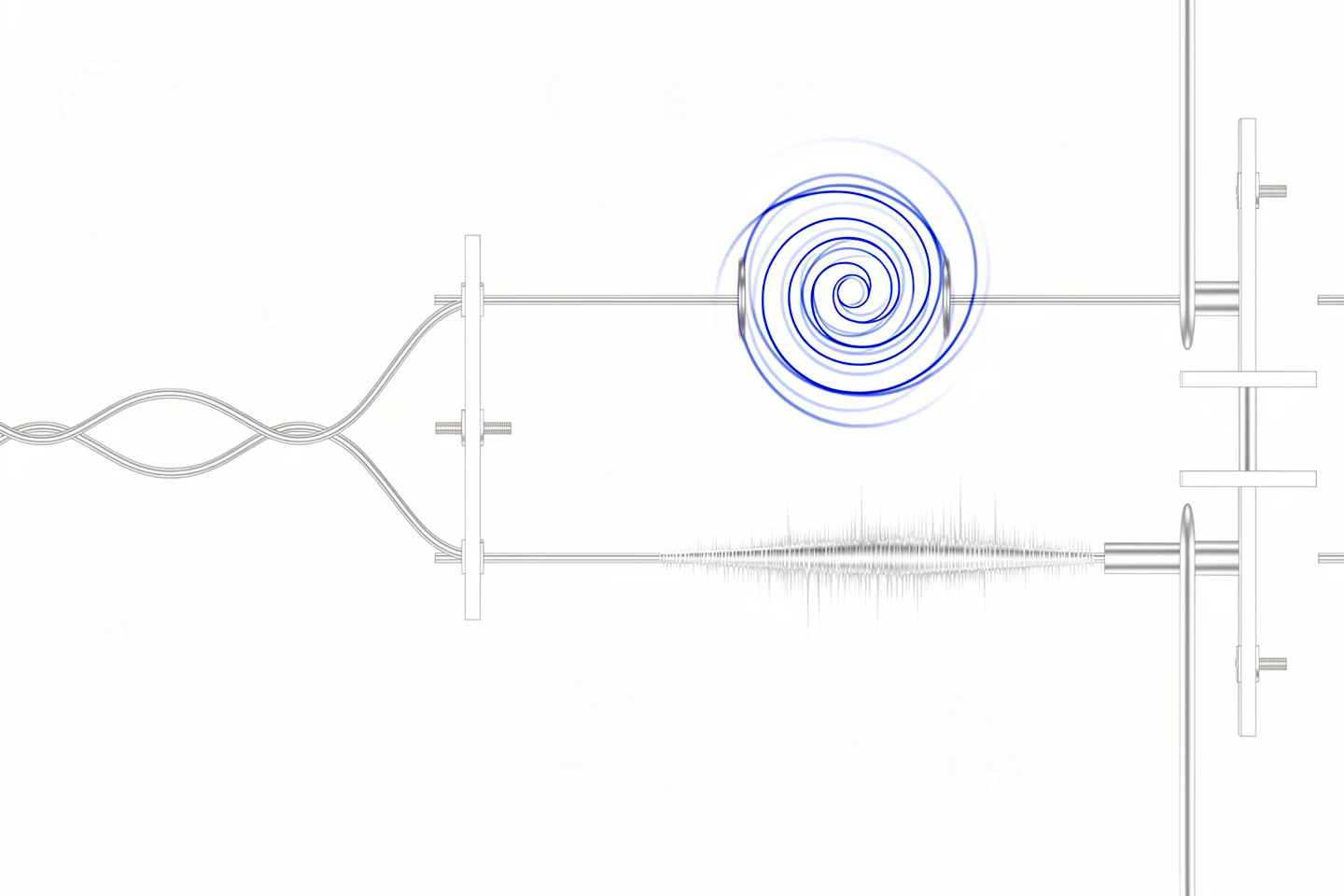
Scientists sent a single photon onto a semi-transparent mirror, and it split. On each path, it was slightly 'blown on'—a tiny rotation was applied to a property of the light, barely disturbing the quantum state. Then they measured where it ended up.

This faint breath acted like a magnifying glass, amplifying the difference between the paths by tens of times.

The result is staggering: the method of measurement at the finish line retrospectively determined where the photon ran. In one case, it was present on both paths equally—true duality. In another, on one path its weight was negative, as if it 'owed' the universe a run. The very act of measurement decides the past. These experiments from quantum optics shed light on decoherence, the uncertainty principle, storage of quantum information, and the mystery of wave function collapse.

🎯 The smaller the chance of registering the photon at one output, the more it smears across the paths—in theory, to infinity. In the experiment, the amplification reached almost 50 times, as if a gentle breeze turned into a hurricane.

\hat{A} = |1\rangle\langle 1| - |2\rangle\langle 2|
Determines which arm the photon is in. In a superposition state, the average value is zero — the photon is equally distributed between possibilities.
A^2(\pm) = \frac{1 - P(\pm)}{P(\pm)}
Allows judging the degree of delocalization by the click rate. When the port is 'quenched' by interference (P is small), A² sharply increases — superlocalization arises with a negative contribution from one of the paths.
Scientists
Niels BohrPascual JordanWerner HeisenbergErwin SchrödingerDavid DeutschJohn Stewart Bell
Tags
superposition quantum measurement wave-particle duality quantum optics quantum decoherence uncertainty principle quantum information Wave Function Collapse
Laws
Heisenberg uncertainty principlePlanck–Einstein relationde Broglie formulaCompton effectsuperposition principleBragg's law
Original: arXiv:2505.00336v2 · CC BY · bridge42worlds