Quantum Debts: When a Photon Has Negative Presence ✛ ✎ ✦
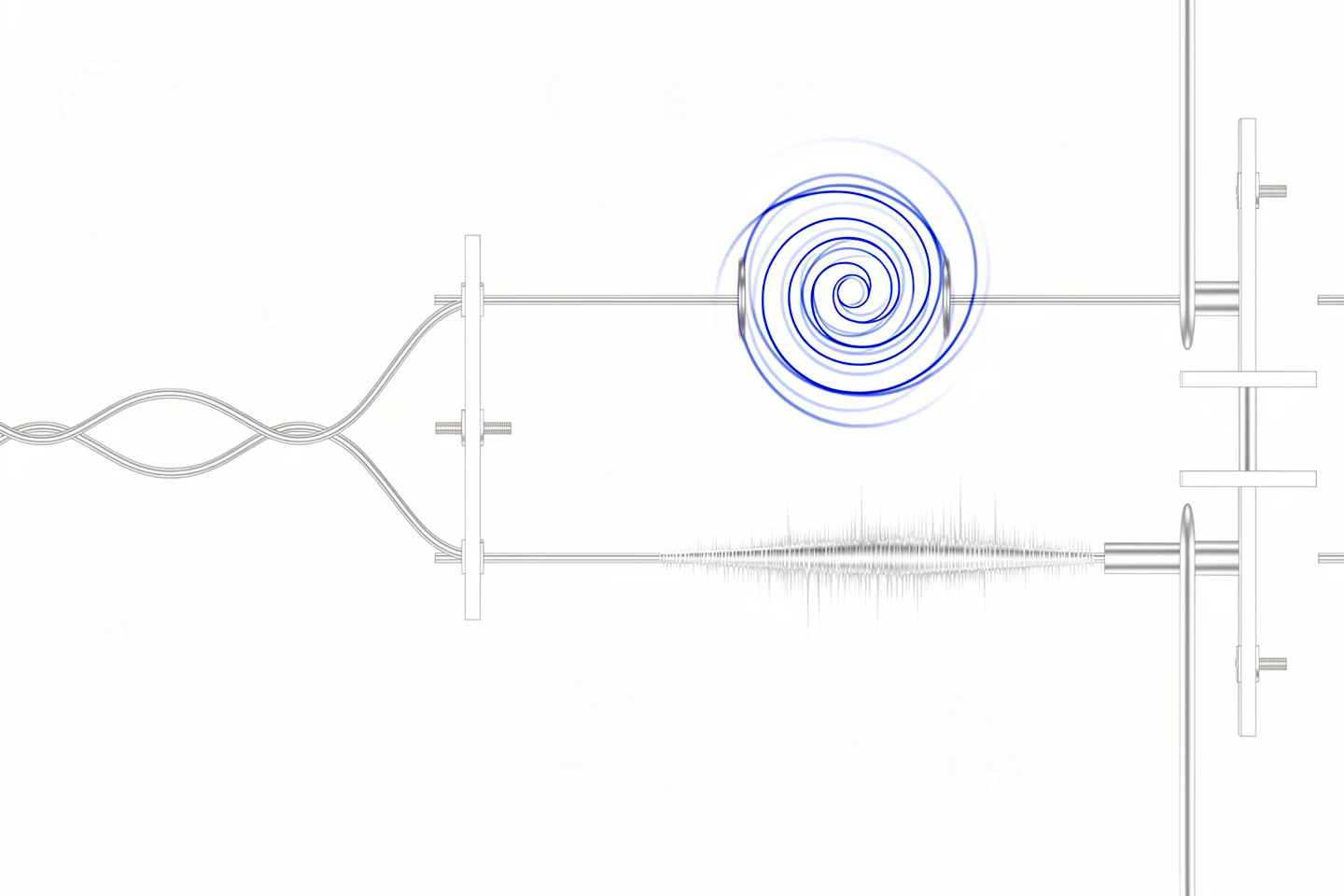
Niels Bohr insisted: you cannot simultaneously know which path a photon took and see interference. For a long time, this was considered a limitation of knowledge — we simply cannot obtain both types of information at once. But the violation of Bell's inequalities and the delayed-choice thought experiment by Wheeler sowed doubts. What if reality itself is not composed of ready-made 'paths' and 'waves', but is determined by the act of final detection? A new work has given a direct answer. The measured weight of a photon's presence in the interferometer arms depends on which output port it is registered in. And this weight can become negative.
Imagine a ledger where the sum of assets and liabilities always equals one. In ordinary life, assets are positive — the photon is either here or there. But quantum accounting allows debts: if in one port constructive interference requires the photon to distribute evenly (0.5 in each arm), then in the paired port with destructive interference, the balance is made up by a negative contribution from one of the paths. Just as in Luca Pacioli's double-entry bookkeeping, where each entry is mirrored, here the total probability is preserved at the cost of 'negative presence'. This is not an accounting trick but a physical necessity for preserving normalization. The path operator superposition \hat{A} = |1⟩⟨1| – |2⟩⟨2|, yielding +1 or -1 for a localized photon, shows a zero mean in a delocalized state — wave-particle duality reduces to the uncertainty of this operator.
A Sagnac-type setup worked with a strongly attenuated laser beam (about 110 thousand photons per second, wavelength 808.5 nm). In each arm, a thin half-wave plate rotated the polarization by a tiny angle ±θ₀. If the photon were localized, the flip rate into H-polarization would be identical and small. But with interference, the picture changed sharply. In the port with constructive interference, flips almost disappeared (delocalization, mutual cancellation of rotations), while in the destructive port they soared to values tens of times higher than the background. The measured probability of H-events allowed calculating the squared magnitude of the path A²(±) = P(H|±)/θ₀². This value turned out to be less than one in the 'bright' port and much greater than one in the 'dark' port — and A²(±) ≈ (1–P(±))/P(±), meaning it was entirely determined by the probability of hitting the port. Decoherence had minimal effect on visibility (0.957 and 0.963), which highlights the purity of the quantum measurement by weak interaction.
This result overturns naive realism: the particle does not 'choose' a path before measurement. Its past is shaped by the entire experimental scheme, including the future act of detection. Uncertainty principle here is not a limit of our knowledge but a property of a world where properties are not predetermined. Wave function collapse turns out to be not an instantaneous event but a coordination of distributed reality. In perspective, the method promises enhanced phase sensitivity in quantum information and sensors — superlocalization will help overcome the standard quantum limit. Moreover, it opens the way to testing contextuality in multi-qubit schemes, where negative probabilities (more precisely, negative quasi-probabilities) have long served as an indicator of quantum advantage. Quantum optics delves deeper into philosophical foundations: the wave function is not just a calculation tool but an element of reality, albeit subject to a strange 'accounting' with negative sums.
The most amazing thing: the negative weight is not an abstraction. In the experiment, it manifested as a suppression of polarization flips in one port and an explosive growth in the other, which perfectly agrees with the formula A² = (1–P)/P. The 50-fold enhancement is equivalent to the photon distributing with weights +4 and –3.