Experimental confirmation of single-photon delocalization in an interferometer ✛ ✎ ✦
Context
From the early days of quantum mechanics, Niels Bohr insisted that one cannot simultaneously know which path a photon took and observe interference — that's the complementarity principle. However, the violation of Bell's inequalities and the delayed-choice thought experiment of Wheeler showed that quantum reality does not fit into the framework of measurement-independent properties. This work provides the first direct experimental answer: wave-particle duality is not just a statistical regularity, but a consequence of the physical delocalization of the particle, which depends on the subsequent measurement.
Methods
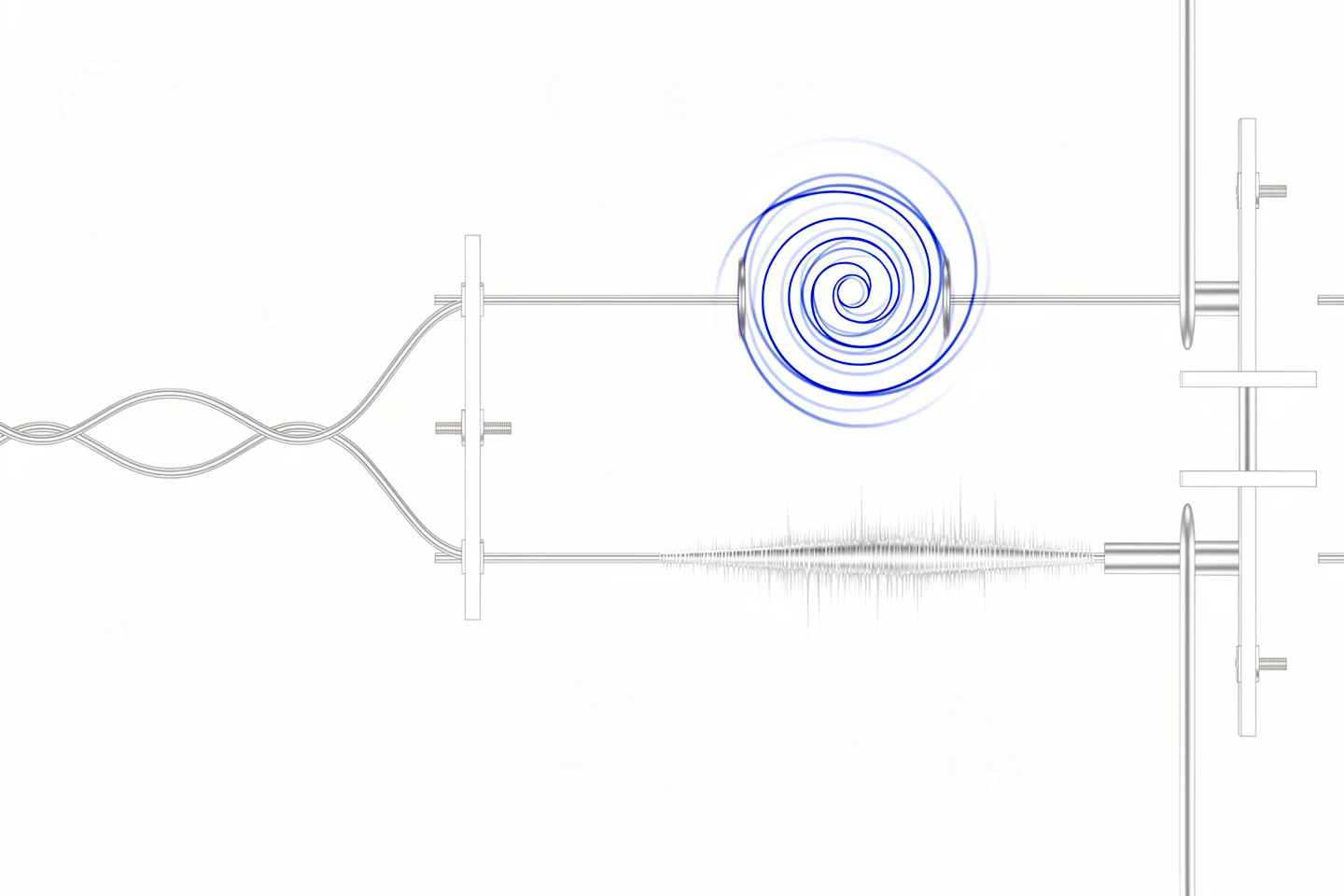
In a Sagnac-type setup, a laser beam (808.5 nm) was attenuated to a rate of ~110,000 photons per second. Vertically polarized photons hit a 50:50 beam splitter, creating a superposition of two paths. In each arm, a half-wave plate rotated the polarization by a small angle +θ₀ and –θ₀ (θ₀≪1). Since the probability of flipping to H-polarization depends only on the square of the angle, localized photons would yield the same flip rate. But under interference the rate changed: suppression indicated delocalization (mutual cancellation of rotations), while enhancement indicated hyper-localization (effective sign flip of the rotation due to a negative 'share' of the photon in one path). Measurements were taken for 32 phases, accumulating signal for 100 seconds per polarization at each output port.
Results
The interference pattern had a visibility of 0.9575 and 0.9629, despite the small decoherence effects introduced by the rotations. Under constructive interference, the H-flip probability P(H|±) dropped below the localized-photon level (~0.015), reaching values close to zero — the photon was equally shared between the paths (ideal delocalization). Under destructive interference, P(H|±) increased dramatically: to 0.857±0.005 at the minus port and 0.663±0.002 at the plus port, corresponding to A² values of up to 57.80 and 41.78. This means that in one arm the photon 'was present' with a weight larger than 7, and in the other with a negative weight, compensating for the overall normalization. Such hyper-localization is necessary to maintain the average A²=1, as in a direct path measurement, and is directly linked to the suppressed click probability of the port: A²(±) ≈ 1/P(±).
Implications
The experiment shatters the classical notion that a particle is always in a definite place before measurement. The uncertainty principle here manifests not as a limitation on simultaneous knowledge, but as a contextual dependence of reality itself. This deepens our understanding of quantum information and the measurement process: weak interactions allow us to extract information about the system without destroying interference, and demonstrate that a particle's past is shaped by its future measurement. Wave function collapse turns out to be not an instantaneous event but the result of the entire experimental configuration coming to terms.
Future development
The method can be extended to multi-beam interferometers and entangled states. Of particular interest is the practical use of hyper-localization to boost phase sensitivity in quantum metrology — exceeding the standard quantum limit is expected. Adaptation for testing contextuality in quantum computing circuits is also possible.
Impact
The results will impact fundamental physics, quantum optics, the development of quantum sensors, and potentially the philosophy of science.
Next steps
Immediate plans include implementing a metrological protocol based on hyper-localization and exploring the method's applicability limits under high loss and decoherence.
Key open problems
The work is directly related to the measurement problem: is the wave function an epistemic or an ontic entity? The obtained data tip the scales in favor of an ontic interpretation, where superposition is a real but context-dependent distribution. This also sheds light on the 'Wigner's friend' paradox and the link between information and reality.
The knowledge machine's view
This section is addressed to the author of the paper and their colleagues. Neighbouring works were found by meaning-based search across our archive, not by word overlap. We do not review: we show the field around the work.
What the work does
The paper experimentally investigates the delocalization of single photons in a Sagnac interferometer. Using weak polarization measurements, it is shown that the degree of photon presence in the arms depends on the outcome at the output port: for a high-probability outcome, the photon is delocalized; for a low-probability outcome, it is superlocalized with a negative 'share' in one of the paths.
Where its strength is
Direct measurement of A² values, including values far exceeding 1, and the demonstration of a link between outcome probability and degree of localization provide a clear quantitative tool for analyzing the role of measurement in shaping quantum reality.
Where it could go next
- It might be interesting to compare the obtained contextual picture with the idea of a quantum switch, where the order of operations becomes indefinite. Nearby lies a work in which such a switch breaks the usual flow of time—this could help fit superlocalization into a broader formalism of causality.based on: Quantum Switch Breaks the Usual Flow of Time arXiv:2508.04643
- The observed negative shares resemble quasiprobability representations arising in reality exchange. In our archive, there is an article where realities swap places without the observer's knowledge—its approach could offer an alternative interpretation of negative weights as a consequence of exchanging branches of the wave function.based on: How to Swap Your Reality Without Knowing arXiv:2512.14377
Worth trying
- Test whether the A² ~ 1/P(±) relationship holds when controlled decoherence is introduced in one of the arms—this would show the robustness of superlocalization.
- Try a scheme with a quantum switch, where polarization rotations in the arms are applied in a superposition of orders, and measure how this affects the distribution of A².
- Using the idea of reality exchange, attempt to recover negative shares from joint weak measurements at two ports and compare with the direct method.
Why this may matter
This experiment offers a rare opportunity to quantitatively trace how the measurement outcome 'retroactively' redistributes the particle's presence in space, and could serve as a testbed for new models of quantum causality.
Nearby works in our archive
- Entanglement That Can't Be Broken: Photons in Invulnerable Quantum Communicationsimilarity 0.61
- How Motion Teaches a Detector to Distinguish Directionssimilarity 0.60
- Gravity Entangles Light and a Rotating Objectsimilarity 0.59
- The Key to Quantum Gravity Lies in a Single Atomsimilarity 0.59
- Two Times in the Quantum Worldsimilarity 0.59
- How to Swap Your Reality Without Knowingsimilarity 0.59
- Quantum Switch Breaks the Usual Flow of Timesimilarity 0.58
The closest work in the archive sits at 0.61 by meaning — the usual level for our corpus.
Theoretically, as the port click probability approaches zero, the hyper-localization A² can become arbitrarily large, limited only by experimental visibility. In our experiment, the enhancement was ~50 times, equivalent to the photon being 'smeared' across the arms with weights +4 and –3.
Key numbers
- Interference visibility: 0.9575 (+ port) and 0.9629 (– port)
- H-flip probability for localized photons: ~0.015
- Maximum hyper-localization A²: 57.80±0.34 (– port) and 41.78±0.17 (+ port)
- Photon count rate: ~110,000 per second
- Laser wavelength: 808.5 nm