Quantum Data Centers: Why Entanglement Changes Everything ✛
Context
Quantum computers are hitting a physical ceiling: a single cryostat can only hold a few dozen qubits because of crosstalk and overheating. To overcome this barrier, the community has turned to distributed computing, an idea familiar from classical data centers. Work on quantum networks is already underway: some groups are exploring entanglement as a data packet, others are using optical switches to connect processors. Against this backdrop, quantum data centers stand out as a pragmatic next step: not a global network, but a local infrastructure where several quantum computers sit in the same building.
Methods
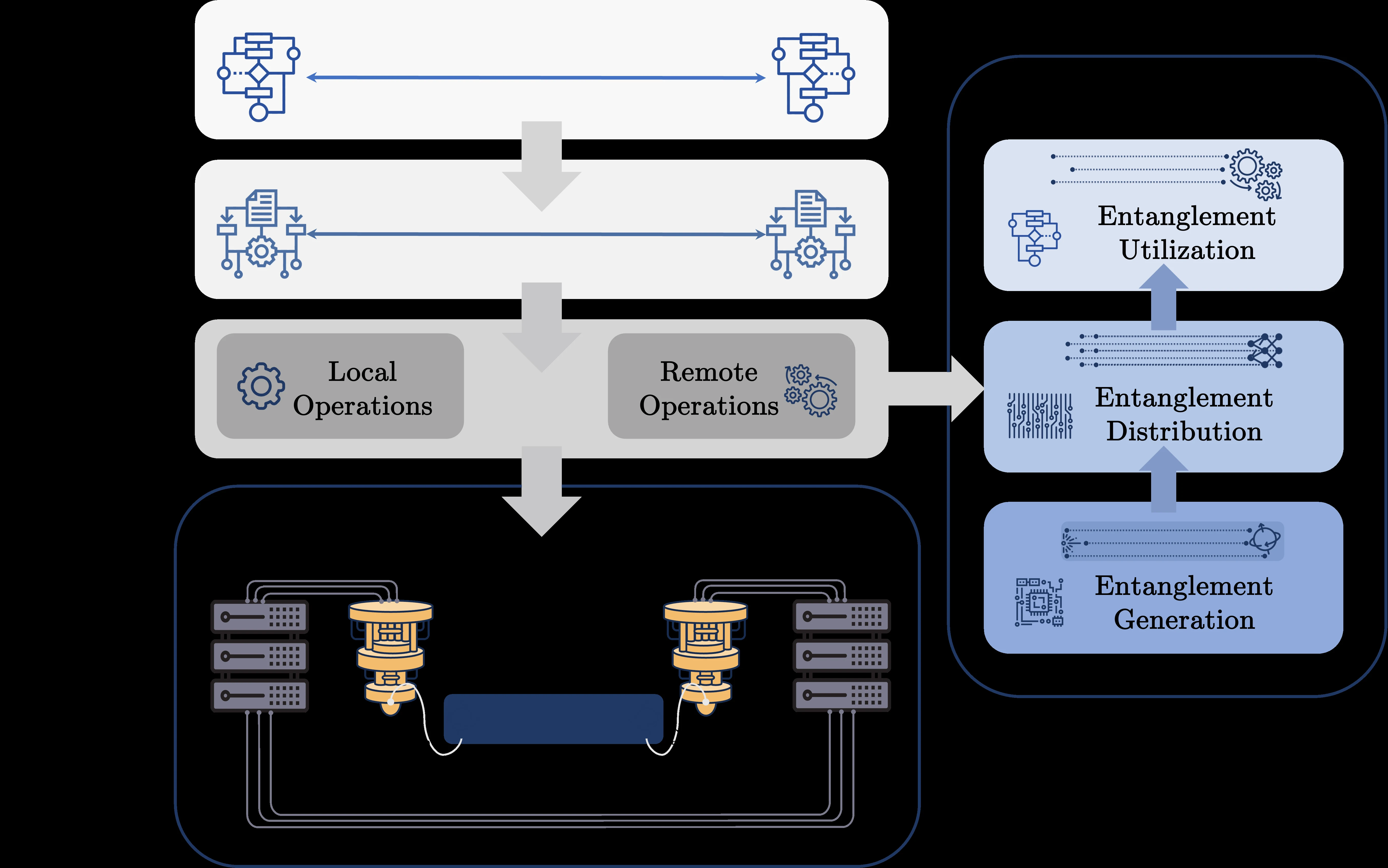
The authors build an architectural model of a quantum data center based on three functional blocks: generation, distribution, and use of entanglement. They compare two transduction methods, direct qubit conversion and entanglement generation, and analyze their success probabilities. For network topology, they introduce a hierarchy: an orchestrator generates multipartite entangled states (graph states) and distributes them to clients, then uses local Pauli measurements to rewire virtual connections. The model is tested on examples: from star to bus, from merging linear graph states to dense artificial topologies.
Results
The key result is demonstrating that the physical topology of a quantum local network can be sparse, while the logical topology can be arbitrarily dense. By holding onto some qubits of a graph state, the orchestrator can create artificial connections between any clients using local operations. For instance, merging linear graph states yields a bus, and X-basis measurements shorten the distance between nodes. The authors also show that entanglement generation via transduction (EGT) relaxes the efficiency requirements compared to direct qubit transfer (DQT). To scale beyond a single data center, they propose four archetypes of inter-network topologies: peer-to-peer, role delegation, clients hand-over, and extranet.
Implications
This work aligns with the broader research on quantum networks but stands out for its emphasis on engineering feasibility: instead of abstract protocols, it focuses on concrete hardware constraints. Neighboring works focus on entanglement as a resource or on optical switches; here, the central role is played by the orchestrator as a physical node that absorbs the complexity. This is not the first test of the idea, but it is a systematization: the authors bring together transduction, graph states, and topological engineering within a single architecture.
Future development
The next logical step is moving from a single data center to quantum hubs: connecting multiple QLANs via a mesh network of orchestrators. An open question is whether inter-network topologies can be realized on n-star graph states using only local operations. Standardization of transduction metrics is also needed: efficiency alone is not enough; one must account for encoding type and noise characteristics.
Impact
Quantum data centers could become a testing ground for quantum internet technologies before the global network becomes a reality. This will influence the design of quantum processors, network protocols, and compilers.
Next steps
The immediate next steps are experimental implementation of EGT with high efficiency and testing topological engineering on real graph states. In parallel, we need to investigate how classical coordination (latency, synchronization) limits scaling.
Key open problems
In quantum computing, the problem of decoherence remains unsolved: qubits live for milliseconds, while network operations take time. Quantum data centers do not solve this, but they shift it to the architectural level: if you cannot extend a qubit's life, spread the computation across many qubits and link them via entanglement.
The knowledge machine's view
This section is addressed to the author of the paper and their colleagues. Neighbouring works were found by meaning-based search across our archive, not by word overlap. We do not review: we show the field around the work.
What the work does
The authors build an architectural model of a quantum data center based on three functional blocks: generation, distribution, and use of entanglement. They compare two transduction methods—direct qubit conversion and entanglement generation—and analyze their success probabilities. The key result is the demonstration that the physical topology of a quantum local network can be sparse, while the logical topology can be arbitrarily dense.
Where its strength is
The strength lies in the engineering concreteness: the orchestrator as a physical node that, through graph states and local Pauli measurements, takes on the complexity of dynamic network reconfiguration. This allows building dense logical topologies on top of a sparse physical one.
Where it could go next
- It might be interesting to view entanglement as a data packet in a broader network perspective: how could the orchestrator interact with quantum internet protocols if the data center becomes a node of a larger network?based on: Quantum Internet: How Entanglement Became a Data Packet arXiv:2505.02057v4
- There is related work on optical switches for connecting processors; perhaps their ideas on multiplexing and routing optical channels could be adapted for the orchestrator to reduce transduction requirements.based on: Quantum Networks: How Optical Switches Link Processors arXiv:2501.05598
- Our archive contains an analysis of imperfect transducers that build quantum bridges; it considers realistic transduction parameters, which could help refine the success probability model in your architecture.based on: Light in a Cryostat: How Imperfect Converters Build Quantum Bridges arXiv:2505.00542v1
Worth trying
- Test the orchestrator concept in a simulation with transduction parameters from the work on imperfect transducers, to estimate realistic throughput.
- Check whether optical switches can be used to dynamically allocate optical channels between the orchestrator and clients, reducing the number of simultaneous transductions.
- Compare the model of entanglement as a data packet with the orchestrator's graph states: perhaps the orchestrator can generate states optimized for specific network requests.
Why this may matter
If the entanglement orchestrator becomes a standard component of quantum data centers, it could accelerate the transition from isolated quantum computers to practically useful distributed computing.
Nearby works in our archive
- Quantum Internet: How Entanglement Became a Data Packetsimilarity 0.65
- Quantum Networks: How Optical Switches Link Processorssimilarity 0.65
- The Cold Brain of a Quantum Computersimilarity 0.60
- Quantum Cold: How Wires Don't Get in the Way of Computingsimilarity 0.59
- Light in a Cryostat: How Imperfect Converters Build Quantum Bridgessimilarity 0.59
The closest work in the archive sits at 0.65 by meaning — the usual level for our corpus.
Breaking a 2048-bit RSA key requires about 4099 logical qubits, which translates to between 10,000 and 10,000,000 physical qubits when accounting for error correction. Current quantum computers have only dozens of physical qubits.
The idea of a quantum data center echoes the 'quantum entanglement' in Liu Cixin's novel 'The Three-Body Problem', where sophons use entanglement for instantaneous communication. In reality, entanglement does not transmit information faster than light, but it allows quantum states to be teleported without physically moving particles.
Key numbers
- logical qubits to break RSA-2048: 4099
- physical qubits to break RSA-2048: 104–107
- frequency gap between superconducting and optical qubits: 5 orders of magnitude
- temperature of superconducting qubits: tens of millikelvin
- distance between qubits in a data center: from a room to a building