Quantum Data Centers: How Entanglement Weaves the Network ✛
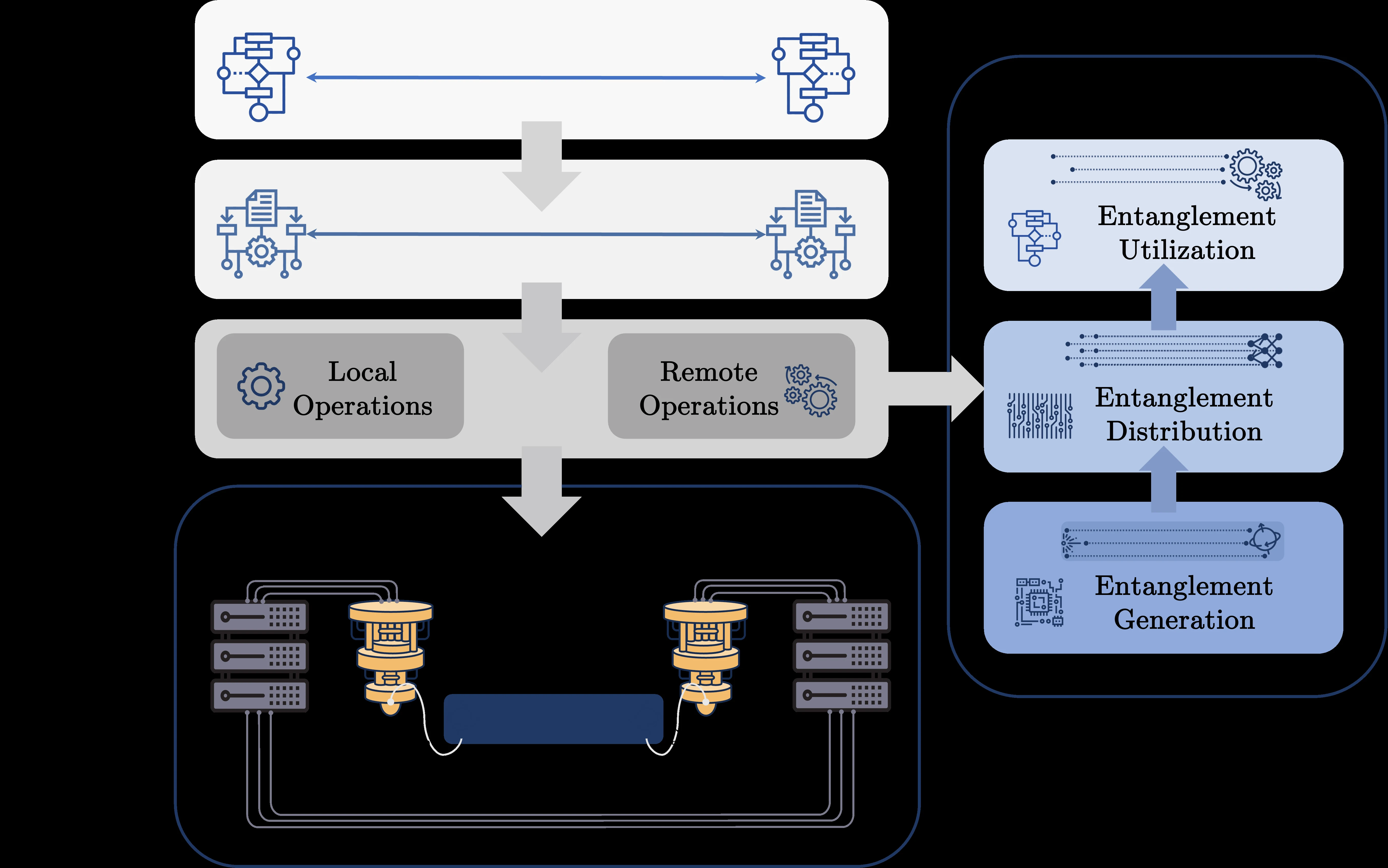
Inside a cryostat cooled to tens of millikelvins live superconducting qubits. There aren't many of them: tens, at most hundreds. Crosstalk and thermal noise prevent packing more. But cracking RSA-2048 requires anywhere from ten thousand to ten million physical qubits. That gap of five orders of magnitude is like the difference between a bicycle and a rocket.
An orchestrator is a conductor who, from a single score of entanglement, can create any melody of connections. It generates graph states, entangled structures where nodes are linked according to a graph pattern. By keeping some qubits to itself, the orchestrator uses local Pauli measurements to rewire virtual connections between clients. The physical wiring stays the same, but the logical topology can change at will. From a linear graph state, fusion creates a bus, and X-basis measurements shorten the distance between nodes.
A quantum data center is not a global network but a local infrastructure: several quantum computers in the same building. They are connected by optical channels that operate at room temperature. Transduction is the bridge between the cryogenic world of qubits and the optical world of photons. The frequency gap is five orders of magnitude. Bridging it means giving qubits the freedom to move.
The next step is quantum hubs: combining several data centers through a mesh network of orchestrators. It remains an open question whether inter-network topologies can be realized on n-star graph states using only local operations. Standardization of transduction metrics will be needed: efficiency alone is not enough; the encoding type and noise characteristics must be considered. Decoherence, the loss of quantum properties due to interaction with the environment, remains a fundamental problem. Quantum data centers do not solve it, but they shift it to the architectural level: if you cannot extend a qubit's lifetime, spread the computation across many qubits and link them with entanglement.
The cryostat is still cold. But now the cold is not a prison but a launching pad. The orchestrator conducts, and entanglement sounds louder and louder.
Cracking a 2048-bit RSA key requires about 4099 logical qubits, which translates to between 10,000 and 10,000,000 physical qubits when accounting for error correction. Current quantum computers have only tens of physical qubits.
The idea of a quantum data center echoes the "quantum entanglement" in Liu Cixin's novel "The Three-Body Problem," where sophons use entanglement for instantaneous communication. In reality, entanglement does not transmit information faster than light, but it allows quantum states to be teleported without physically transferring particles.