Optical links for scalable quantum computers: how microwave-to-optical converters pave the way for distributed computing ✛ ✎ ✦
Context
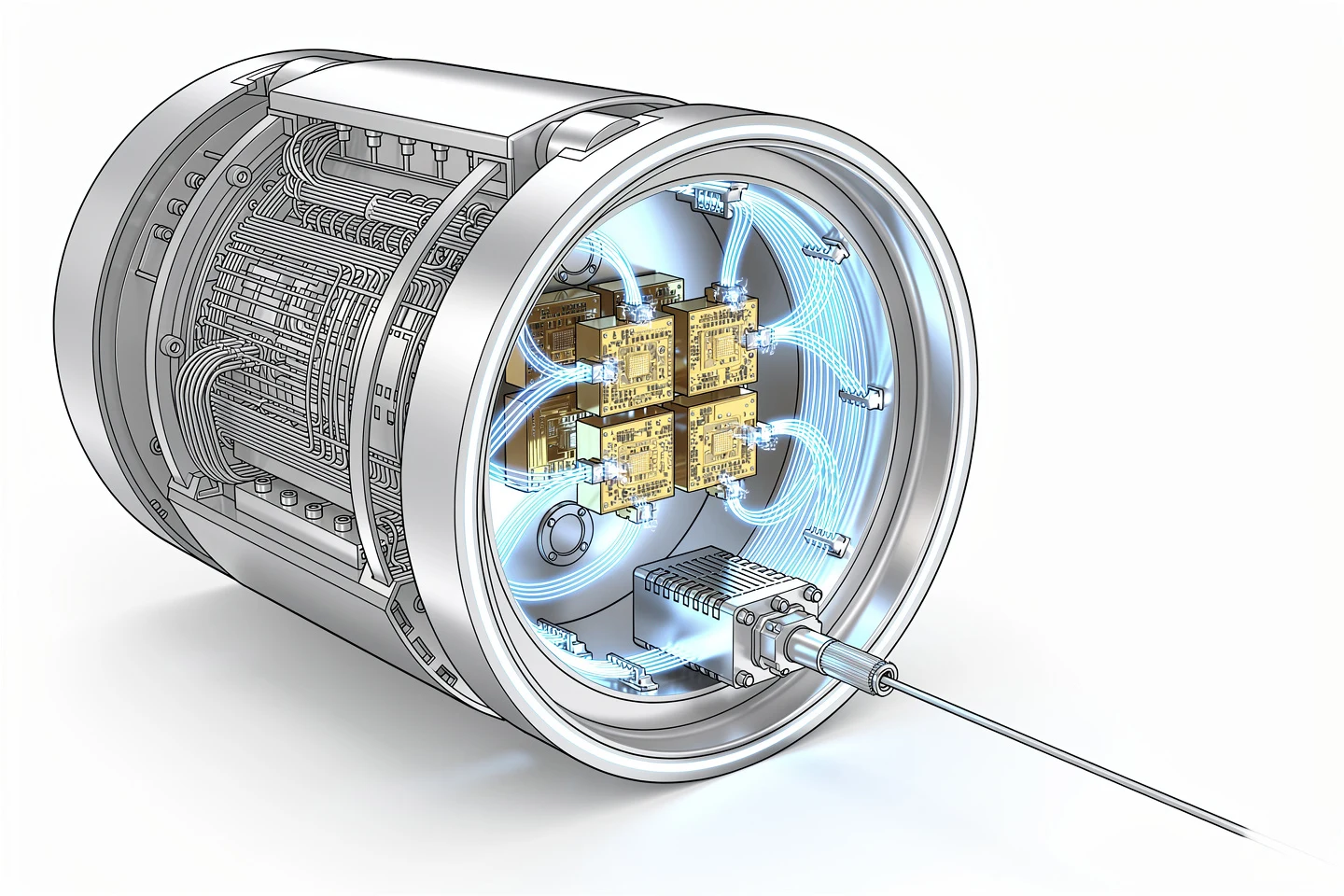
To build a quantum computer capable of solving practically important problems, millions of qubits are needed. However, leading platforms like superconducting circuits face a fundamental limitation: heat removal in cryostats. Scaling is only possible by linking multiple modules through quantum channels. Optical photons are ideal carriers of quantum information thanks to low loss and noise resilience even at room temperature. The key element is a converter from microwave signals (on which qubits operate) to optical ones. The concept of quantum computing laid down by Richard Feynman demands scaling, and this is exactly the approach explored by the authors.
Methods
The authors consider two types of converters: electro-optic and electro-optomechanical, based on the Pockels effect and optomechanical interaction. These devices, built on lithium niobate or silicon chips, parametrically enhance the coupling between microwave and optical fields using a laser pump. Despite current efficiencies on the order of 10⁻³–10⁻² and added noise, protocols for on-demand entanglement generation have been proposed. For instance, using two-mode squeezing or up-conversion followed by Bell measurement (John Stewart Bell) on a beam splitter setup. To compensate for losses, repeated attempts with a fixed delivery time are used, and quantum decoherence is mitigated by storing states in long-lived memory qubits. The entanglement purification procedure was advanced, in particular, by Charles Bennett.
Results
Simulations show that even with current converter parameters (microwave loading efficiency 0.8, noise 0.1 photons per attempt, repetition rate 1 MHz) one can obtain entangled pairs with 91% fidelity in 15 microseconds using 20 parallel channels. After four rounds of quantum distillation, the fidelity rises to 99%. This exceeds the threshold for error correction in the surface code (90%). With more optimistic parameters (noise 0.01, optical detection efficiency 0.5), a single line delivers 91% fidelity in 400 microseconds. Thus, even imperfect converters can create high-quality links.
Implications
The work shows that implementing optical links does not require perfect converters. This changes the development strategy for quantum computers: instead of chasing maximum efficiency, one can focus on integration and scaling up the number of channels. The achieved fidelities are sufficient for algorithmic advantages, for instance, in generating GHZ states or performing the Bernstein–Vazirani test.
Future development
In the coming years, experimental demonstration of optical entanglement between two cryostats is expected. Further material improvements (e.g., quasi-two-dimensional optomechanical crystals) and reduced heating from the optical pump will allow efficiencies above 50% and noise below 0.01. This will pave the way for full-scale lattice surgery—stitching logical qubits through optical channels at every error correction cycle.
Impact
Such distributed systems will impact the development of quantum algorithms, cryptography, and materials simulation. Quantum data centers will be able to pool resources of thousands of qubits, solving problems beyond the reach of classical supercomputers.
Next steps
Next steps include implementing non-destructive state transfer between a qubit and the converter, integration with optical memory, and scaling to hundreds of channels per cryostat.
Key open problems
This work is directly linked to the fundamental problem of scaling superconducting quantum systems and overcoming decoherence in extended channels. The proposed methods are also relevant for building the quantum internet.
The knowledge machine's view
This section is addressed to the author of the paper and their colleagues. Neighbouring works were found by meaning-based search across our archive, not by word overlap. We do not review: we show the field around the work.
What the work does
This study tackles the challenge of scaling superconducting quantum processors by linking modules via optical lines through microwave-to-optical transducers. We simulated on-demand entanglement generation protocols with feedback, parallelization, and distillation, showing that fidelities above 99% are achievable even with current non-ideal transducer parameters.
Where its strength is
The strength of the work lies in demonstrating that practical scalability does not require perfect transducers: combining parallel channels with classical post-processing allows building high-fidelity quantum links on existing hardware.
Where it could go next
- It might be interesting to see how the proposed optical link architecture fits into the broader quantum internet concept, where entanglement is treated as a resource transmitted in packets—this could help unify protocols and connection management.based on: Quantum Internet: How Entanglement Became a Data Packet arXiv:2505.02057v4
- A related work studies combining processors via optical switches in quantum networks; perhaps their approach to routing and channel multiplexing could suggest ways to more efficiently use the multiple parallel lines considered in your simulation.based on: Quantum Networks: How Optical Switches Link Processors arXiv:2501.05598
Worth trying
- Try applying the batch entanglement transmission model from the quantum internet paper to optimize the schedule of generation attempts in parallel channels.
- Assess whether the idea of optical switches could be used to dynamically reallocate optical resources among modules based on current entanglement demand.
- Compare the proposed distillation scheme with similar procedures in quantum networks to identify potential simplifications or improvements leveraging network topology.
Why this may matter
The demonstrated possibility of scaling without breakthroughs in device physics could shift the development focus from improving individual transducers to system integration and network protocols, bringing distributed quantum computing centers closer to reality.
Nearby works in our archive
- Light Instead of Wires: A Quantum Computer on Fiber Opticssimilarity 0.75
- Quantum Networks: How Optical Switches Link Processorssimilarity 0.74
- Quantum Bridge of Lightsimilarity 0.71
- The Cold Brain of a Quantum Computersimilarity 0.69
- Quantum Cold: How Wires Don't Get in the Way of Computingsimilarity 0.68
- Quantum Internet: How Entanglement Became a Data Packetsimilarity 0.68
The archive is crowded around this work: 9 reviews nearby, closest at 0.75. This ground is well walked — and there is plenty to compare against.
Optical fibers used for classical telecommunications can transmit single photons over hundreds of kilometers without significant attenuation: this is the very basis of the quantum network idea.
Key numbers
- conversion efficiency: 0.01–0.5
- added noise: less than 0.1 photons per attempt
- repetition rate: 1 MHz
- entanglement delivery time: 15–400 µs
- required number of channels per cryostat: 100–10,000