Why the Climate Swings Without a Creak ✛
Original: "Statistics of stochastic entropy for recorded transitions between ENSO states"
· Sílvio M. Duarte Queirós
arXiv:2507.10516 · 2025-07-14 · CC BY 4.0 · 1 min
The warm and cold phases of the Pacific Ocean shift back and forth in an ordinary way, not as rare catastrophes.

The swing rocks back and forth. Sometimes strongly, sometimes barely noticeable. The Pacific Ocean also rocks: warm water off the coast of Peru gives way to cold water, and this changes weather across half the planet. The warm phase is called El Niño, and the cold phase is La Niña. Together they are ENSO, the climate swing.

Scientists track the swing with a single number: the air pressure difference between Tahiti and Darwin, Australia. This number is recorded every day. The author of the new study took all records from 1991 to 2023 and asked: how unusual are the transitions from one phase to another? To do this, he compared the probability of the forward path with the probability of the reverse. If the forward path is much more likely, then the transition was sharp and unusual.

It turned out that out of 11 transitions, only one was close to unusual: from the strong La Niña of 1999–2000 to the moderate El Niño of 2002–2003. All the others are like the ordinary rocking of a swing.

Previously, it was unclear whether climate transitions could be measured this way at all. Now it is clear: they can, and almost all of them are ordinary. This means the climate swing rocks without a creak. And if some transition turns out to be too sharp, that will be a signal that something is changing in the system.

El Niño literally translates from Spanish as 'the boy,' and La Niña as 'the girl.' The names arose because the warm current off Peru often appeared around Christmas, associating it with the Christ child.

\Delta S(\vec{s}) = -\ln\frac{p(s_{t_f}; \{s_{t_i},\ldots,s_{t_{f-1}}\})}{p(s_{t_i}; \{s_{t_{i+1}},\ldots,s_{t_f}\})}
Logarithm of the ratio of probabilities of forward and backward SOI trajectories
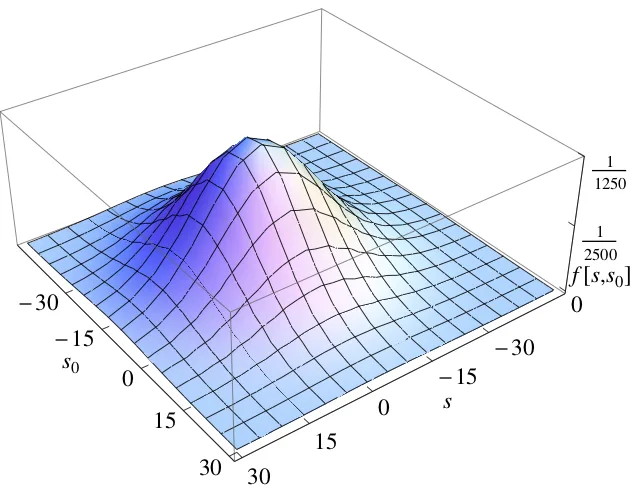
p_t^*(s) = \frac{1}{Z_t^*}\exp\left[\frac{a\beta+2b\alpha^2}{\alpha^2\sqrt{4\alpha^2\gamma^2-\beta^2}}\arctan\left(\frac{\beta+2\alpha^2(s-\Phi(t))}{\sqrt{4\alpha^2\gamma^2-\beta^2}}\right)\right]\left(\gamma^2+\beta(s-\Phi(t))+\alpha^2(s-\Phi(t))^2\right)^{-(1+\frac{a}{2\alpha^2})}
Probability distribution of SOI values given the background protocol
ds = D_1(s,t)\,dt + \sqrt{2D_2(s,t)}\,dW_t
SOI dynamics with drift and multiplicative noise
Scientists
Ludwig BoltzmannRudolf ClausiusJacob BekensteinStephen HawkingJames Clerk MaxwellEdward Witten
Concepts
ENSO El Niño index El Niño-Southern Oscillation Multivariate ENSO Index ERSST spring predictability barrier Southern Oscillation La Niña Jin-Timmermann model recharge oscillator model NOAA CPC interannual variability TAO/TRITON moorings natural variability Warm water volume relative ONI stochastic dynamical system seasonal cycle mixed mode oscillations Westerly wind burst