One in Three Sun-Like Stars Is Born with a Tilted Disk ✛
A spinning top tilted over a table, with a dusty pancake swirling around it. That is what a young stellar system looks like when the star's spin axis and the plane of its protoplanetary disk do not align. Until recently, astronomers did not know how common such a configuration is in nature. Now we have an answer: roughly one in three Sun-like stars is born with a tilted disk.
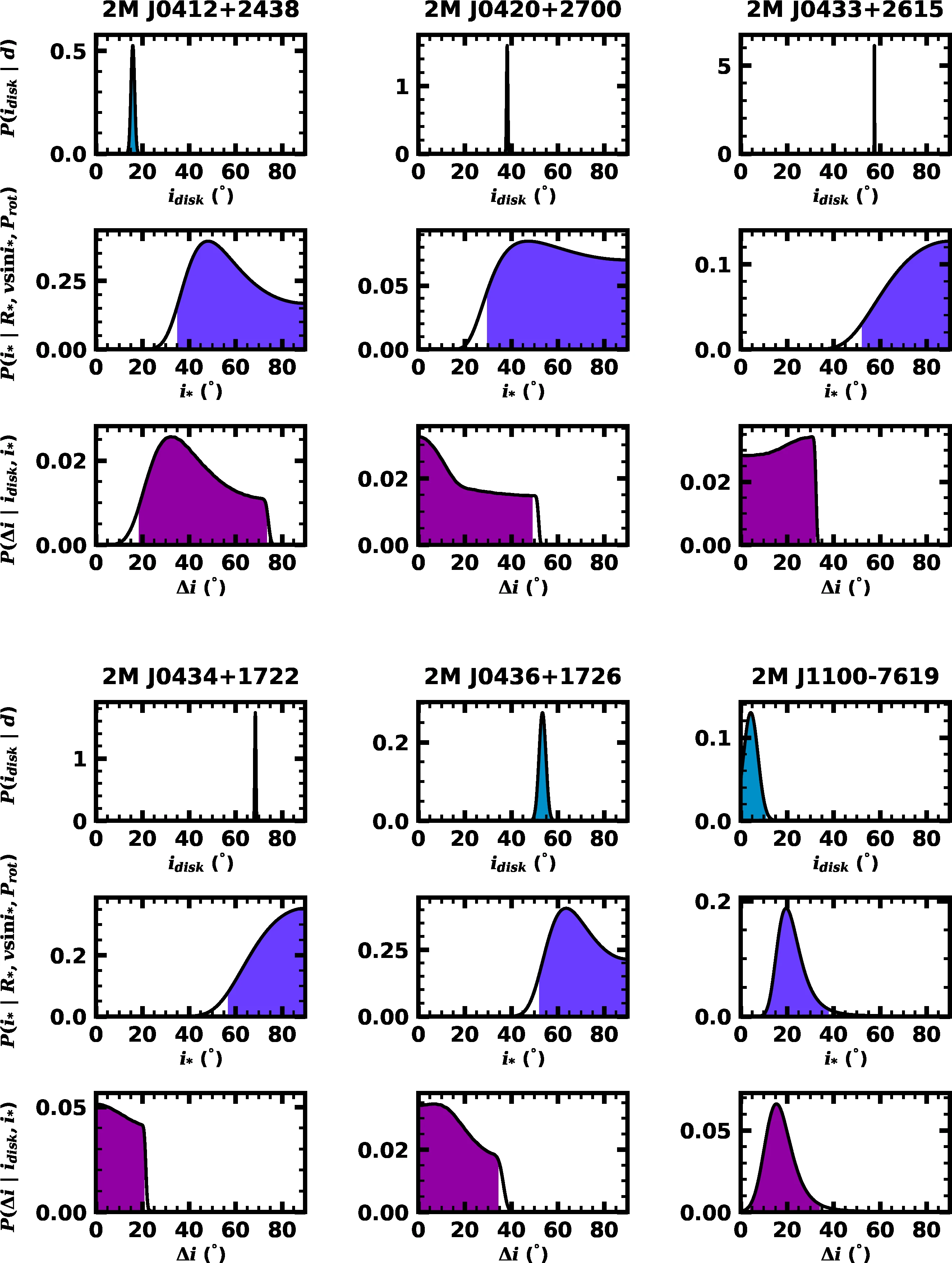
A team of researchers studied 49 isolated T Tauri stars, young variable stars of solar type with ages of 1–3 million years. For each system, they compared the tilt of the star's spin axis (the obliquity, or the angle between the spin axis and the orbital plane) with the tilt of the outer part of its protoplanetary disk, as observed in the millimeter range by the ALMA radio telescope. The star's inclination was derived from photometric data from the TESS and K2 space telescopes: knowing the rotation period, the projected rotation velocity, and the radius, one can calculate the angle at which we view the star. The minimum misalignment angle Δi between the star and the disk turned out to be 17° on average, but the distribution is broad, ranging from 0° to 60°.
The key result: by a significance criterion, 16 of the 49 systems (33±7%) are classified as tilted. This means that primordial misalignments are not rare but a common phenomenon in stellar nurseries. Moreover, no correlation was found between the tilt and mass, temperature, rotation period, or disk inclination; the misalignment arises independently of these parameters. The distribution of angles qualitatively resembles the distribution of orbital obliquities of hot and warm Jupiters around mature stars, hinting at a common origin.
This discovery changes our view of planetary system formation. Previously, orbital tilts of exoplanets were explained by late gravitational interactions, such as the migration of giant planets or the influence of companion stars. Now it is clear that some tilts may be inherited from the initial conditions, when the star and disk are still forming. Even the Sun's modest tilt (~6°) relative to the planetary orbital plane may not be a consequence of chaotic dynamics but a memory of the Solar System's birth.
The outlook for this work is a direct comparison of primordial tilts with the orbital inclinations of long-period planets that will be discovered by the new Gaia catalogs. If the distributions match, the hypothesis of a primordial origin of obliquities will receive strong support. For now, we see for the first time that the spinning top and the dusty pancake are often born already tilted, and that is the norm, not the exception.
The Sun at an age of 5 million years, according to evolutionary models, had an effective temperature of about 3800 K and a spectral class of roughly K9, noticeably cooler than today. Its current tilt relative to the planetary plane (~6°) is quite typical for the young stars in the sample.
In the TV series 'The Expanse' and James S. A. Corey's novels, the inclinations of asteroid and station orbits play a plot role, but there they are caused by artificial maneuvers. Here we are talking about the natural birth of obliquities before planets even form, a process that science fiction usually overlooks.