One in Three Sun-Like Stars Is Born with a Tilted Disk ✛
Context
The question of where the misalignments between stellar spin axes and planetary orbits come from remains open. Earlier measurements were limited either to small samples of young stars with disks or to systems with debris disks at intermediate ages. This work fills the gap: it is the first to statistically assess primordial obliquities for a sufficiently large sample of isolated young stars with protoplanetary disks, made possible by ALMA's sensitivity and precise photometric data from TESS and K2. The study stands apart: the nearest neighbors in the archive deal with disk chemistry, hot Jupiter orbits, or stellar rotation, but do not directly measure the primordial geometry of systems.
Methods
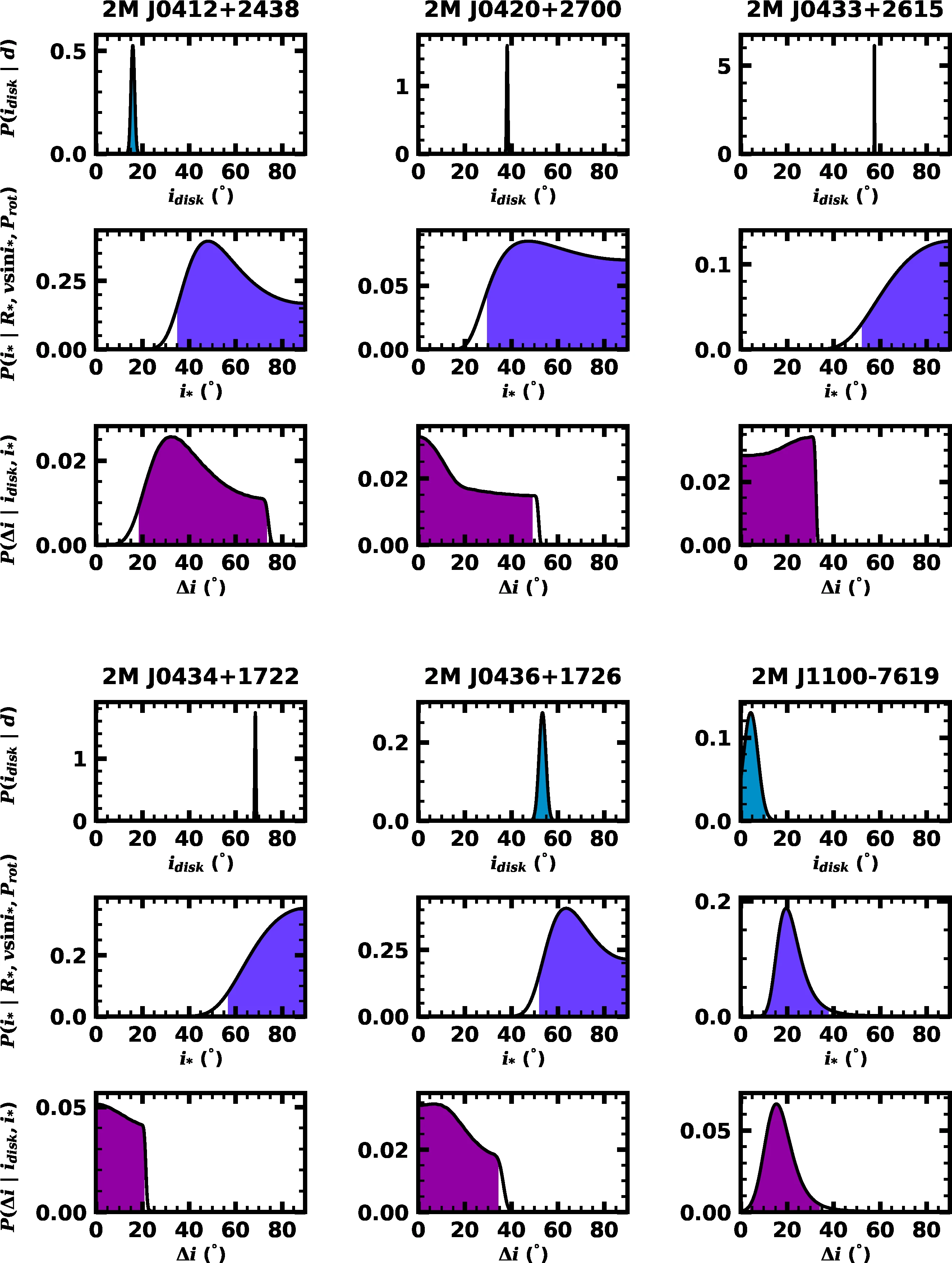
The sample consists of 49 single T Tauri stars with spatially resolved protoplanetary disks. Disk inclinations (idisk) come from ALMA observations at millimeter wavelengths, which are sensitive to dust in the outer regions (≥10 au). Stellar inclinations (i*) are determined using a Bayesian method from the projected rotation velocity (vsini*), rotation period (Prot), and radius (R*), accounting for the correlation between vsini* and equatorial velocity. Rotation periods were partly re-derived from TESS and K2 light curves using Lomb–Scargle periodograms. The minimum misalignment angle Δi is computed as the absolute difference between i* and idisk by random sampling from their distributions. To account for systematics, 25 tests were run with variations of Prot and R* by ±30%.
Results
The mean Δi across the sample is 17°, with a broad distribution peaking between 0° and 15° and a tail out to 60°. By a significance criterion (MAP Δi > 2σ from zero), 16 of 49 systems (33±7%) are classified as tilted. Threshold fractions: Δi ≥ 10° — 33%, ≥ 20° — 22%, ≥ 40° — 12%. No significant correlations of Δi with spectral class, mass, temperature, radius, period, vsini*, or disk inclination were found. Tests for systematics show that even with significant errors in Prot and R*, the fraction of tilted systems remains substantial. The Δi distribution is qualitatively similar to the distribution of orbital obliquities of hot and warm Jupiters around mature stars.
Implications
This work demonstrates for the first time that primordial star-disk misalignments are common, occurring in every third isolated young system. This sets it apart from previous studies, which either used small samples or looked at older systems with debris disks, where obliquities could have been modified by dynamics. The result suggests that some of the observed obliquities in mature planetary systems, including the Sun's moderate tilt (~6°), may be inherited from the initial conditions of formation rather than caused by late gravitational interactions.
Future development
A key next step is a direct comparison of the distributions of primordial obliquities and the orbital inclinations of long-period planets detected by direct imaging. With the release of the fourth Gaia catalog, thousands of three-dimensional orbits of cold Jupiters at distances up to ~7 au will become available, allowing a test of how much dynamics alters obliquities over time. It is also necessary to expand the sample of young stars with simultaneous measurements of inner and outer disk inclinations to assess the contribution of inner warps.
Impact
The results will affect models of planetary system formation and the interpretation of observed exoplanet obliquities. They also provide context for explaining the Solar System's tilt without invoking late perturbations.
Next steps
Increase the sample of young stars with measured disk and stellar inclinations, especially in star-forming regions of different densities. Compare the distributions of primordial obliquities with the orbital inclinations of planets from Gaia and direct imaging.
Key open problems
This work is directly related to the unresolved question of the origin of obliquities in planetary systems: whether they are primordial or acquired during dynamical evolution. It also touches on the connection between protoplanetary disk morphology and the architecture of mature systems, including the frequency of hot Jupiters and multi-planet systems with inclined orbits.
The knowledge machine's view
This section is addressed to the author of the paper and their colleagues. Neighbouring works were found by meaning-based search across our archive, not by word overlap. We do not review: we show the field around the work.
What the work does
The authors measured the minimum misalignment angles between the rotation axes of young Sun-like stars and the outer regions of their protoplanetary disks for 49 isolated systems, using ALMA data on disk inclinations and TESS and K2 light curves to determine stellar inclinations. They found that about one-third of the systems are significantly warped, and found no correlations with stellar or disk parameters.
Where its strength is
The strength of the work lies in the first statistical measurement of primordial misalignments for a sufficiently large sample of isolated young stars with protoplanetary disks, made possible by combining ALMA data and precise photometry.
Where it could go next
- It might be interesting to see how primordial misalignments relate to dust characteristics in disks, using approaches from a neighboring work on weighing dust around young stars.based on: Weighing the Dust Around Young Stars arXiv:2603.06230
- A nearby move is the analysis of rotation and binarity, which could help refine the influence of unseen companions on the measured misalignments.based on: How Spin and Hidden Companions Confuse Stellar Ages arXiv:2606.09485
- It would be interesting to compare the obtained misalignment distribution with data on dust halos around young stars to trace the evolution of system geometry.based on: Dust Halos Around Young Stars arXiv:2604.18332
Worth trying
- Check whether the fraction of warped systems changes when restricting the sample to stars without signs of binarity.
- Compare the measured misalignments with the dust mass in the outer disks to see a possible link between geometry and disk mass.
- Use data on dust halos to identify systems where the outer regions may have been perturbed by recent events.
Nearby works in our archive
- Cosmic Disks Flicker Like Candlessimilarity 0.56
- Dust and Time: How Distant Galaxies Growsimilarity 0.55
- The Age of Globular Clusters: What Dynamics Revealedsimilarity 0.54
- Radio Reveals Star Birth in the Early Universesimilarity 0.54
- How Spin and Hidden Companions Confuse Stellar Agessimilarity 0.54
- Seven Stars from One Doughsimilarity 0.54
- Dust Halos Around Young Starssimilarity 0.54
- Weighing the Dust Around Young Starssimilarity 0.53
The archive is sparse around this work: the closest review is only 0.56, against a usual 0.64. It looks like few have drilled nearby.
The Sun at an age of 5 million years, according to evolutionary models, had an effective temperature of about 3800 K and a spectral class of roughly K9, noticeably cooler than today. Its current tilt relative to the planetary plane (~6°) is quite typical for the young stars in the sample.
In the TV series 'The Expanse' and James S. A. Corey's novels, the inclinations of asteroid and station orbits play a plot role, but there they are caused by artificial maneuvers. Here we are talking about the natural birth of obliquities before planets even form, a process that science fiction usually overlooks.
Key numbers
- fraction of tilted systems: 33±7%
- mean minimum angle Δi: 17°
- maximum observed Δi: about 60°
- sample size: 49 systems
- stellar age: 1–3 million years