Diamond Chip with 49 Sites: A Quantum Sensor for DNA ✛
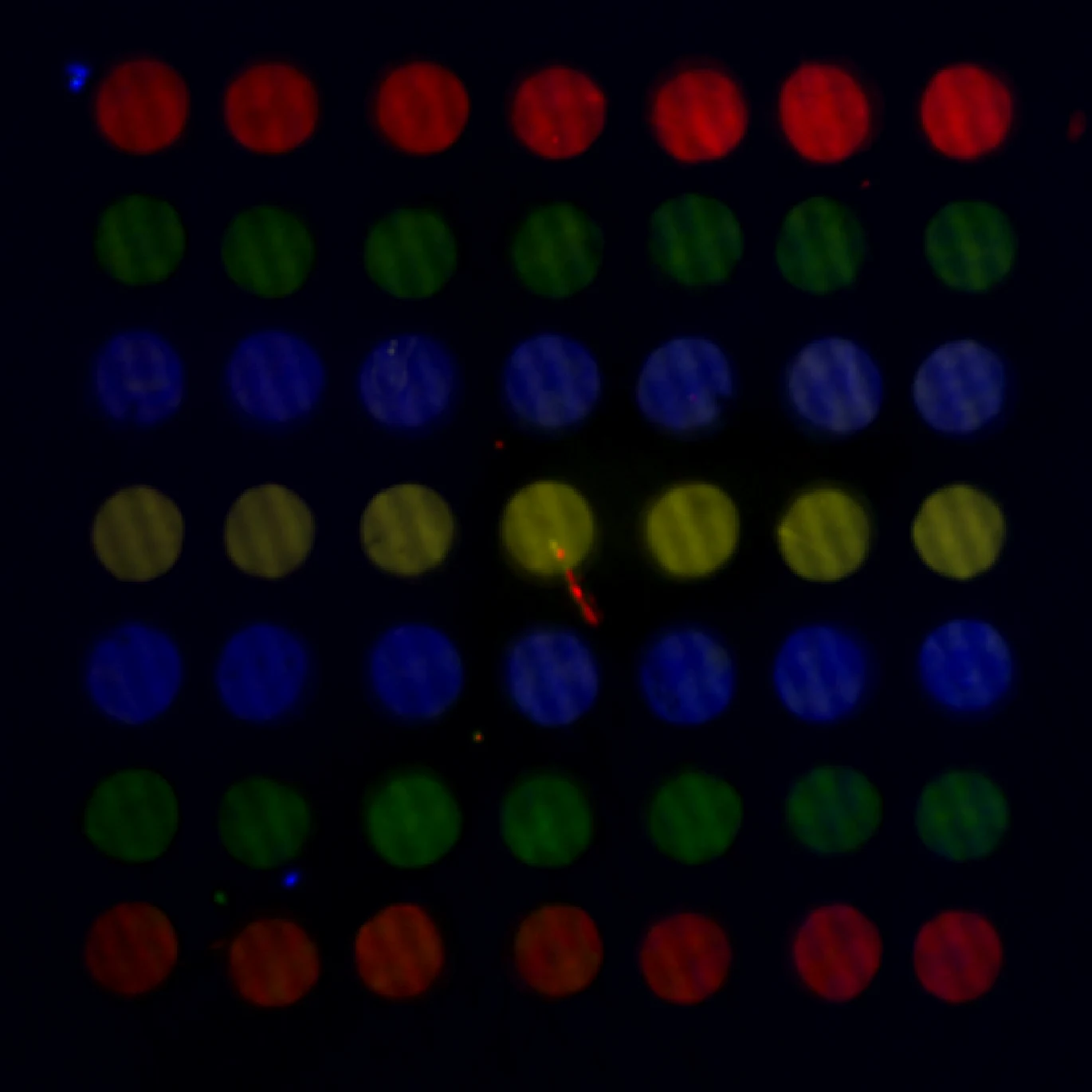
On a two-by-two-millimeter diamond plate, an entire orchestra of forty-nine violins fits. Each string is tuned to its own note, its own DNA fragment. When the right melody enters the hall, the string responds, and the conductor hears a clean sound. That conductor is a quantum sensor hidden within the diamond itself.
Inside the diamond's crystal lattice, there are defects: nitrogen-vacancy centers, or NV centers. These are pairs of a nitrogen atom and an adjacent vacancy that behave like tiny magnets. Their spin is exquisitely sensitive to the slightest changes in the surrounding magnetic field. If a gadolinium ion, a paramagnetic label, is nearby, it creates magnetic noise, and the NV center's spin quickly loses its orientation. The time it takes for the spin to return to equilibrium is called T1 relaxation. It drops when noise is present and recovers when the noise disappears.
The trick is that the label is attached to a short DNA strand that sits on the probe. When a complementary target strand appears in the solution, it hybridizes with the probe and displaces the labeled strand. The magnetic noise vanishes, T1 recovers, and from this change the sensor knows: the target has been found. Thus, hybridization becomes a binary quantum signal: noise means no target, no noise means target.
Previously, quantum sensors based on NV centers could detect single molecules but could not handle dozens of targets simultaneously. Now, a single chip hosts 49 different probes, each with its own label. It is as if an orchestra of 49 violins played at once, and the conductor could hear each part separately. The DNA density on the surface is 27,500 molecules per square micrometer, and nonspecific adsorption is reduced 50-fold. All this opens the door to high-throughput diagnostics: analyzing many genetic markers in a single test.
Looking ahead, the platform could be extended to proteins and small molecules: simply replace the DNA probes with aptamers, short chains that recognize specific molecules. Then a single chip could search for hundreds of biomarkers in a drop of blood at once. This is a step toward personalized medicine, where a diagnosis is made in minutes rather than days. But open questions remain: how to maintain surface stability in real biological fluids, and how to scale up to thousands of probes without losing sensitivity. The orchestra is still tuning up, but the first chords have already sounded.
The PEG layer on diamond (0.28 nm) is comparable to the diameter of a hydrogen atom (0.1 nm), making it one of the thinnest biocompatible layers ever created for quantum sensors.