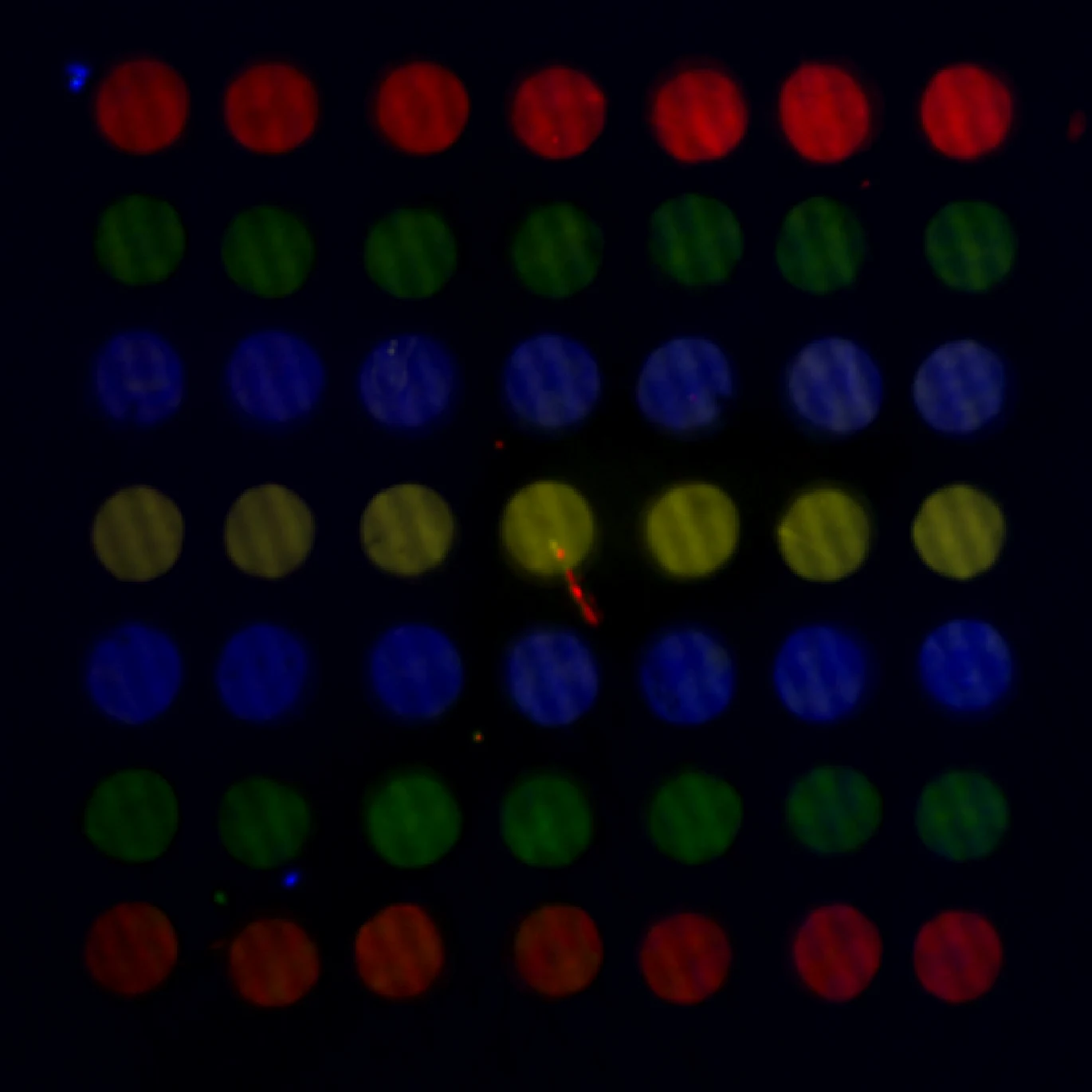
Diamond chip with 49 spots: a quantum sensor for DNA ✛
Context
Quantum sensors based on nitrogen-vacancy (NV) centers in diamond promise to revolutionize biology and medicine thanks to their high sensitivity to magnetic fields at the nanoscale. However, combining high-density spatial multiplexing with uncompromised biochemical specificity has remained elusive. This work stands apart: neighboring studies in the archive explore NV centers for measuring magnetic fields, temperature, and biomolecules, but none address massively parallel detection of multiple targets on a single chip. This work fills that gap by integrating a DNA microarray directly onto the diamond surface.
Methods
On an oxygen-terminated diamond (100) surface, a sub-nanometer layer of biotinylated polyethylene glycol (PEG) was created in 15 minutes via single-step silanization. Streptavidin–biotinylated single-stranded DNA (ssDNA) complexes were then immobilized on this layer. Using a robotic picodroplet dispenser, 49 DNA spots (7×7) were deposited on a 2×2 mm² chip. For quantum readout, a paramagnetic Gd³⁺-DOTA label was attached to a short 'displacer' strand. When complementary DNA target is added, it displaces the labeled strand, removing the source of magnetic noise and restoring the T₁ relaxation time of NV centers. T₁ was measured using a confocal microscope with microwave spin control.
Results
DNA immobilization density reached about 27,500 molecules per µm² with 67% streptavidin surface coverage. PEG layer thickness was 0.28±0.08 nm, and the DNA–streptavidin layer was 2.5 nm. Binding specificity: biotinylated PEG gives a 24-fold higher fluorescence signal than a control without the silane group; nonspecific adsorption on methoxy-PEG was reduced 50-fold compared to bare diamond. On-chip hybridization showed a yield of ~26% and cross-reactivity below 6%. Quantum mechanism: adding the complementary strand restores T₁ to 93% (for 3.4 Gd³⁺ labels) and 95% (for 8.5 labels) of the control value, while a non-complementary strand produces no significant recovery. The correlation time of the Gd³⁺ spin bath was estimated in the range of 0.67–4.76 ns.
Implications
This work is the first to demonstrate practical multiplexed quantum biosensing on a diamond chip with a DNA microarray. Unlike neighboring studies that either developed single NV sensors or investigated fundamental interactions, here a full platform with 49 parallel detection channels has been created. This is a step from proof-of-principle to real technology suitable for diagnostics.
Future development
The platform can be extended to detect proteins and small molecules using DNA aptamers, making it a versatile tool for proteomics and metabolomics. Integrated quantum diagnostic devices for real-time monitoring and personalized medicine could be developed.
Impact
It will directly impact medical diagnostics, pharmaceutical screening, and fundamental studies of biomolecular interactions.
Next steps
Optimizing probe density and improving hybridization yield, as well as testing on real biological samples (e.g., blood serum).
Key open problems
For quantum sensing, the long-term stability of functionalized surfaces in complex biological fluids and scaling to thousands of probes without loss of sensitivity remain unsolved challenges.
The knowledge machine's view
This section is addressed to the author of the paper and their colleagues. Neighbouring works were found by meaning-based search across our archive, not by word overlap. We do not review: we show the field around the work.
What the work does
This work presents a multiplexed quantum biosensing platform: a DNA microarray with 49 probes is deposited on a diamond chip with NV centers. Detection relies on the displacement of a gadolinium-labeled strand upon target hybridization, which restores the T₁ relaxation time. Specificity, immobilization density, and T₁ recovery of 93–95% were demonstrated.
Where its strength is
For the first time, parallel quantum sensing of multiple DNA targets on a single chip has been achieved, combining high probe density with biochemical specificity and label-free detection.
Where it could go next
- One could consider applying the platform to detect biomolecules inside living cells, building on experience with two quantum sensors for intracellular measurements.based on: Two Quantum Sensors Peek Inside a Living Cell arXiv:2607.03552
- It would be interesting to compare the sensitivity and magnetic field measurement approaches with the developed NV-center magnetometer, to adopt methods for improving the signal-to-noise ratio.based on: A Magnetometer That Listens to Diamonds arXiv:2601.03975
- Potential expansion of functionality by integrating principles of the quantum nose for multiplexed detection of various analytes in medical diagnostics.based on: A Quantum Nose for the Hospital arXiv:2603.29944
Worth trying
- Test the platform on real clinical samples, for example, to detect viral nucleic acids, leveraging experience with virus–cell interactions.
- Optimize the density of Gd³⁺ labels per strand to improve the dynamic range and sensitivity.
- Explore spectral multiplexing using different paramagnetic labels with distinct correlation times.
Why this may matter
The platform could serve as the foundation for high-throughput label-free diagnostics, compatible with microfluidics and automation, accelerating the translation of quantum sensors into clinical practice.
Nearby works in our archive
- Two Quantum Sensors Peek Inside a Living Cellsimilarity 0.52
- A Magnetometer That Listens to Diamondssimilarity 0.48
- Tiny Diamond Compass Peers Inside Batteriessimilarity 0.48
- A Digital Twin of Health as an Orchestra of Organssimilarity 0.48
- Quantum Computer Gets a Speed-of-Light Vision Upgradesimilarity 0.48
- A Tabletop Light Maze Captures Gravitysimilarity 0.48
- A Quantum Nose for the Hospitalsimilarity 0.48
The archive is sparse around this work: the closest review is only 0.52, against a usual 0.64. It looks like few have drilled nearby.
The PEG layer on diamond (0.28 nm) is comparable to the diameter of a hydrogen atom (0.1 nm), making it one of the thinnest biocompatible layers ever created for quantum sensors.
Key numbers
- number of probes on chip: 49 (7×7)
- DNA density: 27,500 molecules/µm²
- PEG layer thickness: 0.28 nm
- T1 recovery after displacement: 93–95%
- nonspecific adsorption: reduced 50-fold