Radio Map of Three Galaxies: Compact Sources vs. Diffuse Background ✛
Context
Classifying radio sources in nearby galaxies has long been limited by resolution: diffuse emission on kiloparsec scales blended with compact objects. Previous surveys, such as the Star Formation in Radio Survey, provided hundreds of classified sources, but their nature remained ambiguous. This work sits alongside studies of radio pulsars, black hole awakening, and radio jets, all of which require separating compact objects from the diffuse background. Here, for the first time, data with resolution better than 10 parsecs have been obtained for three galaxies, allowing old classifications to be tested.
Methods
Observations with the VLA in A-configuration at 10 GHz yielded a synthesized beam of 0.16×0.14 arcseconds, which is about 6 parsecs for M51. Data were processed in CASA, and sources were found automatically (PyBDSF) with a 5σ threshold. Compact sources were then matched against the diffuse emission catalog of Linden et al. (2020) and Chandra X-ray catalogs. For each match, the ratio of diffuse to compact flux was computed to understand how much emission remains unresolved.
Results
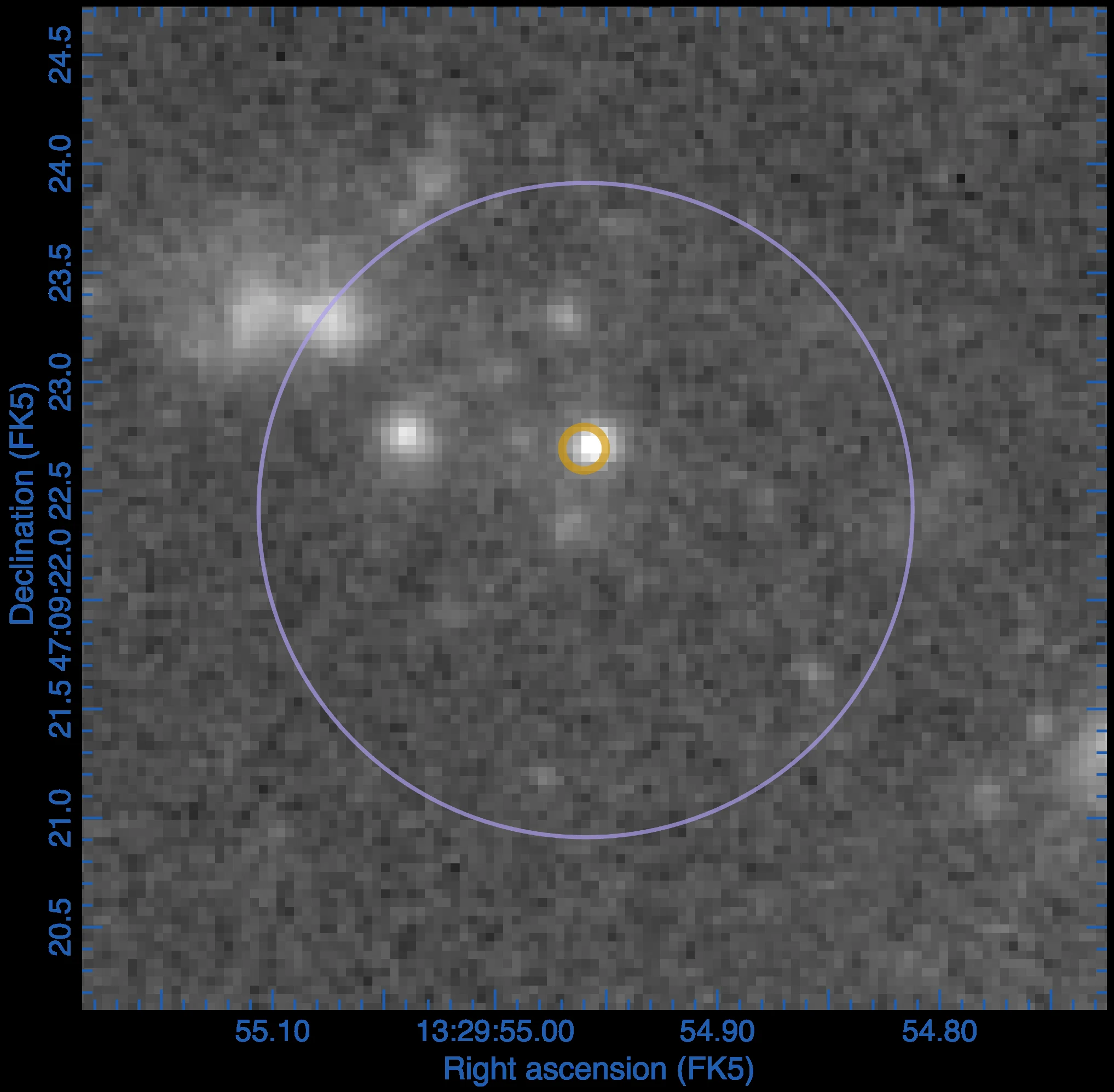
A total of 115 compact radio sources were detected. Of these, 8 coincide with star-forming regions, 4 with anomalous microwave emission (AME) candidates, and 1 with the supernova remnant SN 2011dh. Nine sources have X-ray counterparts, most of which are background galaxies. In NGC 4631, a source previously classified as both a star-forming region and an X-ray binary turned out to be an active galactic nucleus with jets about 5 arcseconds wide. In M51, Source 65 shows a spectral index α=2.7±0.1, indicating optically thick free-free emission from a compact HII region. The median diffuse-to-compact flux ratio is 29.2 for NGC 4631 and 10.7 for M51.
Implications
This work demonstrates that even within the optical radius of a galaxy, background active nuclei can contaminate catalogs of X-ray binaries and star-forming regions. Unlike neighboring studies that either conducted low-resolution surveys or followed individual objects, here compact and diffuse components are systematically compared for three galaxies for the first time. This allows an estimate of the true fraction of misclassifications and the identification of AME candidates that were previously invisible as compact sources.
Future development
With the advent of the Square Kilometre Array and the next generation VLA, the sensitivity and resolution of radio observations will improve by orders of magnitude. This will enable large-scale catalogs of compact sources in thousands of galaxies and the separation of contributions from HII regions, supernova remnants, and active nuclei. Population studies of AME will emerge, testing the spinning dust model. High-resolution multi-wavelength surveys will become the standard for classifying radio sources.
Impact
The results will affect research on X-ray binaries, supernovae, star-forming regions, and anomalous microwave emission. They are also important for preparing future sky surveys with new radio telescopes.
Next steps
Expand the sample of galaxies with archival VLA A-configuration and Chandra data. Conduct spectroscopy of AME candidates with JWST to verify their nature.
Key open problems
In radio astronomy, the nature of anomalous microwave emission remains unresolved: the spinning dust model does not explain all observations. It is also unclear what fraction of compact radio sources in galaxies are background active nuclei, which is critical for building clean catalogs of X-ray binaries and searching for intermediate-mass black holes.
The knowledge machine's view
This section is addressed to the author of the paper and their colleagues. Neighbouring works were found by meaning-based search across our archive, not by word overlap. We do not review: we show the field around the work.
What the work does
The study uses the VLA in its A-configuration to produce radio maps of three galaxies at a resolution of a few parsecs, revealing 115 compact sources and cross-matching them with catalogs of diffuse emission and X-ray data. It finds that some objects were previously misclassified, including background active galactic nuclei and candidates for anomalous microwave emission.
Where its strength is
Systematically matching compact and diffuse components on sub-10 pc scales allows a direct estimate of the contribution from unresolved emission and exposes false classifications, an approach that is both rare and valuable.
Where it could go next
- It might be interesting to compare the properties of compact sources with the radio source population found in low-resolution surveys to see how classification changes when moving to high resolution.based on: Five Thousand Giants on the Radio Sky arXiv:2608.08410v1
- One of the AME candidates in your sample could be studied in detail with MeerKAT observations to test its nature and its connection to diffuse emission.based on: Radio Echo at the Cluster's Edge: MeerKAT Catches a Ghostly Glow arXiv:2608.12042v1
Worth trying
- Apply the method of separating compact and diffuse components to other nearby galaxies observed with the VLA in A-configuration to statistically assess the fraction of misclassifications.
- Use spectral indices of compact sources to identify AME candidates and then confirm their nature through observations at other frequencies.
- Cross-match X-ray and radio data for all compact sources to uncover new X-ray binaries or background AGNs missed in previous catalogs.
Nearby works in our archive
- Five Thousand Giants on the Radio Skysimilarity 0.55
- Radio Reveals Star Birth in the Early Universesimilarity 0.55
- Lone Radio Pulsars: The Mystery of Rare Burstssimilarity 0.54
- Radio Beacons from the Dark: 27 New Lighthouses in the Galaxysimilarity 0.54
- The Galaxy's Halo Is Lumpy: A Map from Hundreds of Radio Burstssimilarity 0.54
- Radio Echo at the Cluster's Edge: MeerKAT Catches a Ghostly Glowsimilarity 0.53
The archive is sparse around this work: the closest review is only 0.55, against a usual 0.64. It looks like few have drilled nearby.
A resolution of 0.15 arcseconds at the distance of M51 is equivalent to spotting a coin on the surface of the Moon from Earth. Yet the median diffuse-to-compact flux ratio in NGC 4631 reaches 29, meaning most of the emission remains unresolved even in the most extended VLA configuration.
Key numbers
- number of compact sources: 115
- synthesized beam: 0.16×0.14 arcseconds
- median diffuse-to-compact ratio in NGC 4631: 29.2
- spectral index of Source 65: 2.7 ± 0.1
- distance to M51: 8.58 Mpc