Two Arrows of Time from Timelessness ✛
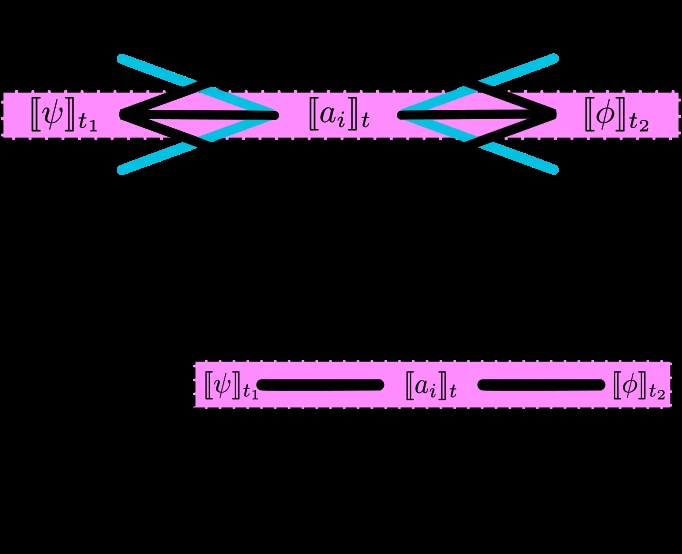
Time in quantum mechanics is like a shadow on a wall: we see its motion, but we cannot grasp the shadow itself. The Schrödinger equation describes how a system's state changes, but time enters it as an external parameter that nothing measures. Physicists have long sought to make time an intrinsic property of the quantum world, and two approaches stand out on this path.
The first approach, proposed by Page and Wootters, removes time from the fundamental equations altogether. The universe is divided into two parts: a clock and everything else. The clock is any system that changes regularly, for example, an atom in an excited state. Entanglement between the clock and the rest of the system creates the illusion of time's flow. Here, time is not a background but a relation: the hand on the dial appears only when we look at it together with the mechanism. The second approach, developed by Bauer, instead doubles time. It introduces an extra degree of freedom, a pseudospin that distinguishes two directions of time: forward and backward. In this picture, a quantum system moves along two branches of time at once, like on a two-way road.
The authors compare five formalisms by their temporal properties and find an unexpected bridge. The Bauer approach and the fixed-point formalism turn out to be isomorphic for continuous spectra, meaning that two different mathematical constructions describe the same physics. Moreover, one can build a unified model with two constraint equations: one for the forward time branch, the other for the backward branch. In this model, two times emerge from a timeless state, like two sides of a coin from melted metal.
The practical benefit of such a symmetric picture may show up in quantum metrology. If quantum clocks with two arrows of time can be built, they would be less susceptible to noise and allow more precise time measurements. This matters for synchronizing quantum computers and for future experiments in quantum gravity, where time ceases to be an external parameter.
The two-way road of time emerging from a timeless crossroads is not just a mathematical curiosity. It is a step toward understanding how a universe with no external clock generates the arrow of time we feel every moment.
The idea that time might flow in both directions goes back to Wheeler and Feynman, who in 1945 proposed a time-symmetric electrodynamics.
The idea of two arrows of time echoes Greg Egan's novel 'The Arrow of Time', where physicists confront the consequences of time-symmetric laws.