Two Times or None at All ✛
Context
The work sits at the intersection of the quantum theory of time and quantum gravity. Around it, ideas are developing about how time can emerge from entanglement (the Page–Wootters approach), how the quantum vacuum blurs time, and how temperature changes the number of dimensions in quantum systems. What unites these studies is the attempt to understand time not as an external background but as something internal to quantum theory. This article stands out by systematically comparing two competing approaches and proposing their synthesis.
Methods
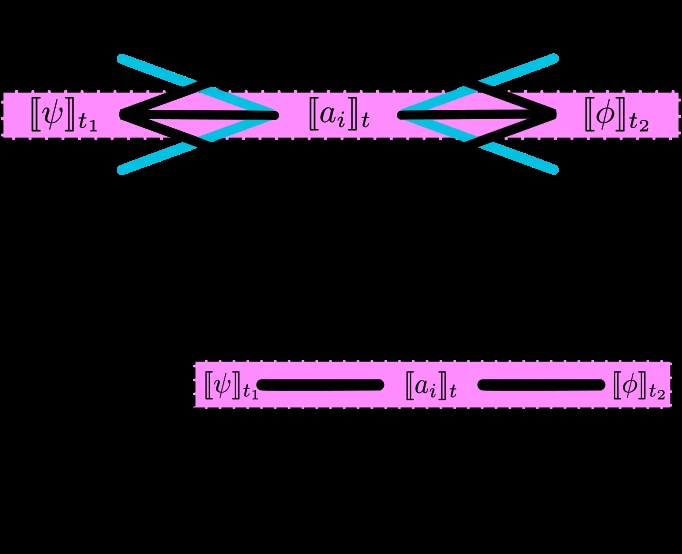
The authors conduct a review and mathematical analysis of formalisms. They start with the Page–Wootters approach, where the universe is divided into a clock and the rest of the system, and the total state obeys a constraint equation. Then they examine Bauer's approach, which extends the state space by adding a 'pseudospin', a degree of freedom responsible for the direction of time. Next, they compare these approaches with other formalisms: decoherent histories, the two-vector formalism, the transactional interpretation, and the fixed-point formalism. Finally, they propose a unified construction with two constraint equations.
Results
The main result is a taxonomy of temporal properties of various formalisms. The Page–Wootters approach breaks both temporal and event symmetry but admits a time operator. Bauer's approach and the fixed-point formalism preserve both symmetries and also admit a time operator. The two-vector formalism and its extensions preserve temporal symmetry but break event symmetry. The authors show that Bauer's formalism and the fixed-point formalism are isomorphic for continuous spectra. They also demonstrate that one can combine two times and timelessness by introducing two constraint equations for the upper and lower branches of the Keldysh contour.
Implications
The work shows that the choice between 'two times' and 'none' is not mutually exclusive. Unlike neighboring studies that focus either on the timeless approach or on individual aspects of quantum time, this article systematically compares formalisms and offers a concrete path for their unification. This could change the view of the problem of time in quantum gravity and stimulate the search for experimental tests.
Future development
The most promising direction is the development of the unified construction with two constraint equations. This could lead to a new understanding of quantum clocks and their synchronization. There is also the possibility of extending to the relativistic case, which is necessary for quantum gravity. Furthermore, the connection with nonequilibrium quantum field theory via the Keldysh contour opens the way to applying many-body methods.
Impact
The results could affect quantum metrology, especially clock synchronization and quantum computing with superpositions of temporal orders.
Next steps
The next step is a detailed development of the unified model with two constraint equations and its test on simple quantum systems.
Key open problems
The article is directly related to the unresolved problem of time in quantum gravity and to the question of how time emerges from quantum entanglement. It also touches on the long-standing problem of deriving Born's rule.
The knowledge machine's view
This section is addressed to the author of the paper and their colleagues. Neighbouring works were found by meaning-based search across our archive, not by word overlap. We do not review: we show the field around the work.
What the work does
The authors systematically compare the timeless Page–Wootters approach with Bauer's two-time approach, showing that they are not mutually exclusive: they construct a framework in which two times emerge from a timeless state. A mathematical analysis of the formalisms is carried out, including an isomorphism between Bauer's approach and the fixed-point formalism, and a unification is proposed via two constraint equations for the Keldysh contour.
Where its strength is
The strength of the work lies in its systematic comparison of competing formalisms and an explicit synthesis that paves the way for a time-symmetric description of quantum processes and new tools for quantum metrology.
Where it could go next
- It might be interesting to see how the proposed two-time construction relates to the idea of quantum clocks that are themselves quantum systems and can influence the measured time.based on: Clocks That Tick Quantumly arXiv:2602.02077
- A related avenue is the emergence of time from eternity: perhaps your formalism with two times and a timeless state allows a similar interpretation in terms of the arrow of time arising from a symmetric state.based on: Clock Without Hands: Can Time Emerge from Eternity? arXiv:2605.24970
- It would be interesting to compare your approach with the idea of a quantum wave generating the Universe: there, time also emerges from a timeless quantum state, and such a comparison could clarify commonalities and differences in the mechanisms of time emergence.based on: The Quantum Wave That Gives Birth to the Universe arXiv:2607.05020
Worth trying
- Consider applying your two-constraint construction to a specific quantum clock model from work 2602.02077 and see how the description of time measurement changes.
- Examine whether your timeless state with two times can be interpreted as a special case of the time-from-eternity scenario from work 2605.24970.
- Investigate whether your construction admits a generalization to quantum cosmology, similar to that proposed in work 2607.05020.
Why this may matter
If the synthesis of the two approaches proves fruitful, it could provide a new language for describing quantum processes without a preferred direction of time, which is important for quantum gravity and possibly for understanding the arrow of time.
Nearby works in our archive
- Clocks That Tick Quantumlysimilarity 0.57
- Clock Without Hands: Can Time Emerge from Eternity?similarity 0.56
- The Quantum Wave That Gives Birth to the Universesimilarity 0.56
- The Universe as a Web of Quantum Connectionssimilarity 0.55
- The Quantum Fabric of Spacetimesimilarity 0.54
The archive is sparse around this work: the closest review is only 0.57, against a usual 0.64. It looks like few have drilled nearby.
The idea that time might flow in both directions goes back to Wheeler and Feynman, who in 1945 proposed a time-symmetric electrodynamics.
The idea of two arrows of time echoes Greg Egan's novel 'The Arrow of Time', where physicists confront the consequences of time-symmetric laws.
Key numbers
- number of temporal branches in Bauer's approach: 2
- number of constraint equations in the unified model: 2
- number of compared formalisms: 5