Quantum time is a concept from quantum gravity research that examines how time behaves at the most fundamental level. In classical physics, time is a universal backdrop against which events unfold, but in quantum gravity, time may emerge from more basic ingredients, such as entanglement or the ticking of quantum clocks. The idea challenges our intuitive notion of a single, flowing timeline, suggesting that at the quantum scale, time might be fuzzy, branch, or even run backward in certain contexts.
History
The problem of time in quantum gravity was highlighted by Bryce DeWitt in the 1960s with his famous equation, which lacked a time variable. Carlo Rovelli and others developed the relational interpretation in the 1990s, arguing that time emerges from quantum entanglement.
How it works
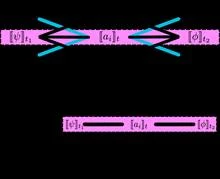
In quantum mechanics, time is treated as a parameter, not an observable, meaning it doesn't have an operator like position or momentum. Quantum gravity approaches, such as loop quantum gravity or the Wheeler-DeWitt equation, often produce a 'timeless' universe where the wavefunction of the cosmos doesn't depend on time. Instead, time emerges through correlations between subsystems, like a clock measuring the evolution of another system. This relational view, pioneered by Carlo Rovelli, posits that time is a derived property, not fundamental.
In practice
Research on quantum time informs the development of quantum clocks and sensors, which use quantum superposition to measure time with extreme precision, potentially improving GPS and gravitational wave detectors.
Fun fact
In some quantum gravity models, the universe's wavefunction is completely static, and what we perceive as time's flow is an illusion created by our interaction with the environment.
Clocks in the Universe are tricky things. Usually, in calculations of the birth of the world, a special scalar field plays the role of a clock — something like an invisible fluid filling all of space. It ticks, and physicists watch how the world changes relative to that ticking. But these clocks are man-made, introduced for convenience.
The authors of the new work took a different path.
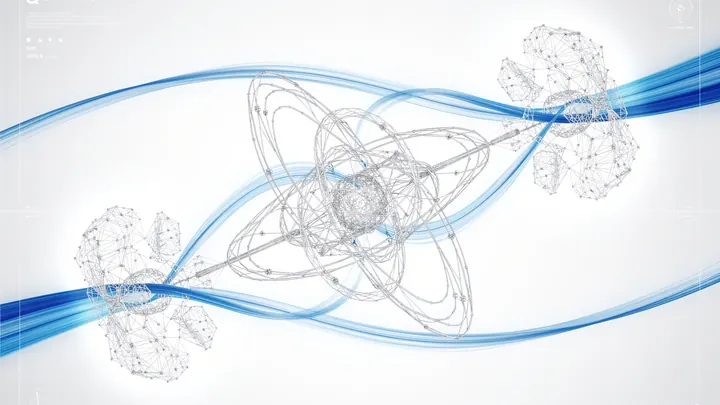
In the quiet of the quantum world, there is no emptiness. Particles are intertwined by invisible threads — entanglement. The authors of the work proposed that the very fabric of spacetime is woven from these threads. This is not just a metaphor: they built a mathematical framework where the distance between points is determined by how much shared information they hold.
An optical trap holds an atom almost motionless, like a ball on a soft spring. But as soon as acceleration appears, say gravity, the equilibrium shifts. The atom moves within the standing light wave, and this changes the rate at which it exchanges energy with the field. The frequency of this exchange becomes a direct indicator of acceleration.
General relativity, which describes the structure of the universe, does not forbid closed timelike curves. But Stephen Hawking put forward the 'chronology protection' conjecture: quantum effects should destroy such curves, making time travel to the past impossible.
Usually, a black hole is described as a frozen frame: there's mass, there's charge, and it's all static. But real objects live in time. They radiate, lose energy, and change.
Two synchronized swimmers dive into the sea. One hits calm water, the other a whirlpool. Their movements, perfectly coordinated at the start, diverge. Something similar happens to two quantum particles when one moves in flat space and the other in curved space.
A quantum wave is like a long-exposure photograph: everything’s blurred, but the blur itself reveals motion. Usually these frozen waves are treated as convenient abstractions. Yet if at each point in the image you estimate, by brightness, the moment on the particle’s internal clock it landed there, flat space suddenly acquires curves.
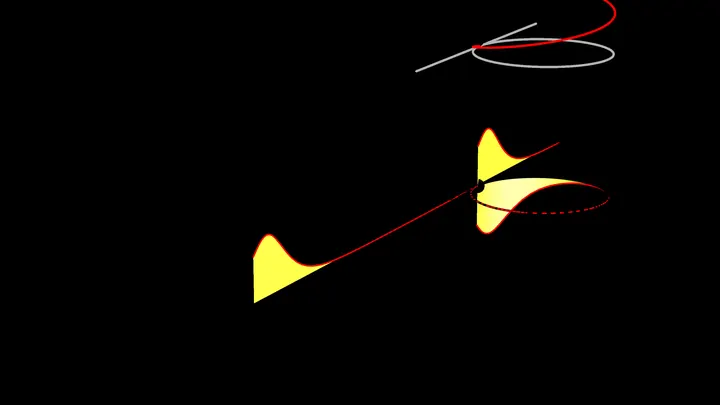
In the ocean, a whirlpool pulls everything into a closed loop, just as a gravitational wave in empty space twists time into a loop. Gravitational wave — a ripple in the fabric of spacetime, and its special shape can turn the usual flow of events into a closed cycle. In such a zone, an object can return to its own past without violating the laws of physics.
Gravity seems simple: it keeps us on the ground and makes planets orbit. But if it were classical (described by Einstein's equations as the curvature of spacetime, while all matter follows the quantum laws of the Standard Model) then an ordinary quantum bit (qubit) falling freely…
Time in physics is like a conductor setting the tempo for the whole orchestra. But in the quantum world, there's no single baton: each particle can live by its own clock. Usually, we simplify the picture and assume time flows the same for everyone.
An old mechanical alarm clock ticks on the shelf. You hear the steady sound, see the hands moving, and you're certain time is passing. But if you take the clock apart, you won't find a single part labeled "time." Only springs and gears.
The deepest equations of physics, like the Wheeler–DeWitt equation, contain no time. Past and future are scrambled within them, like frames on a film reel with no arrow indicating which way to play it. This symmetry is not a flaw but a feature.
In physics, there's an old ache. General relativity paints the beginning of the universe as a point — a singularity where equations break down and volume shrinks to zero. Quantum mechanics hints that at the most critical moment, something goes differently than classical physics predicts.
A stone falls into a pond, and ripples spread across the water. They reflect off the shore, overlap, and die out. All this motion unfolds in space. But what if the pond itself changed its depth or density for an instant — not at one point, but everywhere at once? A temporal boundary is exactly such a jump in properties over time, not space.
A rubber band stretched in different directions behaves differently from a whole sheet of paper. If you pull on an edge, the deformation does not spread evenly but seems to linger in certain spots.
A handful of rice grains falls onto a hot skillet, and they start jumping. Each grain pushes its neighbors, and the whole pile stirs without any external hand. That's active matter: a multitude of particles that draw energy on their own and convert it into motion.
A broken guitar string doesn't just go silent. It still vibrates for a while, and by the character of that vibration, a luthier can tell what kind of string it was — thick or thin, tightly wound or loose. In much the same way, physicists listen to the "vibration" of quantum systems when they want to understand their structure.
Two phones with identical batteries: one charges in a basement with a weak signal, and the process goes slower. The battery percentage here plays the role of a clock hand. Physicists applied the same logic to the quantum world. Their clock is a microscopic battery that stores energy. The charging rate depends on a hidden quantum 'mode'—like a switch.
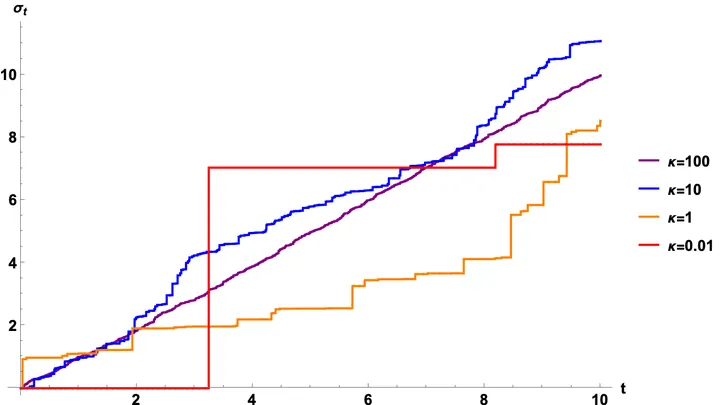
A regular wall clock runs smoothly, but quantum clocks are a different story. They tick at random moments, and each tick can have a different duration. On average, if you watch such a clock for a long time, it will show the correct time. But at any given moment, its hand might jump forward by an unexpected amount.
Time is like a highway: from afar it looks flawlessly paved, but zoom in and every pothole appears. These bumps are the quantum fluctuations of the vacuum, making it impossible to measure the journey exactly. Physicists built a clock model whose operation relies on spontaneous particle creation from the void.
Two particles can become linked so that a nudge on one instantly reverberates in the other, even if they are separated by galaxies. Einstein called it "spooky action at a distance." Physicists wondered: can gravity itself, a simple mutual attraction, create such a connection?
We’re used to time flowing only forward. But quantum laws let it become like a coin showing heads and tails at once.
Take a particle with its own spin — its intrinsic rotation. In a magnetic field, it spins like a top. Send this particle through a device where two opposing magnetic flows fight each other — and it will start moving into the future and the past at the same time.
Time in quantum mechanics is like a shadow on a wall: we see its motion, but we cannot grasp the shadow itself. The Schrödinger equation describes how a system's state changes, but time enters it as an external parameter that nothing measures.